In a groundbreaking achievement for radio astronomy, astronomers utilizing South Africa's MeerKAT radio telescope have identified the most distant hydroxyl megamaser ever observed. This celestial phenomenon, essentially a powerful natural laser in space, is located in a galaxy undergoing a violent merger approximately 8 billion light-years away. This discovery marks a significant leap into the early universe, offering an unprecedented view of galactic evolution and cosmic processes when the universe was less than half its current age. The observation was led by researchers Thato Manamela and Roger Deane, who detailed their findings in a recent study.
The extraordinary nature of this discovery stems from its immense distance, placing it deep within the primordial cosmos. The light captured by MeerKAT began its journey when the universe was only about 13.8 billion years old, effectively observing the galaxy as a 'toddler'. During this era, galaxies were considerably more volatile, frequently colliding, and exhibiting heightened star formation rates compared to the more settled, mature galaxies observed in our cosmic neighborhood today. This provides a rare, direct insight into the dynamic interactions and energetic environments that characterized the early universe.
A New Frontier in Cosmic Observation
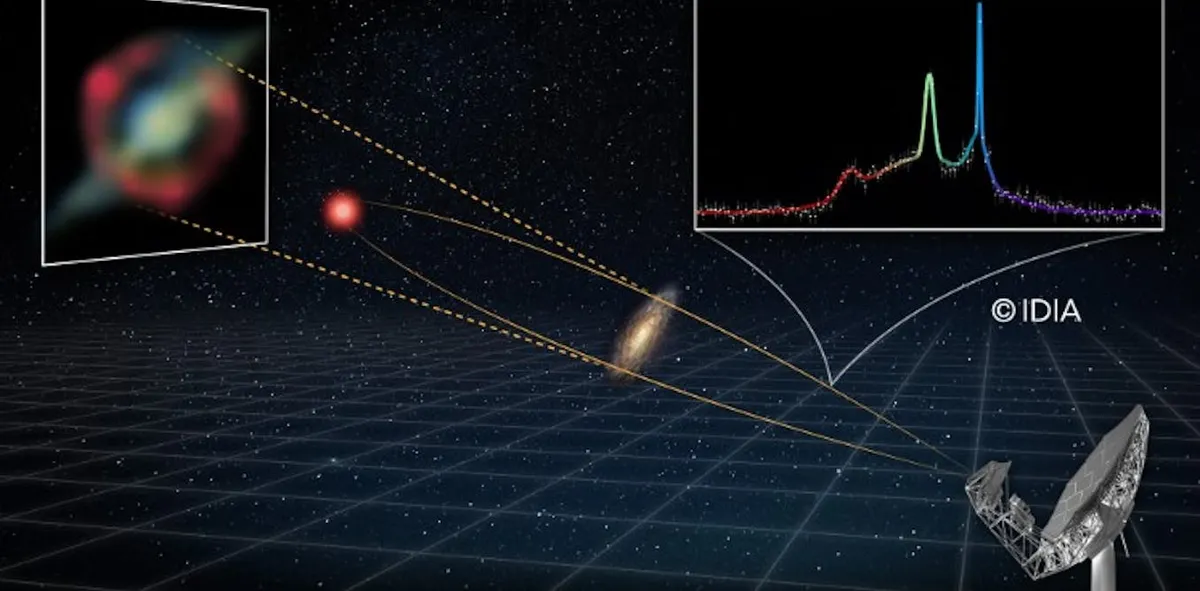
The detected hydroxyl megamaser is exceptionally luminous, radiating with a power millions of times greater than typical galactic masers. Megamasers and gigamasers are cosmic radio lasers, with gigamasers being even more powerful, a billion times more luminous than a standard maser. What makes this particular detection remarkable is the efficiency with which it was achieved. The signal, often requiring hundreds of hours of observation due to its faintness and extreme distance, was identified by MeerKAT in just five hours. This rapid success was partly due to gravitational lensing, a phenomenon where massive objects in the foreground bend and magnify light from distant sources, acting as a natural cosmic telescope. Furthermore, MeerKAT's wide bandwidth capability allowed for the simultaneous detection of both the hydroxyl megamaser signal and neutral hydrogen absorption within the same observation, a feat that previously necessitated separate observations with older technologies.
This swift identification suggests that future, more extensive surveys conducted by MeerKAT and the forthcoming Square Kilometre Array (SKA) Observatory are poised to uncover a wealth of similar distant and extreme cosmic objects. It validates the current technological capabilities in detecting faint signals from the remote past and foreshadows the scientific potential of the SKA, an international mega-project designed to be the world's largest radio telescope. Complementing the SKA's low-to-mid frequency focus, the planned next-generation Very Large Array (ngVLA) in the US will operate at higher frequencies. Together, these facilities represent the cornerstones of next-generation global radio astronomy, promising to revolutionize our understanding of galactic evolution in the early universe.
Enabling Technologies and Capabilities
The success of this discovery is intrinsically linked to the advanced capabilities of the MeerKAT radio telescope, particularly its remarkable sensitivity and extensive frequency coverage. This allows astronomers to probe vast cosmic volumes in search of spectral lines—unique chemical fingerprints emitted or absorbed by specific atoms and molecules at characteristic frequencies. The ability to analyze these frequencies provides crucial information about the composition of gas clouds across the cosmos.
MeerKAT's broad bandwidth was pivotal, enabling the simultaneous capture of both hydroxyl and neutral hydrogen spectral lines in a single observation. This contrasts sharply with historical methods that required multiple, time-consuming separate observations. Beyond the telescope itself, significant advancements in data processing and high-performance computing were indispensable. The Inter-University Institute for Data Intensive Astronomy (IDIA) provided the computational resources necessary to handle the colossal data streams generated by MeerKAT, which can amount to gigabytes per second. Extracting such a faint signal, millions of times weaker than a typical mobile phone signal, from this data deluge requires sophisticated calibration pipelines. These pipelines function as advanced automated systems that meticulously remove instrumental noise and interference, a process demanding trillions of calculations performed on supercomputers over days to transform raw data into a coherent scientific finding. The contribution of gravitational lensing, which amplified the faint signal, cannot be overstated, effectively rendering distant objects detectable.
Transforming Cosmic Understanding
While a single astronomical system rarely overhauls our understanding of the universe, the confluence of record-breaking distance and rapid detection in this instance is highly significant. It strongly indicates that systematic search strategies, like those employed in deep MeerKAT surveys, can effectively transform previously rare megamaser discoveries into potent tools for studying obscured star formation in the distant universe. This finding suggests that future instruments like the SKA will not merely search for known phenomena but will actively uncover hidden historical cosmic events.
Hydroxyl megamasers are typically associated with galaxy mergers, environments where pairs of supermassive black holes are often found. The centers of most large galaxies host such black holes, and during mergers, these can spiral towards each other, emitting gravitational waves. By identifying systems like this one, astronomers gain crucial insights into a pivotal stage of galaxy evolution and the extreme conditions under which these events unfold. Utilizing megamasers to locate these black hole pairs offers a method to study the final stages of the assembly of the largest cosmic structures. Detecting galaxies at this critical evolutionary juncture—the prelude to violent collisions and massive energy releases—allows for detailed study by next-generation detectors. The strength of the hydroxyl signal detected by MeerKAT in such a short observation period implies that a substantial number of such systems will be detectable across the vast expanse of cosmic history.
South Africa's Leading Role in Radio Astronomy
This remarkable discovery underscores South Africa's prominent and expanding position in the field of radio astronomy. The nation's sophisticated infrastructure, including the MeerKAT telescope, coupled with advanced data-intensive platforms like IDIA, offers world-class observational and analytical capabilities. It further highlights the substantial local expertise in managing and interpreting complex, large-scale datasets, which are crucial for modern astronomical research.
Discoveries of this magnitude depend on a synergy of cutting-edge data processing, precise signal extraction, and astute scientific interpretation—all areas where the South African research community demonstrates significant strength. As the country transitions from utilizing powerful scout telescopes like MeerKAT to developing and operating the SKAO, one of the world's most ambitious astronomical projects, South Africa is strategically positioned to continue as a global hub for data-intensive astronomy. Findings like this reinforce the nation's vital contribution to shaping the future trajectory of astronomical discovery and understanding.