
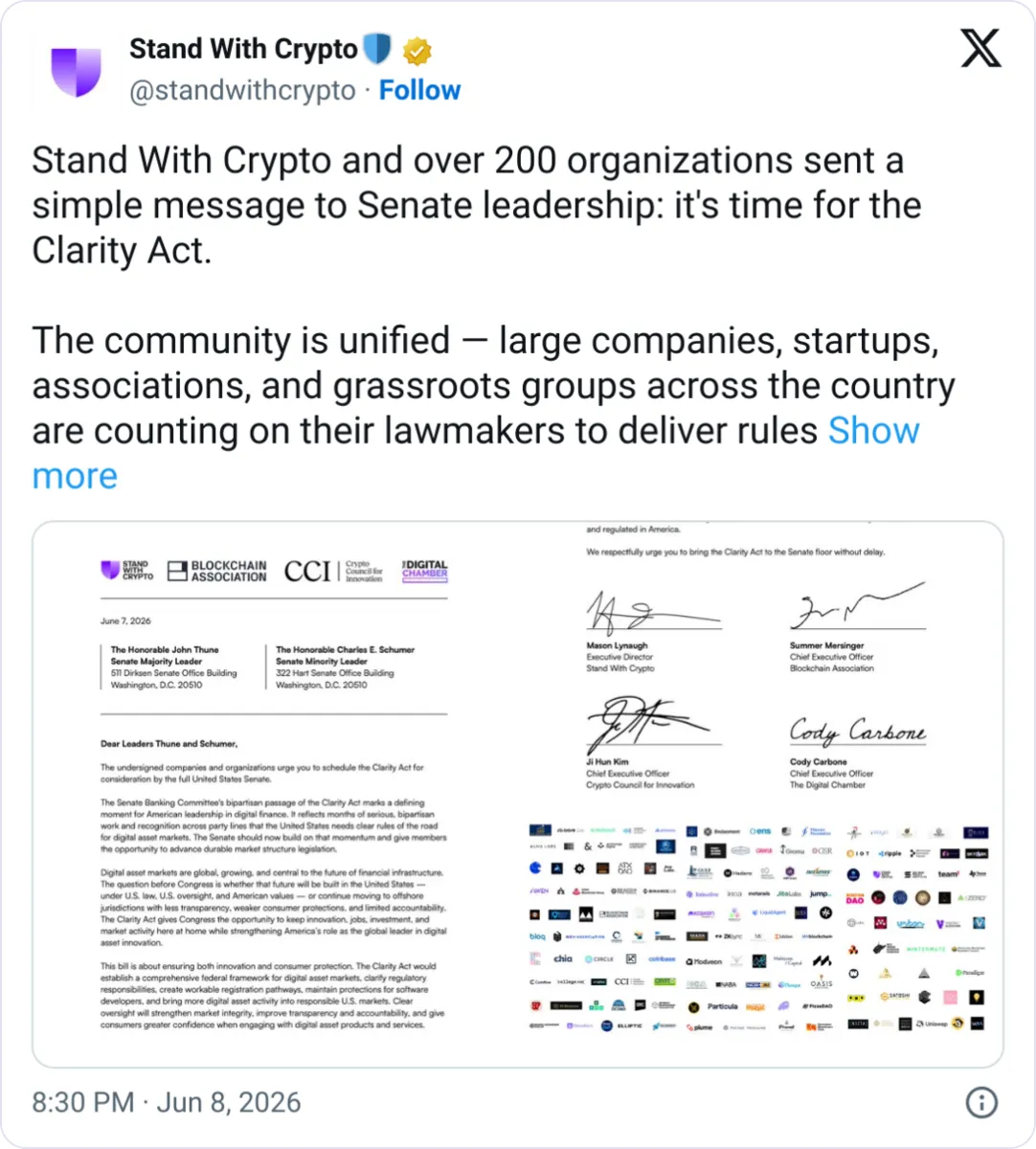
In a concerted effort to establish a clearer regulatory framework for digital assets, more than 200 cryptocurrency companies and industry organizations have penned a letter to U.S. Senate leaders. The appeal, spearheaded by advocacy groups, urges the scheduling of a vote on the CLARITY Act, a pivotal piece of legislation aimed at defining the roles of the Securities and Exchange Commission (SEC) and the Commodity Futures Trading Commission (CFTC) in overseeing the burgeoning crypto market. The signatories express concern that further delays could lead to the bill missing a critical legislative window, particularly with the upcoming midterm elections potentially shifting legislative priorities.
The CLARITY Act, which has navigated a complex path through bipartisan negotiations, seeks to provide much-needed certainty for the digital asset industry. Proponents argue that its passage is crucial for retaining innovation, investment, and jobs within the United States, positioning the nation as a leader in digital asset innovation rather than ceding ground to offshore jurisdictions with potentially weaker regulatory oversight and consumer protections. The letter highlights the months of dedicated, bipartisan work that culminated in the Senate Banking Committee's approval of the bill, emphasizing the importance of building on this momentum.
The Push for Legislative Clarity
The letter, shared by the crypto lobby group Stand With Crypto, directly addressed Senate Majority Leader Chuck Schumer and Minority Leader John Thune, imploring them to bring the CLARITY Act to the Senate floor without delay. The organizations emphasized that the bill represents a significant step towards durable market structure legislation and provides an opportunity for lawmakers to advance a bipartisan consensus. The urgency stems from the desire to solidify the U.S. as a global hub for digital asset innovation, a goal that hinges on establishing clear, predictable rules of the road.

The proposed legislation aims to delineate regulatory responsibilities between key federal agencies, a move that has been the subject of intense debate and negotiation. Disagreements have surfaced regarding specific provisions, particularly concerning the regulation of stablecoins and the treatment of decentralized finance (DeFi) protocols. Banking groups have advocated for measures that would restrict platforms from offering yields on stablecoins, while the cryptocurrency industry has pushed for protections that safeguard developers of decentralized platforms. These differing viewpoints have prolonged the legislative process, necessitating ongoing dialogue between industry stakeholders and policymakers.
Industry Consensus and Concerns
Signatories to the letter include prominent industry associations such as Stand With Crypto, The Digital Chamber, the Blockchain Association, and the Crypto Council for Innovation. Their collective voice underscores a unified industry demand for regulatory clarity. The letter forcefully argues that failing to pass the CLARITY Act could result in the U.S. losing its competitive edge in the rapidly evolving digital asset landscape, pushing vital economic activity and technological development to regions with more established and favorable regulatory environments.
The broader implications of the CLARITY Act extend to its potential to shape the future of financial infrastructure. The letter posits that the decision before Congress is whether this future will be cultivated within the United States, governed by American laws and values, or whether it will continue its migration to less transparent overseas markets. This framing underscores the strategic importance of the bill, not just for the crypto industry, but for the nation's economic competitiveness and technological sovereignty in the digital age.
Legislative Hurdles and Outlook
Despite the significant lobbying efforts, the path forward for the CLARITY Act remains uncertain. Analysts have begun to recalibrate their projections for its passage, with firms like Galaxy Digital reportedly lowering their odds for its enactment in 2026. The critical timeframe for passing the bill is before the August recess, after which legislative attention is expected to shift significantly due to the upcoming midterm elections.
The bill’s progress is further complicated by the need to reconcile differing versions passed by the Senate Agriculture and Banking Committees. Additionally, lawmakers have identified critical amendments related to ethics and the policing of illicit finance as necessary to garner the broad support, estimated at 60 votes, required to avoid protracted debate and ensure passage. Senator Cynthia Lummis has acknowledged these concerns, indicating that efforts are underway to address them to maintain legislative momentum.
The lack of visible advancements in negotiations or resolutions to the core provisions in question, as noted by Galaxy, contributes to the prevailing uncertainty. The industry, while united in its call for clarity, faces the challenge of navigating these complex political and regulatory dynamics to achieve a legislative outcome that fosters innovation while ensuring market integrity and consumer protection.