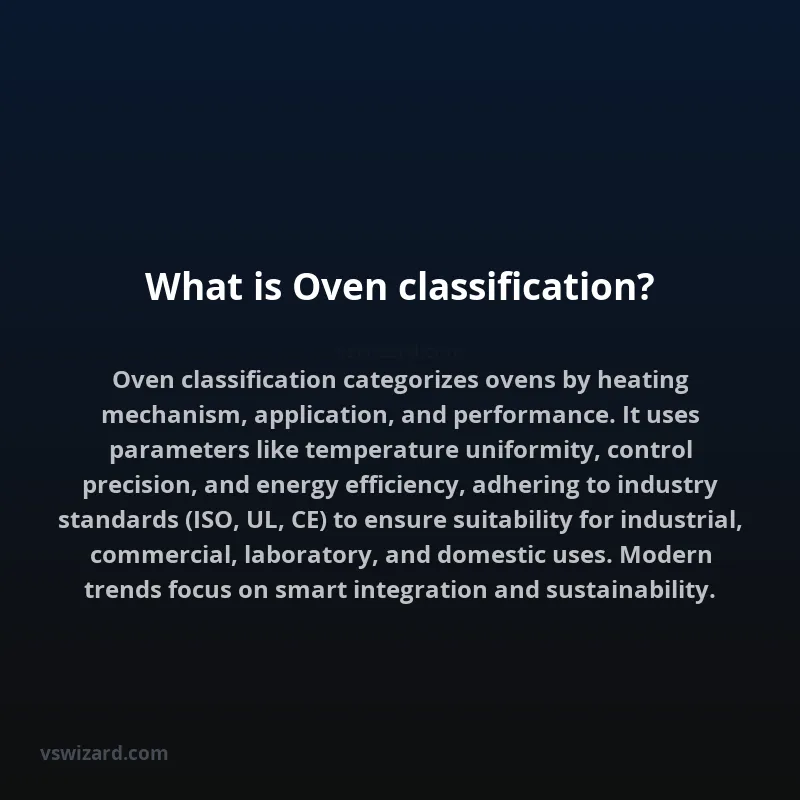
Oven classification refers to the systematic categorization and differentiation of oven apparatus based on a diverse array of technical, functional, and performance parameters. This classification scheme is critical for standardizing manufacturing, ensuring interoperability, facilitating precise application selection, and enabling objective comparative analysis within industrial, commercial, and domestic contexts. Key classification vectors include heating methodology (convection, radiation, conduction, microwave), temperature control precision (e.g., PID controllers, thermostatic, zoned), capacity and volume metrics, energy efficiency ratings (e.g., Energy Star, EU Energy Label), safety certifications (e.g., UL, CE), material composition, and specific operational capabilities such as programmability, steam injection, self-cleaning functions, and atmospheric control. The underlying physics dictates that different heating mechanisms impart thermal energy via distinct modes, influencing cooking uniformity, reaction kinetics, and material transformation rates, thus necessitating granular classification to align oven characteristics with specific process requirements.
The establishment of robust oven classification systems is intrinsically linked to advancements in thermodynamics, materials science, and control engineering. Historically, rudimentary classifications emerged from basic functional distinctions (e.g., bake ovens, roast ovens). However, modern industrial and scientific applications demand sophisticated taxonomies that account for factors like thermal cycling capabilities, inert atmosphere generation, vacuum sealing, electromagnetic field generation (for microwave ovens), and precise humidity control. Regulatory bodies and industry consortia play a vital role in defining and updating these standards to reflect technological evolution, environmental considerations (e.g., emissions, energy consumption), and safety mandates. The precision of a classification system directly impacts the efficacy of its application, from laboratory research and pharmaceutical manufacturing to food processing and advanced materials synthesis, where specific thermal profiles are paramount for product integrity and yield.
Oven Types by Heating Mechanism
Convection Ovens
Convection ovens utilize forced air circulation, typically via one or more fans, to distribute heat evenly throughout the cooking cavity. This mechanical movement of heated air enhances heat transfer coefficients, leading to faster cooking times and improved browning compared to static heat ovens. Advanced convection systems may incorporate multiple fans, directional airflow patterns, and humidity control elements.
Radiation Ovens
Radiation ovens primarily rely on infrared (IR) or visible light (e.g., quartz or halogen elements) to transfer heat directly to the food or material. This method is effective for surface heating, searing, and achieving specific charring effects. The intensity and spectral output of the radiation source are critical parameters.
Conduction Ovens
Conduction ovens transfer heat through direct contact with heated surfaces. This is common in applications like griddles or hot plate ovens, where thermal energy is passed from the heating element to the cooking surface and then to the food. Efficiency is highly dependent on the thermal conductivity of the materials involved.
Microwave Ovens
Microwave ovens employ electromagnetic radiation in the microwave frequency range (typically 2.45 GHz) to excite polar molecules (primarily water) within the food, generating heat through dielectric heating. This volumetric heating mechanism is rapid but can lead to uneven cooking if not managed properly. Magnetrons are the primary source of microwave generation.
Hybrid Ovens
Hybrid or combination ovens integrate multiple heating technologies, such as convection and microwave, or convection and steam, within a single unit. This allows for versatile cooking and processing capabilities, leveraging the advantages of each distinct heating method.
Classification by Application and Industry
Industrial Ovens
Designed for high-volume, continuous or batch processing, industrial ovens are engineered for demanding applications in manufacturing, materials processing, and chemical synthesis. They often feature precise temperature control, robust construction, specialized atmospheric control (e.g., inert gas, vacuum), and high throughput capabilities.
Batch Ovens
Used for processing discrete quantities of material, batch ovens are loaded, heated, and unloaded in cycles. They offer flexibility for varied production runs.
Continuous Ovens
Continuous ovens, often conveyorized, process materials without interruption, ideal for high-volume production lines.
Commercial Ovens
Found in food service establishments, commercial ovens are built for durability, rapid heating, and consistent performance under heavy use. They encompass ranges, convection ovens, deck ovens, and specialized units like pizza ovens.
Laboratory Ovens
Laboratory ovens prioritize precision, accuracy, and repeatability for scientific research, testing, and calibration. They are typically smaller and feature highly refined temperature control, often with features for controlled airflow and precise humidity settings.
Domestic Ovens
Standard ovens found in residential kitchens, designed for convenience and versatility in home cooking. Classification here often relates to energy efficiency, capacity, and specific cooking functions.
Technical Parameters and Performance Metrics
Oven classification relies on a quantifiable set of technical parameters:
- Temperature Range and Uniformity: The operational temperature limits (minimum and maximum) and the spatial variation of temperature within the cavity. Measured in degrees Celsius (°C) or Fahrenheit (°F). Uniformity is often expressed as a ± value at a given setpoint.
- Heating/Cooling Rates: The speed at which the oven can reach a set temperature (ramp-up time) and potentially decrease temperature (ramp-down time).
- Control System Precision: The accuracy and stability of the temperature control algorithm (e.g., PID loop tuning parameters, hysteresis, overshoot).
- Volume/Capacity: The internal usable volume, typically measured in liters (L) or cubic feet (ft³).
- Energy Efficiency: Measured via standardized protocols (e.g., kWh/cycle, % energy recovery) and often tied to regulatory labels.
- Atmospheric Control: The ability to maintain specific gas compositions (e.g., O₂, N₂, Ar), pressure (vacuum or positive pressure), and humidity levels.
- Material Compatibility: Suitability for processing specific materials, considering factors like corrosion resistance, thermal stability, and non-reactivity.
Industry Standards and Certifications
Several standards bodies and certifications influence oven design and classification:
- ISO Standards: Particularly ISO 9000 series for quality management, and specific standards related to industrial equipment.
- UL (Underwriters Laboratories): Safety certification for electrical appliances, ensuring compliance with hazardous substance regulations and electrical safety.
- CE Marking: European conformity marking, indicating compliance with health, safety, and environmental protection standards within the European Economic Area.
- Energy Star: A program promoting energy-efficient appliances.
- ASTM International: Standards relevant to material testing and performance, which may dictate specific oven requirements for testing conditions.
Oven Classification Table Example
The following table illustrates a simplified classification based on primary heating method and application:
| Classification Category | Heating Method | Typical Application | Key Performance Indicator |
|---|---|---|---|
| Industrial Convection Batch Oven | Forced Air Circulation | Heat treatment of metals, curing polymers | Temperature Uniformity (±1°C) |
| Commercial Deck Oven | Radiant/Conduction | Baking bread and pizza | Deck Temperature Stability |
| Laboratory Vacuum Oven | Conduction/Radiation (internal) | Drying sensitive materials, degassing | Achievable Vacuum Level, Temperature Precision |
| Domestic Microwave Oven | Dielectric Heating | Food reheating, cooking | Cooking Power (Watts) |
| Specialty Inert Atmosphere Furnace | Radiant/Conduction | Sintering ceramics, semiconductor processing | Atmosphere Purity (ppm O₂), Ramp Rate |
Evolution and Future Trends
The evolution of oven classification mirrors advancements in process control, energy management, and material science. Early classifications were rudimentary, focusing on basic heating types. Contemporary systems are increasingly sophisticated, incorporating metrics for precision thermal cycling, advanced atmospheric manipulation, and integrated data logging for process validation. Future trends indicate a greater emphasis on Industry 4.0 integration, with smart ovens featuring predictive maintenance, remote monitoring, automated recipe execution, and adaptive process control based on real-time sensor feedback. Sustainability will also drive classification, with stricter energy efficiency standards and requirements for reduced emissions or waste heat recovery becoming paramount. The classification of ovens will continue to adapt to novel manufacturing processes, such as additive manufacturing post-processing and advanced materials synthesis, requiring specialized thermal environments.