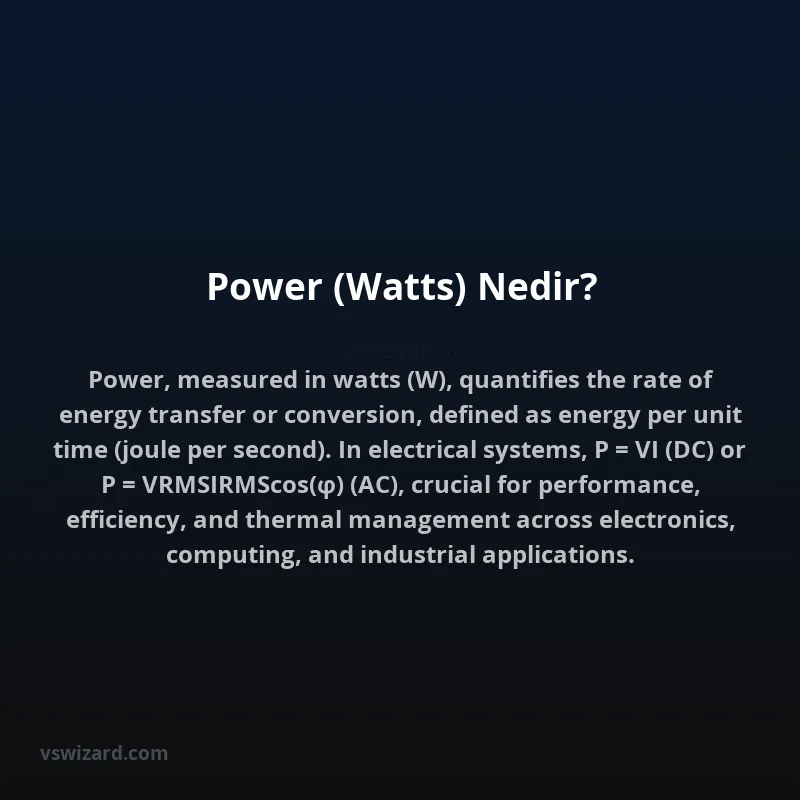
Power, quantified in watts (W), represents the rate at which energy is transferred or converted. In electrical contexts, it is defined as the product of voltage (V) and current (I), a relationship fundamental to Ohm's Law (P = VI). This thermodynamic and electrical scalar quantity measures the energy expended or transformed per unit of time. A watt is equivalent to one joule per second (J/s). Understanding power is crucial for analyzing the operational characteristics and energy consumption of virtually any device, from simple resistors to complex computational systems. Its measurement dictates efficiency, operational capacity, and thermal management requirements in engineering design and application.
The concept of power extends beyond electrical circuits to encompass mechanical work and other forms of energy transfer. Mechanically, power is the rate at which work is done, calculated as force multiplied by velocity (P = Fv) or torque multiplied by angular velocity (P = τω). In thermodynamics, it relates to heat transfer rates and the efficiency of engines and power cycles. In the realm of information technology and electronics, power consumption is a primary design constraint, influencing battery life, cooling solutions, and overall system performance. Efficient power management is paramount for mobile devices, data centers, and high-performance computing, directly impacting operational costs and environmental footprint.
History and Metrology
The unit of power was named in honor of Scottish inventor James Watt, who made significant improvements to the steam engine. The definition of the watt has evolved with advancements in metrology. Initially defined based on mechanical work, its modern definition is tied to fundamental physical constants, ensuring high precision and international comparability. The International System of Units (SI) formally adopted the watt as the standard unit of power. Standards organizations like the International Electrotechnical Commission (IEC) and the National Institute of Standards and Technology (NIST) establish measurement protocols and calibration procedures to ensure accurate power quantification across diverse applications.
Early Developments
James Watt's work in the late 18th century on steam engines led to the need for a standardized measure of work rate. He introduced the unit 'horsepower' as a relatable metric for comparing the output of his engines to that of draft horses. This practical comparison highlighted the importance of quantifying energy output over time. The subsequent formalization of the watt as a SI unit in the late 19th century provided a universal standard for scientific and industrial use.
Modern Metrology
Contemporary metrology relies on precise electrical standards for defining the watt. The international definition is linked to the Josephson effect and the quantum Hall effect, allowing for the realization of the watt with exceptional accuracy. Calibration laboratories employ sophisticated equipment, such as power analyzers and wattmeters, to measure power consumption and output. These instruments are designed to capture instantaneous power, average power, and power factor, providing detailed insights into the energy dynamics of a system.
Electrical Power Calculation and Principles
In electrical systems, power is a fundamental parameter derived from voltage and current. For direct current (DC) circuits, the calculation is straightforward: P = V × I, where P is power in watts, V is voltage in volts, and I is current in amperes. For alternating current (AC) circuits, the calculation is more nuanced due to phase differences between voltage and current. Apparent power (S) is the product of RMS voltage and RMS current (S = VRMS × IRMS), measured in volt-amperes (VA). Real power (P), also known as active power or true power, is the power actually consumed by the load to perform work, calculated as P = VRMS × IRMS × cos(φ), where cos(φ) is the power factor.
The power factor is critical in AC systems as it indicates how effectively electrical power is being converted into useful work. A power factor of 1 (unity) means all apparent power is real power. Values less than 1 indicate that a portion of the current is used to establish magnetic fields (reactive power) rather than doing work, leading to increased losses in transmission lines and requiring larger equipment. Reactive power (Q), measured in volt-ampere reactive (VAR), is associated with energy that oscillates between the source and the load's reactive components (inductors and capacitors).
| Parameter | Symbol | Unit | Formula (AC, Single Phase) | Description |
|---|---|---|---|---|
| Real Power (Active Power) | P | Watts (W) | P = VRMS × IRMS × cos(φ) | Power that performs useful work. |
| Apparent Power | S | Volt-Amperes (VA) | S = VRMS × IRMS | Total power supplied to the circuit. |
| Reactive Power | Q | Volt-Ampere Reactive (VAR) | Q = VRMS × IRMS × sin(φ) | Power associated with magnetic or electric fields. |
| Power Factor | cos(φ) | Unitless | cos(φ) = P / S | Ratio of real power to apparent power. |
Power Dissipation and Thermal Management
Electronic components dissipate power as heat. This power dissipation, measured in watts, directly influences the operating temperature of the device. Exceeding a component's thermal limit can lead to performance degradation, reduced lifespan, or catastrophic failure. Effective thermal management strategies, such as heat sinks, fans, and advanced cooling systems (e.g., liquid cooling), are designed to dissipate this heat and maintain components within safe operating temperatures. The power dissipation rating of a component is a critical specification for system designers.
Applications and Implications
The measurement and management of power are fundamental across a vast spectrum of technological domains.
Consumer Electronics
In consumer devices such as smartphones, laptops, and televisions, power consumption directly impacts battery life, heat generation, and overall usability. Manufacturers strive to optimize power efficiency to extend operational times and reduce thermal issues. Power ratings on chargers and power supplies indicate the maximum power they can deliver.
Industrial Machinery and Automation
Industrial equipment, including motors, pumps, and robotic arms, are rated by their power output in horsepower or kilowatts (kW). Understanding the power requirements is essential for selecting appropriate power sources, ensuring safe operation, and calculating energy costs. Variable frequency drives (VFDs) are used to control motor speed and power consumption.
Computing and Data Centers
High-performance computing (HPC) clusters and data centers are massive consumers of electrical power. The power draw of individual servers, GPUs, CPUs, and cooling infrastructure is meticulously monitored. Power Usage Effectiveness (PUE) is a key metric in data centers, quantifying the total energy consumed by a data center facility to total energy delivered to IT equipment, with lower PUE indicating higher efficiency. Advances in processor architecture often focus on performance-per-watt metrics.
Renewable Energy Systems
Solar panels, wind turbines, and hydroelectric generators produce electrical power. Their output is measured in watts, kilowatts, or megawatts (MW), depending on scale. Power conversion efficiency, battery storage capacity, and grid integration are critical aspects of these systems, all involving power calculations.
Automotive Industry
Electric vehicles (EVs) have power ratings for their electric motors and battery systems. Charging speeds are often described in terms of kilowatts, indicating the rate at which energy is transferred to the battery. Internal combustion engines are also rated by their peak power output.
Performance Metrics and Benchmarking
In many applications, power is directly correlated with performance. For instance, high-performance computing tasks often benefit from components with higher power draw, implying greater computational throughput. However, the industry increasingly emphasizes performance-per-watt. This metric quantizes the efficiency of a device or system by dividing a performance measure (e.g., floating-point operations per second, frames rendered per second) by its power consumption.
Benchmarks and Standards
Various industry benchmarks exist to evaluate power efficiency. For CPUs and GPUs, benchmarks like SPECpower_ssj measure server power consumption under varying loads. In the context of AI and machine learning, research papers often report FLOPs (floating-point operations) per watt for neural network inference and training hardware to compare the energy efficiency of different models and accelerators. Standards like Energy Star provide labels for products that meet specific energy efficiency criteria.
Pros and Cons of High Power Operation
Pros
- Increased Performance: Higher power availability generally translates to greater computational throughput, faster processing speeds, and enhanced operational capabilities.
- Faster Task Completion: Devices operating at higher power levels can complete tasks more rapidly, reducing wait times and increasing productivity.
- Enhanced Capabilities: For equipment like motors or industrial machinery, higher power ratings enable handling heavier loads or performing more demanding operations.
Cons
- Higher Energy Consumption: The most direct consequence is increased electricity usage, leading to higher operational costs.
- Increased Heat Dissipation: Higher power draw invariably results in more waste heat, necessitating robust and often expensive cooling solutions.
- Reduced Component Lifespan: Elevated temperatures and increased stress on components due to higher power operation can shorten their operational life.
- Environmental Impact: Greater energy consumption, particularly from non-renewable sources, contributes to a larger carbon footprint.
- Infrastructure Demands: High-power devices require more robust electrical infrastructure, including thicker wiring, higher-rated circuit breakers, and more substantial power supplies.
Future Trends and Outlook
The ongoing drive towards greater energy efficiency, particularly in computing and data centers, is central to future power management strategies. Innovations in semiconductor technology, such as advanced transistor designs and lower-voltage operation, aim to reduce intrinsic power consumption. Furthermore, the development of more sophisticated power management integrated circuits (PMICs) allows for dynamic adjustment of power delivery based on workload demands, optimizing energy use. The integration of AI for predictive power management and grid optimization is also a significant trend. As computational demands continue to escalate, achieving higher performance while minimizing energy expenditure will remain a paramount engineering challenge.