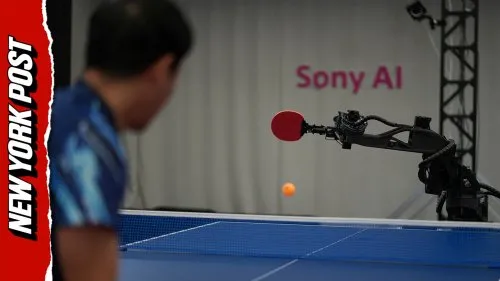
In a significant advancement for artificial intelligence and robotics, Sony's AI research division has developed a table tennis robot, codenamed 'Ace', that has successfully competed against and defeated elite human players. This groundbreaking achievement, showcased in Tokyo, marks a pivotal moment in the integration of AI into complex physical sports, demonstrating a level of adaptability, strategy, and precision previously thought to be exclusively within human capabilities. The development of Ace represents years of dedicated research into machine learning, computer vision, and advanced robotic control systems.
The robot's triumph over highly skilled human athletes signifies more than just a technical marvel; it opens new avenues for understanding human-robot interaction, sports analytics, and the future of competitive play. Ace's ability to analyze game situations in real-time, predict opponent movements, and execute precise shots underscores the rapid progress in AI's capacity to master intricate physical tasks. This development has implications that extend beyond the table tennis arena, potentially influencing the design of future robotic systems for various applications.
Advancements in AI and Robotics
Ace is not merely a programmed machine executing pre-defined sequences; it is an intelligent system capable of learning and adapting. Its sophisticated neural networks process visual data at an astonishing rate, allowing it to perceive the trajectory, speed, and spin of the ball with remarkable accuracy. This real-time data is then fed into an AI algorithm that determines the optimal response, including the type of shot, its placement, and the force required. The robot's physical design also plays a crucial role, featuring high-speed actuators and a finely tuned arm mechanism that allows for agile and precise movements, mimicking, and in some aspects exceeding, human reaction times.
The development process involved extensive training, utilizing vast datasets of human play and countless simulated matches. Through reinforcement learning, Ace iteratively improved its performance, learning from both its successes and failures. This iterative refinement allows the AI to develop unique strategies and counter-strategies, making it a formidable opponent. The engineers behind Ace focused on replicating the nuanced decision-making that top human players employ, including feints, spin variations, and strategic placement of shots, demonstrating a deep understanding of the game's complexity.
The Competitive Edge: AI vs. Human Skill
The matches against elite human players highlight the robot's remarkable ability to perform under pressure. Unlike human athletes who can be affected by psychological factors, Ace maintains consistent performance, driven purely by its algorithms and sensor data. This consistency is a key advantage in high-stakes competition. The robot's physical limitations, such as reach and agility, are compensated for by its superior processing speed and predictive capabilities, allowing it to cover the table effectively and anticipate shots milliseconds before they are played.
Furthermore, Ace's victory provides invaluable data for both AI research and sports science. By analyzing the robot's performance and comparing it to human play, researchers can gain deeper insights into the biomechanics of table tennis, the cognitive processes involved in strategic decision-making, and the subtle nuances that differentiate novice players from professionals. This data can inform training methodologies for human athletes and guide the development of more sophisticated AI systems capable of understanding and interacting with the physical world in increasingly complex ways.
Future Implications and Ethical Considerations
The success of Ace raises intriguing questions about the future of sports and the role of AI in competitive environments. While it currently serves as a challenging training partner and a benchmark for AI capabilities, its ability to compete at an elite level could eventually lead to new forms of competition or even integration into professional sports leagues. This possibility prompts discussions about fairness, the definition of athletic achievement, and the potential impact on human participation in sports.
Beyond the sporting world, the advancements demonstrated by Ace have broader implications. The sophisticated control systems, real-time data processing, and adaptive learning algorithms developed for this project can be adapted for various industrial, medical, and domestic applications. From advanced manufacturing and surgical robotics to sophisticated personal assistance systems, the underlying AI technologies have the potential to revolutionize numerous sectors. However, as AI systems become more capable of complex physical tasks, it is crucial to continue addressing the ethical considerations surrounding their development and deployment, ensuring they are used responsibly and for the benefit of society.
Impact Analysis
The achievement of an AI robot like Ace in defeating top human athletes in a physically demanding sport like table tennis represents a significant leap in AI's ability to bridge the gap between digital intelligence and physical execution. It challenges our perceptions of what machines are capable of and pushes the boundaries of human-robot collaboration and competition. The insights gained from Ace's development and performance will undoubtedly accelerate research in robotics, machine learning, and control theory, influencing the trajectory of AI development for years to come.
This milestone underscores the growing importance of AI ethics and policy. As AI systems become more autonomous and capable of complex interactions, frameworks for responsible development, safety, and societal integration become increasingly critical. The success of Ace serves as a potent reminder of the need for ongoing dialogue among researchers, policymakers, and the public to navigate the ethical landscape shaped by these powerful technologies, ensuring that AI advancements serve humanity's best interests while mitigating potential risks.