

Deep Dive: Material Science and Performance Attributes of Heat-Shrink Tubing
Material Composition and Core Properties
The efficacy and versatility of heat-shrink tubing stem directly from its sophisticated material composition. Cross-linking polymers, typically through irradiation or chemical processes, imbues these materials with a "memory" effect, allowing them to return to an extruded, pre-expanded state upon heating. The choice of base polymer profoundly influences the tubing's performance characteristics, dictating its thermal, electrical, mechanical, and chemical resistance profiles.
Polyolefin-Based Tubing
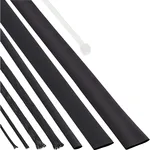
Polyolefin is the most widely utilized material for general-purpose heat-shrink tubing due to its excellent balance of properties and cost-effectiveness. It offers good electrical insulation, moderate chemical resistance, and a flexible yet robust mechanical barrier. Polyolefin tubing is available in various wall thicknesses and shrink ratios, making it suitable for a broad spectrum of applications, from wire harness bundling and insulation to strain relief. Flame-retardant variants are common, meeting critical safety standards.
Fluoropolymer Heat-Shrink Tubing
For applications demanding extreme performance, fluoropolymers such as PTFE (Polytetrafluoroethylene), FEP (Fluorinated Ethylene Propylene), and Kynar (PVDF - Polyvinylidene Fluoride) are selected. PTFE tubing exhibits exceptional high-temperature resistance, superior chemical inertness, and a low coefficient of friction, ideal for harsh chemical environments or high-frequency electrical insulation. FEP offers similar properties but with a lower shrink temperature, while Kynar provides good abrasion resistance and high dielectric strength, often used in aerospace and automotive industries.
Elastomeric and Specialized Tubing
Elastomeric heat-shrink tubing, particularly silicone and Viton, is engineered for flexibility in extreme temperature ranges and superior resistance to specific fluids. Silicone tubing maintains its elasticity at very low and very high temperatures, making it suitable for aerospace and medical applications where flexibility and biocompatibility are paramount. Viton, a fluorocarbon elastomer, provides unparalleled resistance to aggressive fuels, oils, and hydraulic fluids, making it a critical component in automotive and aircraft engine compartments.
Key Performance Attributes and Application Considerations
Beyond material choice, several performance attributes are critical for proper application and long-term reliability.
Shrink Ratio and Wall Thickness
The shrink ratio, expressed as 2:1, 3:1, 4:1, etc., indicates the reduction in diameter from its supplied (expanded) state to its fully recovered (shrunk) state. A higher ratio allows a single piece of tubing to accommodate components with larger diameter variations, crucial for covering connectors and cables simultaneously. Wall thickness, whether thin, medium, or heavy, directly impacts the mechanical protection, cut-through resistance, and dielectric strength provided by the tubing.
Environmental Sealing and Adhesion
Adhesive-lined heat-shrink tubing integrates a thermoplastic adhesive layer on the inside surface. Upon heating, this adhesive melts and flows, filling voids and forming an impermeable barrier against moisture, contaminants, and corrosion. This feature significantly enhances environmental sealing, strain relief, and bond strength, making it ideal for outdoor, marine, or direct burial applications where moisture ingress is a concern.
Electrical Insulation and Dielectric Strength
One of the primary functions of heat-shrink tubing is electrical insulation. Its dielectric strength, measured in volts per mil (V/mil), indicates its ability to withstand an electrical field without breakdown. Material selection, wall thickness, and the presence of any internal voids or contaminants directly influence this property, ensuring safe and reliable operation of electrical systems.
By understanding these nuanced material compositions and critical performance attributes, engineers and technicians can precisely select the optimal heat-shrink tubing solution for even the most demanding applications, ensuring robust protection and extended operational life.