



The Technical Nuances of Manual Abrasive Application
The Science of Manual Sanding
Manual sanding is an art underpinned by fundamental material science and mechanical principles. At its core, sanding involves the controlled removal of substrate material via the cutting action of abrasive particles. These particles, bonded to a backing material, create microscopic furrows, effectively smoothing rough surfaces, removing defects, and profiling materials for subsequent finishing stages. The efficacy of this process is heavily influenced by the abrasive type, particle size (grit), backing flexibility, and the applied pressure and technique. Understanding these interdependencies is critical for achieving optimal results and preventing common issues like premature clogging, inconsistent finishes, or excessive material removal.
Abrasive Mineralogy: Matching Grain to Substrate
The choice of abrasive mineral is paramount, as each type possesses distinct hardness, friability, and fracture characteristics that dictate its suitability for specific materials. Aluminum Oxide (AlO) is a ubiquitous synthetic abrasive, known for its toughness and durability. Its semi-friable nature allows it to fracture during use, creating new sharp edges for sustained cutting action. This makes it an excellent general-purpose abrasive for woodworking, ferrous metals, and many plastics.
Silicon Carbide (SiC) is a harder and sharper, but more brittle, abrasive than aluminum oxide. Its needle-like crystal structure produces aggressive cutting for its size. SiC is particularly effective on non-ferrous metals (aluminum, brass), glass, stone, plastics, and for wet sanding applications, especially in automotive clear coat finishing, where its sharp edges cut quickly and resist loading when wet.
Garnet is a natural mineral abrasive, relatively softer than synthetic alternatives. Its unique blocky, angular fracture pattern makes it ideal for traditional woodworking, where it creates a very smooth, consistent finish with minimal scratching. While not as aggressive as synthetic abrasives, its fine cutting action is preferred for delicate wood species.
Ceramic Abrasives represent the pinnacle of abrasive technology. Engineered for extreme hardness and toughness, ceramic grains are designed for severe applications, offering exceptional stock removal rates and extended lifespan, particularly on hardened steels, exotic alloys, and very dense woods. Their microstructure allows for continuous self-sharpening, maintaining a high cut rate throughout their operational life.
Grit Progression and Backing Material Dynamics
Achieving a superior finish mandates a disciplined approach to grit progression. Starting with an overly fine grit on a rough surface is inefficient, while skipping grits can leave deep scratch marks that are difficult to remove later. The general rule is to start with the coarsest grit necessary to remove defects or achieve the initial profile, then systematically transition to progressively finer grits, typically increasing grit numbers by 50% to 100% at each stage. For instance, progressing from 80-grit to 120-grit, then 180-grit, 220-grit, and potentially higher, ensures each subsequent grit removes the scratch pattern of the previous one.
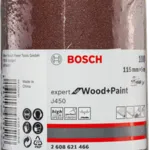
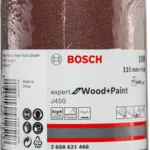
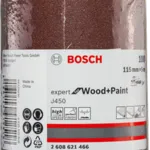
The backing material provides the foundation for the abrasive grains, influencing the abrasive's flexibility, durability, and resistance to tearing. Paper-backed abrasives are common and cost-effective, available in various weight classifications (A-weight for light sanding, through F-weight for heavy-duty applications). Their primary limitation is often tear resistance and susceptibility to moisture.
Cloth-backed abrasives offer superior durability, tear resistance, and flexibility compared to paper. This makes them ideal for sanding contoured surfaces or for applications demanding high tensile strength, such as sanding belts for manual block sanding. They are often used for metalworking due to their robustness.
Film-backed abrasives feature a polyester film backing, providing exceptional dimensional stability and uniform thickness. This uniformity translates to a more consistent finish and reduced risk of 'digging in.' Film backings are highly tear-resistant and can be used wet or dry, making them a preferred choice for precision finishing in automotive and composite applications.
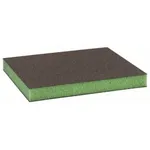
Foam-backed abrasives, commonly found in sanding sponges and pads, integrate a layer of foam between the abrasive and a flexible backing. This design allows the abrasive to conform exquisitely to intricate shapes, curves, and contours, distributing sanding pressure evenly to prevent localized over-sanding. They are excellent for fine finishing and typically allow for wet or dry use, reducing hand fatigue during extended use.
Ergonomics and Technique in Manual Sanding
Effective manual sanding is as much about technique and tool ergonomics as it is about abrasive selection. Sanding blocks come in various forms—rigid, flexible, soft-backed, and contoured—each designed to optimize pressure distribution and conformity to the workpiece. A rigid block is ideal for maintaining flat surfaces, while a soft-backed or foam block excels on slightly curved or irregular surfaces, preventing 'dish-out' or over-sanding of high spots. Consistent, even pressure is crucial, typically applied with the entire hand across the block to avoid finger pressure points that can create uneven finishes or gouges.
For woodworking, sanding with the grain is generally recommended to prevent cross-grain scratching, though initial coarse sanding across the grain can be more efficient for aggressive material removal, provided subsequent steps meticulously remove all cross-grain marks. For paint and primer, cross-hatching techniques (sanding in alternating directions) can help reveal low spots and ensure uniform material removal. Dust management, even in manual sanding, is vital; regularly cleaning the abrasive surface and the workpiece prevents premature clogging (loading) of the abrasive, maintaining cutting efficiency and preventing unwanted scratches from trapped debris.