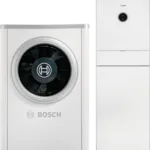
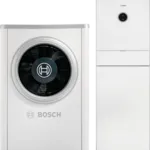
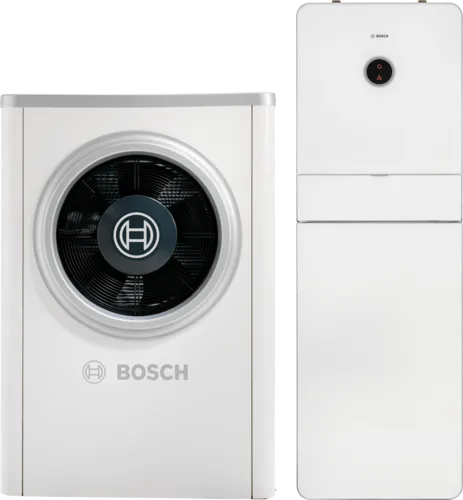
Bosch LW/M 11 Ground-to-Water Indoor Heat Pump Unit
Specifications
Design
Design
| Type |
Indoor unit
|
|---|---|
| Heating system |
Ground to water
|
| Product colour |
White
|
Performance
Performance
| Heating capacity in watts |
11000
W
43% better than others
|
|---|
Power
Power
| Energy efficiency class (heating) |
A++
|
|---|---|
| AC input voltage |
400
V
79% better than others
|
| AC input frequency |
50
Hz
16% better than others
|
| Current |
20
A
72% better than others
|
Indoor unit
Indoor unit
| Noise level (indoor unit) |
48 dB
|
|---|---|
| Indoor unit width |
60
cm
62% better than others
|
| Indoor unit depth |
64.6
cm
51% better than others
|
| Indoor unit height |
180
cm
74% better than others
|
| Indoor unit weight |
218
kg
65% better than others
|
| Water tank capacity |
185 L
|
Outdoor unit
Outdoor unit
| Noise level (outdoor unit) |
44 dB
|
|---|
Disclaimer: Information on this page may need review. If you notice any discrepancies, please report them

The Bosch LW/M 11 represents a significant entry into the domestic and light commercial heating market, specifically targeting installations where a ground-to-water heat source is utilized. As an indoor unit, it's designed for integration within the building's envelope, simplifying external infrastructure requirements and potentially offering a cleaner aesthetic for properties. This unit's focus on ground-source energy extraction positions it as a robust solution for consistent, reliable heating, leveraging the stable temperatures found beneath the earth's surface.
Analyzing its role in the competitive heat pump landscape, the LW/M 11 distinguishes itself by its specific application focus. While many heat pumps are air-to-water, the ground-source capability of this Bosch model implies a higher Coefficient of Performance (COP) and a more predictable heating output, less susceptible to ambient air temperature fluctuations. This makes it an attractive option for new builds or major renovations where ground loops or boreholes can be implemented, promising long-term energy savings and a reduced carbon footprint. Its indoor configuration also suggests a design prioritizing ease of maintenance and accessibility for servicing within a protected environment.
Pros & Cons
Pros
What we love about this product
- Efficient Ground-Source Operation: Leverages stable subterranean temperatures for consistent and efficient heating performance.
- Indoor Installation Flexibility: Designed for internal placement, simplifying external aesthetics and protecting the unit from weather elements.
- Bosch Brand Reliability: Benefits from Bosch's reputation for quality engineering and durable appliance manufacturing.
- Potential for High COP: Ground-source systems typically offer higher Coefficients of Performance compared to air-source units, leading to significant energy savings.
Cons
Points to consider before buying
- Requires Ground Loop Infrastructure: Installation necessitates the complexity and cost associated with ground loop or borehole systems.
- Limited to Heating Applications: Primarily designed as a heating unit; cooling functionality is not specified.
- Space Requirement for Indoor Unit: The indoor unit requires dedicated installation space within the property.
Questions and Answers

What is the primary advantage of a ground-to-water heat pump like the Bosch LW/M 11 over an air-to-water unit?
The core advantage lies in the stability of the heat source. Ground temperatures remain relatively constant year-round, unlike air temperatures which fluctuate significantly. This allows the LW/M 11 to operate with greater efficiency and consistency, often achieving a higher Coefficient of Performance (COP), especially during very cold weather when air-source units struggle. This translates to more predictable heating costs and reliable warmth.
Write at least 5 characters