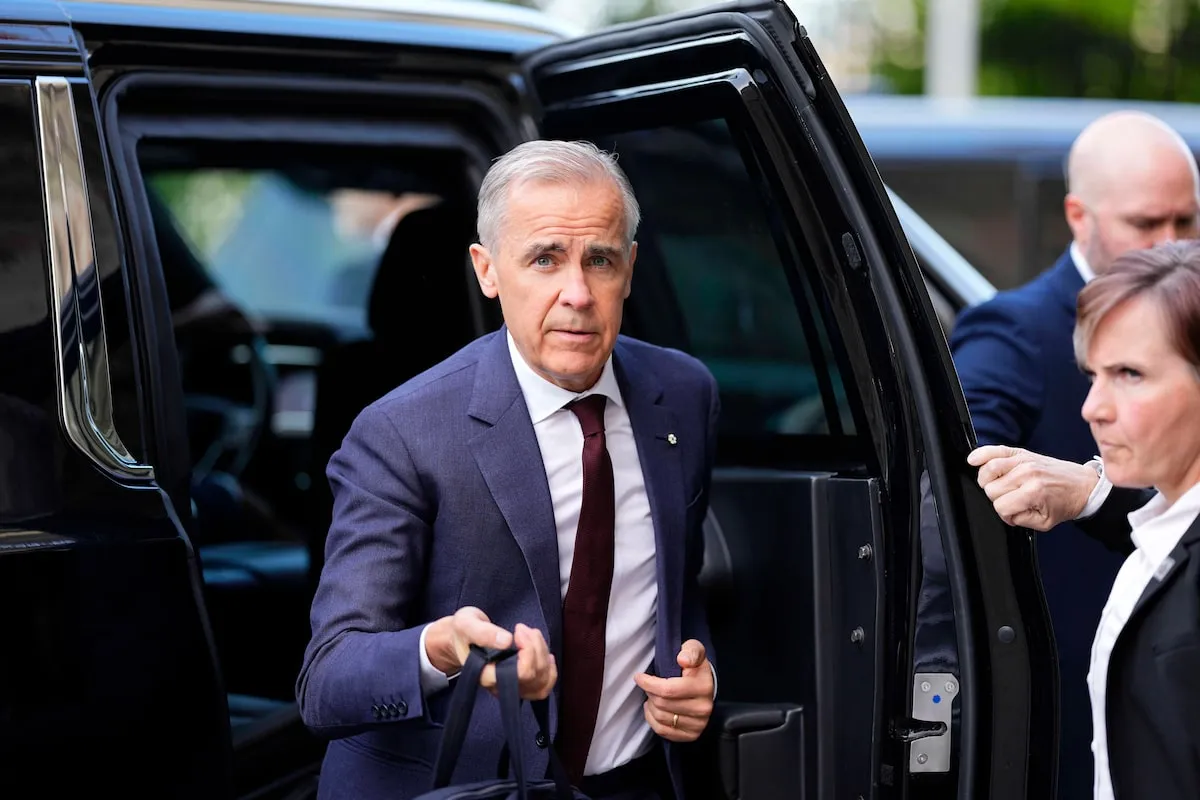
Prime Minister Mark Carney has attributed the recent contraction in the Canadian economy, marked by two consecutive quarters of negative GDP growth, to a confluence of factors, including the government's strategic reduction in immigration targets. Speaking on Tuesday, Carney acknowledged that while the administration's focus on boosting investment aims to foster a more robust and resilient economy, the transition period would likely see "uneven" economic data. He emphasized that the economy is undergoing a fundamental transformation and that sustained effort is required to navigate these crosscurrents and achieve long-term stability and growth.
This marks Carney's first public statement following the release of Statistics Canada's report last Friday, which indicated a 0.1 percent annualized contraction in the first quarter of the year. This followed a more significant 1 percent annualized decline in the preceding quarter. While the term "technical recession" is often invoked after two consecutive quarters of negative GDP growth, many economists caution against premature conclusions, highlighting that GDP figures are subject to revision and that a true recession involves a broad-based, significant downturn across multiple sectors. The current economic landscape is further complicated by external pressures, including aggressive U.S. trade policies and uncertainty surrounding the United States-Mexico-Canada Agreement (USMCA), which have impacted exports and business investment.
Economic Performance and Recession Debate
The latest GDP figures from Statistics Canada reveal a complex economic picture. While consumer spending has remained relatively robust, overall domestic demand experienced an annualized decline of 0.4 percent in the first quarter. This contraction was exacerbated by a decrease in government spending on major weapons systems and a substantial increase in imports, which are subtracted from GDP calculations when they exceed exports. Economists are divided on whether these trends constitute a recession. The Conservative Party, led by Pierre Poilievre, has been vocal in labeling the situation a recession, criticizing the Prime Minister for not directly addressing the economic downturn. Poilievre has accused the Prime Minister of evading questions and has repeatedly used the term "devastating economic report" to describe the latest data.
Despite the debate, there is a consensus that economic growth has effectively stalled over the past year. Factors contributing to this stagnation include the lingering effects of U.S. tariffs on key Canadian exports like autos, industrial metals, and wood products. The ongoing review of the USMCA also casts a shadow over business investment. Furthermore, elevated unemployment rates and a sluggish housing market continue to present significant headwinds. The official arbiter of recessions in Canada, the C.D. Howe Institute, alongside the U.S. National Bureau of Economic Research, typically assesses recessions based on the depth, duration, and breadth of an economic contraction, making the current two-quarter decline a point of discussion rather than a definitive marker.
Immigration Policy and Population Dynamics
Prime Minister Carney specifically highlighted the government's recent policy adjustments regarding immigration as a contributing factor to the current economic data. In the fall of 2024, the Liberal government announced plans to gradually reduce the admission of permanent residents and curb the influx of temporary residents, a move prompted by concerns over the impact of high immigration levels on Canada's housing and labor markets. Statistics Canada reported earlier this year that Canada experienced its first annual population decline on record in 2025, with a drop of over 100,000 people.
This policy shift has drawn analysis from economists, who view immigration as a key variable influencing economic growth. A research note from National Bank economists Taylor Schleich, Matthieu Arseneau, and Alexandra Ducharme suggested that the slowdown in immigration has resulted in a smaller national population in the first quarter of 2026 compared to the previous quarter. This demographic shift, they argue, has contributed to positive real GDP per capita growth, which has been on an upward trend for two years. While acknowledging the fragility of the Canadian economy, these economists remain cautious about definitively labeling the current situation as a recession.
Broader Economic Considerations
The definition of a recession remains a subject of interpretation. While two consecutive quarters of declining GDP is a common benchmark, it is not a universally applied rule. The severity of the economic shock, as seen during the COVID-19 pandemic, can override this quantitative measure. Conversely, a more localized or sector-specific downturn, such as the one observed in 2015 following a global oil price drop, may not be classified as a recession even if it meets the two-quarter GDP decline criterion, as its impact was concentrated in specific regions like Alberta.
The current economic environment in Canada is characterized by a delicate balance between various policy decisions and external economic forces. The government's commitment to stimulating investment and transforming the economy signals a long-term strategic approach. However, the immediate data suggests that the path forward will involve navigating short-term fluctuations and uncertainties. The interplay between domestic demand, government spending, trade relations, and demographic trends will be crucial in shaping Canada's economic trajectory in the coming months and years.