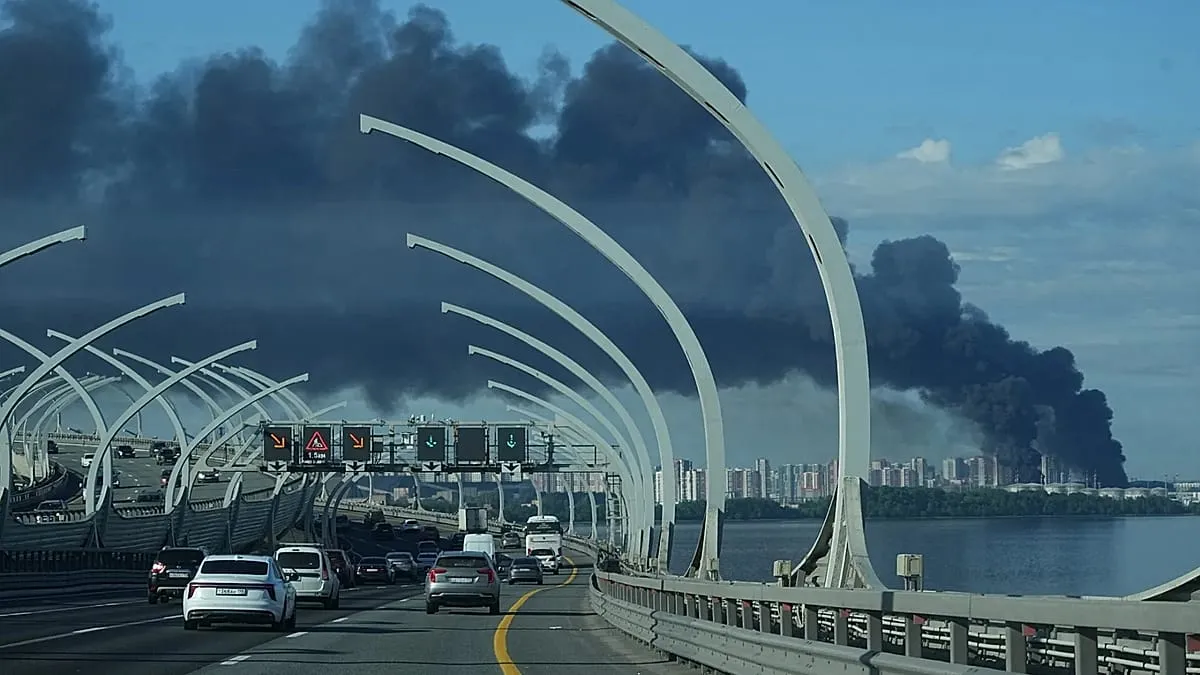
Early Wednesday morning, a plume of smoke was observed rising over St. Petersburg, Russia, a stark visual as the nation's flagship economic forum commenced. Coinciding with the event, which was slated to host Russian President Vladimir Putin, Ukrainian forces launched drone attacks targeting energy and military sites within the strategically important port city. This offensive marks a significant escalation, bringing the conflict zones closer to high-profile Russian venues.
The Ukrainian military confirmed strikes on the Petersburg Oil Terminal, situated approximately 1,100 kilometers from the Ukrainian border. In addition to energy infrastructure, President Volodymyr Zelenskyy stated on X that "purely military targets at the Kronstadt base were also hit." Further afield, an enterprise in the Tambov region, reportedly involved in the production of Russian weaponry, was also identified as a target. City governor Alexander Beglov acknowledged that several infrastructure facilities in the Kronstadt, Kirovsky, and Krasnoselsky districts sustained damage, reporting injuries but no fatalities, with cleanup operations underway.
Escalation on Multiple Fronts
These strikes in St. Petersburg occurred shortly after a devastating Russian attack on Ukraine. On Tuesday, Russia launched a widespread drone and missile barrage targeting Kyiv and other Ukrainian cities, resulting in at least 23 fatalities and injuring 138 individuals. President Zelenskyy warned that Moscow was potentially preparing for further large-scale assaults, emphasizing the continued reliance of Russian weaponry on components sourced internationally. He reiterated calls for more stringent sanctions against Russia, aiming to disrupt its ability to circumvent existing economic restrictions.
The effectiveness of Ukraine's air defense systems against the barrage of over 70 missiles and 650 drones, supplemented by approximately 100 drones during the day, is under scrutiny. While most drones were reportedly intercepted, ballistic missiles continue to pose a substantial threat. The Patriot air defense system remains a critical asset for Ukraine in countering this specific threat. However, concerns are mounting over depleted stockpiles of Patriot interceptors, reportedly affected by the joint US-Israeli operations in Iran and the significant reliance of Gulf states on the system.
Ukrainian Calls for Enhanced Air Defense and Sanctions
President Zelenskyy has been a vocal advocate for bolstering European air defense capabilities and has persistently urged the United States to supply additional missiles for Patriot systems. The urgency stems from Russia's continued capacity to produce advanced weaponry, a feat facilitated by intricate schemes to bypass international sanctions. The effectiveness of these sanctions and the need for greater international cooperation in preventing the supply of critical components to the Russian military industry remain key discussion points.
The strategic targeting of St. Petersburg, a major economic and industrial hub, during the economic forum underscores Ukraine's intent to disrupt Russian economic activities and highlight the proximity of the conflict's impact. The attacks serve as a potent reminder that despite Russia's offensive actions, Ukraine possesses the capability to project force deep into Russian territory, affecting critical infrastructure and military assets. This reciprocal targeting demonstrates a hardening of the conflict, with significant implications for future diplomatic and economic engagements.
Broader Geopolitical and Economic Ramifications
The drone attacks on St. Petersburg and the simultaneous Russian offensive against Ukraine have intensified concerns about regional stability and the global economic outlook. The St. Petersburg International Economic Forum, a platform intended to showcase Russia's economic resilience, now finds itself overshadowed by direct military actions on its soil. This juxtaposition is likely to impact international participation and sentiment towards Russian economic ventures.
Furthermore, the renewed emphasis on the need for advanced air defense systems, particularly the Patriot missile system, highlights critical vulnerabilities in global defense capabilities and supply chains. The reported depletion of interceptor stocks raises questions about the readiness of allied nations and the potential strain on resources in prolonged conflicts. The interconnectedness of global supply chains, even for military hardware, is starkly illustrated by Russia's alleged circumvention of sanctions and the impact on allied defense readiness.