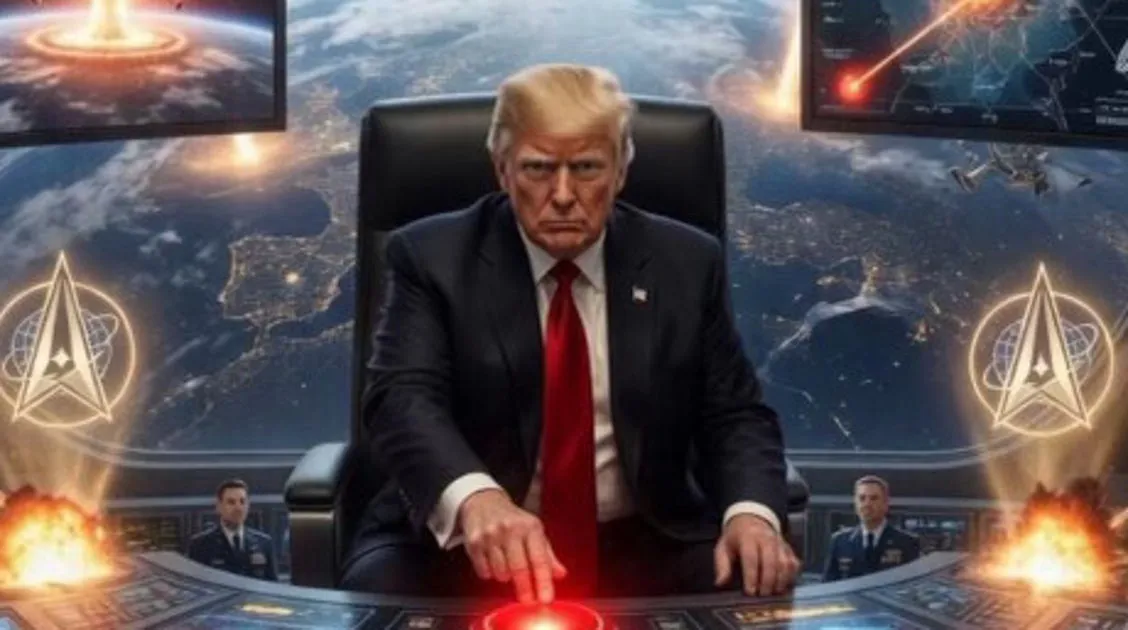
Former President Donald Trump recently leveraged his social media platform, Truth Social, to share a series of AI-generated images depicting himself in scenarios involving the destruction of Earth. These posts emerged on a Sunday, coinciding with a pre-taped Bible reading event where Trump's message was played, and House Speaker Mike Johnson was leading prayers for "mercy upon our land." The controversial imagery showed Trump pressing a red button on a control panel, seemingly initiating global devastation, while smaller figures were seated nearby and screens displayed mushroom clouds and the text "TARGET DESTROYED." This juxtaposition of violent imagery with a religious event and prayers for peace has drawn significant attention and criticism.
The AI-generated visuals are part of a pattern where Trump has utilized his Truth Social account to disseminate provocative and often extraterrestrial-themed content. In the days leading up to and following the Sunday posts, he shared multiple images. One depicted him commanding a "Star Wars"-like droid army with American flags and Space Force logos. Another showed him escorting an alien into custody, flanked by military personnel. A further image portrayed him manning a spacecraft as missiles were launched. These posts occurred while thousands gathered in Washington, D.C., for an event called "Rededicate 250," which featured Trump officials and controversial speakers.
AI-Generated Imagery and Political Commentary
The use of artificial intelligence to create political imagery is a rapidly evolving landscape, and Donald Trump's deployment of these tools for his social media output offers a unique case study. The specific image of him bombing Earth, complete with nuclear-like explosions, was posted shortly after prayers for mercy were offered at a MAGA-friendly event. This stark contrast has been interpreted by many as a commentary on his aggressive political persona, even when juxtaposed with themes of peace and religion. The AI-generated nature of the images allows for a visual narrative that might be difficult or impossible to create through traditional means, amplifying the intended message, however controversial.
These AI creations are not isolated incidents but appear to be part of a broader strategy of online communication for the former president. Earlier in the weekend, Trump had shared an AI-generated image themed around Space Force, hinting at his engagement with futuristic and military aesthetics. His subsequent posts, including the one depicting Earth's destruction, were part of a series of what have been described as "bizarre memes" and "attacks against his opponents." This tactic of using visually striking, albeit disturbing, AI-generated content can serve to capture attention, generate discussion, and reinforce a particular image or narrative among his supporters.
Contextualizing the Posts Amidst Religious Gatherings
The timing of these posts is particularly noteworthy. The AI imagery of planetary destruction was shared on Sunday, the same day as a prayer rally on the National Mall where speakers included Trump and his allies. Speaker Mike Johnson, a prominent figure in the event, was heard praying for divine mercy and forgiveness for the nation's mistakes. Trump's own contribution to the event was a pre-taped Bible reading. The dissemination of images showing him initiating global destruction moments after these religious affirmations created a jarring dissonance, leading to widespread commentary and concern from various observers.
The "Rededicate 250" event itself, held on the National Mall, was framed as a patriotic and spiritual gathering. However, the inclusion of controversial speakers and the subsequent posting of violent AI-generated content by Trump have led to questions about the underlying messages being conveyed. Critics have pointed out the perceived contradiction between the stated aims of the event and the visuals shared by the former president, suggesting that these AI images may be a form of dark humor, a veiled threat, or simply a provocative attempt to maintain public attention through sensationalism. The use of AI to create such imagery bypasses the need for actual photographic evidence, allowing for limitless and potentially inflammatory visual narratives to be generated and disseminated rapidly.
The Role of AI in Political Discourse
The incident highlights the growing role of artificial intelligence in shaping political discourse and public perception. AI image generators can create hyper-realistic or fantastical visuals that can be used to persuade, provoke, or even mislead audiences. In this instance, Trump's use of AI resulted in images that were widely seen as violent and disturbing, yet they were shared on a platform with a significant following, underscoring the potential for AI-generated content to influence public opinion and political narratives.
As AI technology becomes more accessible, the creation and dissemination of such content are likely to increase. This raises significant ethical and societal questions about the authenticity of digital media, the potential for manipulation, and the responsibility of social media platforms in hosting and distributing AI-generated imagery. The ability to rapidly generate and share such potent visuals means that the lines between reality, satire, and propaganda can become increasingly blurred, posing a challenge for informed public discourse and democratic processes.
Impact Analysis
Donald Trump's use of AI-generated images, particularly those depicting violent scenarios like bombing Earth, represents a significant escalation in the use of artificial intelligence for political messaging. While AI in marketing and content creation is becoming commonplace, its application in generating politically charged, potentially threatening imagery raises concerns about the manipulation of public opinion and the erosion of trust in digital media. This incident underscores the need for greater media literacy and critical engagement with online content, especially as AI capabilities continue to advance. The juxtaposition of these visuals with religious events also highlights the complex and often contradictory ways in which technology and ideology intersect in contemporary political arenas, potentially influencing voter perception and the broader national conversation.