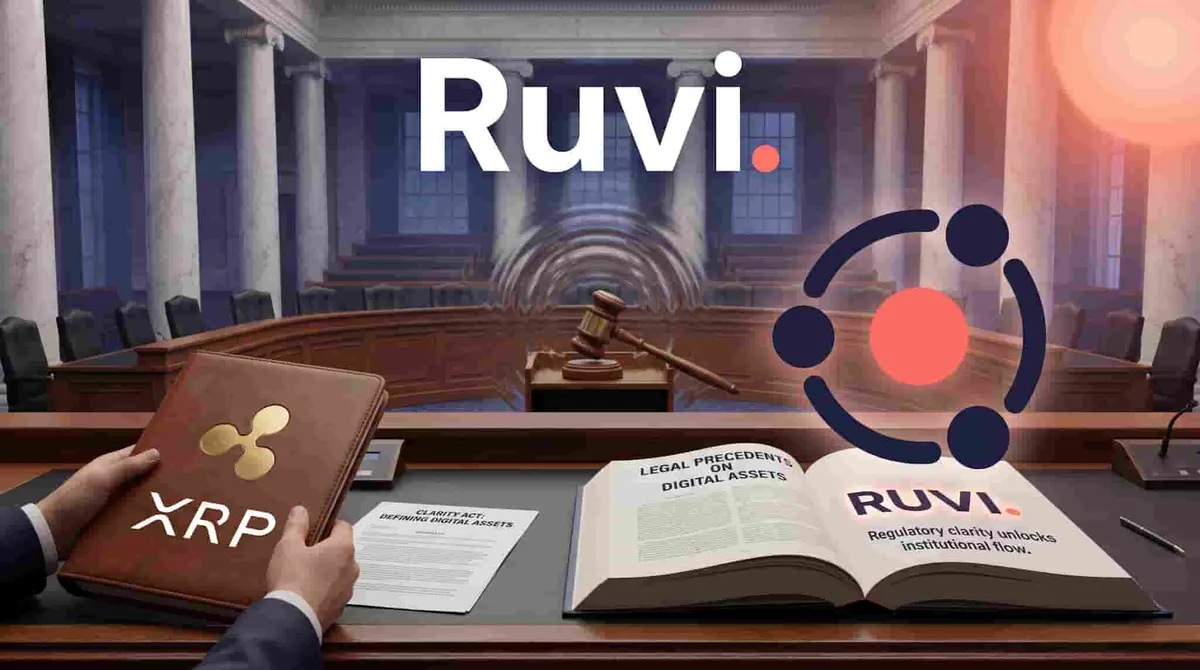
XRP has demonstrated a significant increase of 89% over the past year, reaching approximately $1.32 with a market capitalization of around $82.2 billion. However, this upward momentum appears to be decelerating, approaching a critical liquidity zone. Immediate resistance is observed between $1.45 and $1.50, a level that could dictate the short-term trajectory of the digital asset. While XRP has seen substantial gains, the flattening price action is prompting investors to scrutinize alternative opportunities, particularly those offering tangible revenue generation rather than pure speculation.
Amidst this market shift, traditional investors and cryptocurrency holders alike are exploring projects that present a more structured financial model. The decentralized AI superapp, Ruvi Ai (RUVI), is gaining attention for its economic framework, which is built upon a fixed supply, structured returns, and a revenue-backed buyback yield mechanism. This approach contrasts with speculative trading, focusing instead on verifiable on-chain performance and sustainable value accrual.
Ruvi AI's Structured Presale and Tokenomics
Ruvi Ai has implemented a unique, on-chain verifiable presale structure designed as a pricing ladder. This phased approach aims to align token distribution with growing adoption. A total of 1.5 billion $RUVI tokens are allocated across seven distinct phases, commencing at $0.010 and escalating to $0.070 by the final phase. Phases 1 and 2, priced at $0.010 and $0.015 respectively, have already been successfully sold out. The project is currently in Phase 3, with tokens available at $0.020.
The total supply of $RUVI is strictly capped at 5 billion tokens, with no provision for minting additional tokens, thereby preventing inflationary dilution of existing holdings. A key feature for presale participants is the 100% unlock of tokens at launch, without any vesting periods or cliffs, ensuring immediate liquidity. All transactions within the presale are immutably recorded on the blockchain, offering a high degree of transparency and verifiability. This methodical structure is particularly appealing to traditional finance capital seeking predictable and auditable investment vehicles.
XRP Capital's Shift Towards On-Chain Revenue Models
While XRP facilitates significant value transfer across banking rails, it currently captures a minimal portion of the associated fee revenue. The network's validators process these transactions, but the XRP token itself remains largely passive in revenue generation. This disconnect presents a notable opportunity for alternative assets that can directly monetize network activity. Ruvi Ai aims to bridge this gap by creating a direct link between platform usage and token value.
In Ruvi's ecosystem, every interaction with the AI superapp, such as running prompts, meters $RUVI tokens. Furthermore, contributors who enhance the AI models are rewarded in $RUVI. Crucially, the revenue generated by the platform is systematically channeled into an open-market buyback program, which permanently burns a portion of the $RUVI supply on-chain. This creates a deflationary pressure that grows in direct proportion to the platform's adoption and usage, offering a tangible revenue capture mechanism distinct from speculative promises.
Analyzing Potential Returns with Ruvi's Buyback Yield
The economic model of Ruvi Ai is engineered to provide structured exposure rather than pure speculative trading. The fixed supply of 5 billion non-mintable tokens inherently includes a form of capital protection. The ongoing platform revenue funds buybacks on the open market, leading to a permanent reduction in circulating supply—a deflationary mechanic that intensifies as the platform gains traction. For instance, a $500 investment at Phase 3's price of $0.020 would acquire 25,000 $RUVI tokens.
Should these tokens be valued at the final presale phase price of $0.070, the initial $500 investment would theoretically grow to $1,750. Projecting towards a potential $0.10 listing price could see that allocation reach $2,500. If the token price were to achieve $1, the initial $500 position could be valued at $25,000. Additional bonuses are available for VIP buyers, potentially reaching up to a 100% bonus at VIP 5, distributed prior to the official listing. Post-presale, a staking mechanism is planned, with yield percentages varying based on tier: Bronze (approximately 6%), Silver (around 10%), and Gold (approximately 14%), all derived from platform revenue. This contrasts sharply with XRP's current position, where capital is stalling near $1.32 without significant revenue capture.
Conclusion: A Shift Towards Sustainable Token Economics
XRP's remarkable 89% year-over-year performance is currently plateauing around the $1.32 mark. Investors are increasingly scrutinizing assets that capture value directly from their network's activity. Ruvi Ai, currently priced at $0.020 in Phase 3, boasts over 3,000 holders, more than 20 AI models in operation, a fixed 5 billion token supply, and a revenue-backed buyback mechanism designed to reduce supply. These attributes position it as a structured investment alternative to speculative assets. As capital allocation strategies evolve, the sustainable economic model offered by Ruvi Ai warrants closer examination.