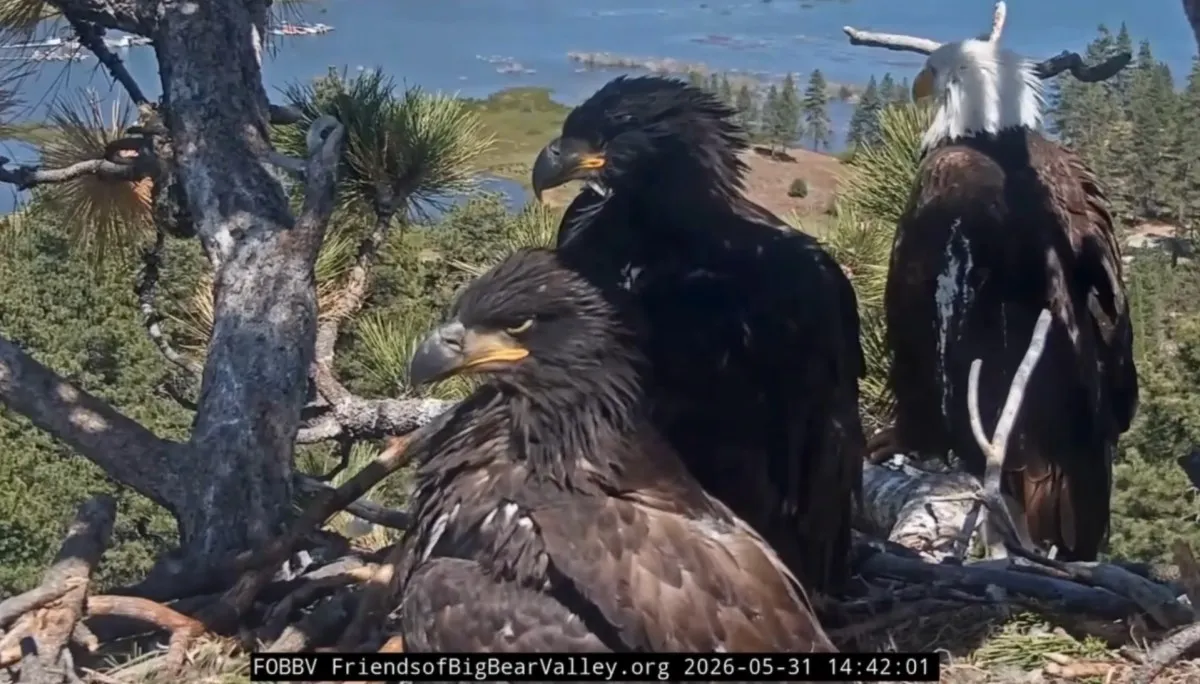
The tranquil life at the Big Bear Lake eagle nest, home to the widely followed bald eagles Jackie and Shadow, recently saw an unusual visitor: Fiona the squirrel. While the eagle family, including eaglets Sandy and Luna, typically shares its domain with other wildlife, Fiona's persistent nocturnal visits stirred a protective response from Jackie. The renowned eagle, known for her nurturing role, made it clear that her nesting territory would not be casually approached.
During the late hours of May 30th and into May 31st, Fiona the flying squirrel was observed making multiple attempts to approach the nest. This bold behavior prompted Jackie, one of the parent eagles, to assert her dominance. According to observations shared by Friends of Big Bear Valley (FOBBV), Jackie delivered a firm "slap" and vocalized her displeasure, signaling her intolerance for the squirrel's presence while she was attempting to rest.
Nest Dynamics and Inter-Species Interactions
The Ambitious Squirrel Visitor
Fiona, a nickname given to one of the local flying squirrels, has become a recurring character in the Big Bear eagle nest's narrative. These nocturnal creatures, identified as San Bernardino flying squirrels (Glaucomys sabrinus californicus), are known to inhabit the area surrounding Jackie and Shadow's nest. While their presence is not uncommon, Fiona's recent activities appeared to cross a boundary for Jackie, leading to the direct confrontation.
The squirrels are primarily attracted to the nest area by potential food scraps left behind by the eagles, such as fish tails, feathers, eggshells, and even insects. Despite their small size and gliding capabilities, which allow them to travel significant distances, their visits often involve cautious reconnaissance. However, Fiona's persistence on this occasion was met with a clear, albeit surprising, territorial display from Jackie.
Jackie's Protective Response
The interaction between Jackie and Fiona was captured and shared, highlighting the eagle's assertive nature. The "dramatic slap" observed was a clear communication of displeasure and a warning to the squirrel. This behavior is not uncommon among nesting birds, who will defend their young and territory vigorously against perceived threats, regardless of the intruder's size.
The incident underscored the complex ecosystem at play within the Big Bear Valley. While the eagles are apex predators in their immediate vicinity, other species, like the flying squirrels, have carved out niches that occasionally bring them into close proximity. Jackie's swift action demonstrates the instinctual drive to protect her family and maintain the security of the nest.
The Eaglets' Development and Nest Challenges
Sandy and Luna's Growth
Alongside the inter-species drama, the eaglets Sandy and Luna are continuing their development. Since hatching in early April, they have been under the constant care and protection of Jackie and Shadow. The parents have been diligent in providing food and guarding the nest against various threats.
The recent incident with Fiona also saw the eaglets, Sandy and Luna, practicing their own defensive behaviors. While still young, they are learning from their parents and beginning to exhibit territorial instincts. Their development is being closely monitored through the 24/7 livestream provided by Friends of Big Bear Valley, which has garnered a significant audience.
Past Threats and Resilience
The 2026 nesting season has already presented its share of challenges. Earlier in the season, ravens managed to destroy two of Jackie and Shadow's initial eggs. This incident highlighted the persistent threats that bald eagles face from other avian species. The successful hatching of two new eggs and their subsequent growth demonstrate the pair's resilience.
The San Bernardino flying squirrels themselves are a subspecies of the Humboldt's flying squirrel, noted for their ability to glide up to 300 feet and their diet of truffles, seeds, and lichens. Their presence, while sometimes presenting minor conflicts, is a natural part of the forest ecosystem. Volunteers have observed that these squirrels are particularly attracted to food remnants from the eagles' meals, creating a dynamic of cohabitation and occasional contention.
Conservation Efforts and Future Outlook
The San Bernardino Flying Squirrel
The San Bernardino flying squirrel (Glaucomys sabrinus californicus) is a subspecies with specific habitat requirements. Their primary food sources include fungi, conifer seeds, and lichens, but they have also been observed to supplement their diet with animal matter found in eagle nests. Their ability to glide allows for efficient movement through their forested habitat.
Conservation efforts are underway to protect the habitat of these and other species in the San Bernardino National Forest. The Friends of Big Bear Valley (FOBBV) are actively involved in monitoring the eagle nest and advocating for the preservation of the surrounding environment. This includes efforts to protect the foraging areas crucial for the survival of species like the San Bernardino flying squirrel.
Protecting Eagle Territories
The long-term survival of Jackie and Shadow's lineage, and indeed all bald eagles, depends on the conservation of their natural habitats. Environmental groups are working to raise funds to protect the foraging grounds vital for these magnificent birds from potential development. Public awareness, fostered by livestreams like the one from Big Bear, plays a crucial role in these conservation initiatives.
The ongoing vigilance of parent eagles like Jackie and Shadow, coupled with dedicated conservation work, ensures that these iconic birds continue to thrive. The recent encounter with Fiona the squirrel, while seemingly minor, is a reminder of the dynamic natural world that unfolds daily in their protected habitat.
Impact Analysis
The interaction between Jackie the bald eagle and Fiona the flying squirrel serves as a vivid, albeit small-scale, illustration of the ongoing territorial negotiations within natural ecosystems. While this specific event primarily generated interest due to the online fame of the eagles, it underscores the constant dynamics of predator-prey and competitor relationships. For observers, it offers a tangible glimpse into the daily challenges and protective instincts of wildlife. For conservationists, it highlights the importance of preserving intact habitats where such interactions can occur naturally, reinforcing the need for continued protection of the San Bernardino National Forest and its diverse inhabitants, including both the renowned eagles and the less conspicuous, yet integral, flying squirrels.