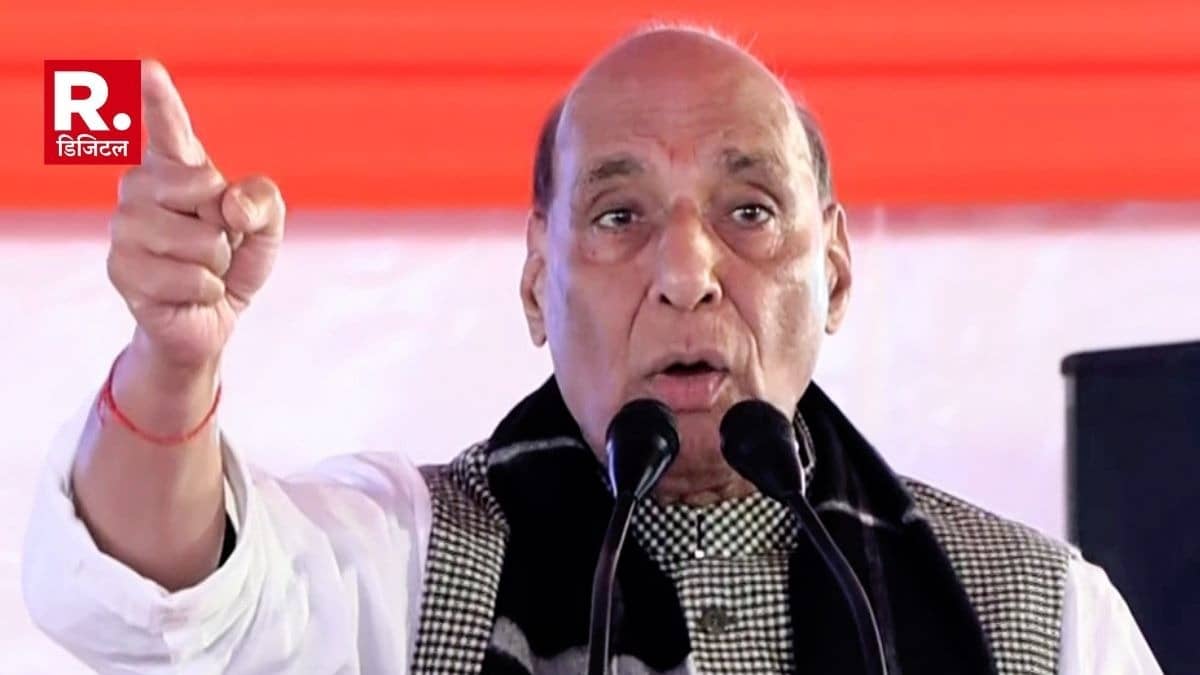
New Delhi: Defence Minister Rajnath Singh has articulated a significant concern regarding the 'dual-use dilemma' inherent in Artificial Intelligence (AI), particularly its implications for national security. Speaking at the ANI National Security Summit 2.0, Singh underscored that while AI offers immense potential, its misuse presents formidable challenges, ranging from sophisticated disinformation campaigns through deepfakes to advanced cyber warfare and the development of autonomous weapon systems. He drew a stark parallel to the mythological demon 'Bhasmasur', illustrating how a powerful boon, when wielded inappropriately, can become a catastrophic threat, capable of destabilizing critical infrastructure such as banking systems, hospitals, and power grids.
The Defence Minister emphasized that the challenges posed by AI are not speculative but are already emerging and are expected to intensify. He stated, "When we talk about deterrence, we can't just see a rosy picture of AI. As the Defence Minister, I've had the opportunity to understand the country's security system in great detail. Therefore, I see concerns related to it." Singh highlighted the critical need for India to maintain a vigilant stance, acknowledging that technologies with the potential to bolster defenses could equally be weaponized against them if they fall into the wrong hands, thereby exacerbating the inherent risks associated with general-purpose AI models.
AI Integration in India's Defence Sector
Despite the inherent risks, Rajnath Singh also provided concrete examples of AI's successful integration within India's defense apparatus, showcasing its strategic benefits. He cited the effective utilization of AI in Operation Sindoor, demonstrating its application across sophisticated systems like the BrahMos missile, thereby enhancing precision and strike capabilities. Furthermore, the Sudarshan Air Defence missile system was presented as a prime example of a large-scale, ambitious project that leverages AI to its fullest potential, significantly bolstering India's defense posture.
The Indian armed forces are actively developing a comprehensive roadmap to counter emerging AI-based threats. This strategy involves the strategic deployment of AI, machine learning, and big data science to fortify capabilities and maintain a competitive edge. Minister Singh expressed confidence that these advancements will not only bolster national security but also contribute to India's empowerment and prosperity on the global stage. The initiative to enhance military competitiveness through these advanced technologies underscores India's commitment to staying at the forefront of defense innovation.
AI Beyond Warfare: Enhancing Welfare and Governance
Minister Singh broadened the perspective on AI's utility, extending its application beyond military objectives to encompass civilian welfare and administrative efficiency. He announced the development of an AI-enabled portal designed to streamline the pension process for retired military personnel. This initiative aims to simplify administrative procedures, ensuring that veterans receive their entitlements smoothly and efficiently, thereby acknowledging their service and contributions.
The Minister highlighted that AI is becoming a potent tool for improving the 'working culture,' enhancing soldier welfare, and elevating the overall standard of living for citizens. By implementing AI in administrative functions, the government aims to increase operational efficiency and provide better services to its personnel and the public. This multifaceted approach to AI deployment reflects a strategic vision to harness its power for comprehensive national development, ensuring that the benefits of technological advancement are distributed across various sectors.
Impact Analysis
Rajnath Singh's remarks at the ANI National Security Summit signify a critical juncture in India's approach to Artificial Intelligence. The explicit acknowledgment of AI's dual-use nature, coupled with the mythological 'Bhasmasur' analogy, clearly communicates the gravity with which the nation views potential threats. This balanced perspective—recognizing both the risks of deepfakes, cyber warfare, and autonomous weapons, and the tangible benefits in defense operations like Operation Sindoor and the BrahMos missile systems—positions India as a proactive stakeholder in the global AI discourse. The emphasis on developing domestic AI capabilities for defense and welfare suggests a strategic imperative to achieve technological self-reliance while mitigating the inherent vulnerabilities. This dual focus is crucial for navigating the complex geopolitical landscape shaped by rapidly advancing AI technologies, ensuring national security, and fostering economic growth.