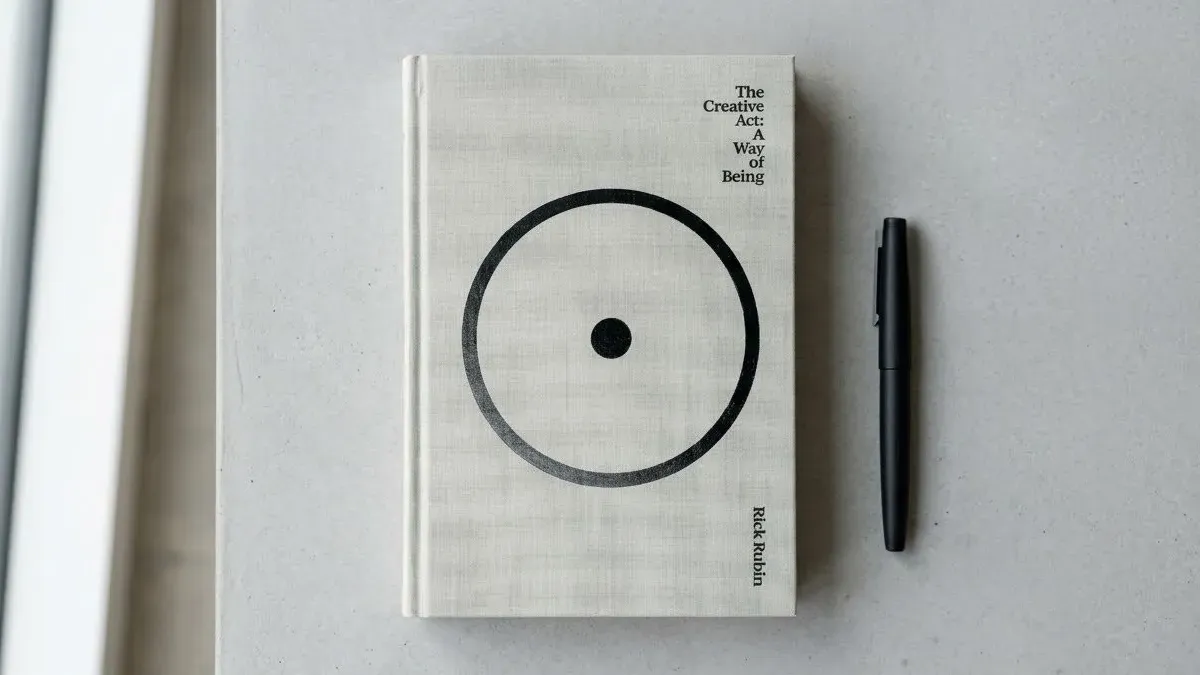
In a landscape increasingly defined by algorithmic generation and content saturation, Rick Rubin’s The Creative Act: A Way of Being emerges not merely as a book on creativity, but as a philosophical anchor. Published in early 2023 and quickly achieving #1 New York Times bestseller status, Rubin’s work transcends typical self-help or creative process guides. Instead, it presents a fundamental redefinition of creativity as a relationship with the world, a continuous state of being rather than a finite output. This perspective is particularly resonant in the current era, where the advent of sophisticated AI tools like Midjourney, DALL-E, and ChatGPT has prompted critical questions about the nature of human artistry and originality.
Rubin, a legendary music producer renowned for his transformative work with artists across genres, approaches creativity not as a talent possessed by a few, but as an inherent capacity within everyone. He posits that ideas are not generated but received, likening the artist to an antenna attuned to a universal creative field he terms “the Source.” This concept, while not explicitly religious, draws parallels with spiritual philosophies, emphasizing receptivity, mindfulness, and a deep connection to the surrounding environment. The book’s structure, comprising 78 short, self-contained “Areas of Thought,” allows for non-linear engagement, inviting readers to dip into specific insights as needed, mirroring the unpredictable flow of creative inspiration itself.
The Transformative Frameworks of 'The Creative Act'
One of the most impactful contributions of The Creative Act is its delineation of the creative process into four distinct, yet interconnected, phases: Seeds, Experimentation, Crafting, and Completion. Rubin stresses the importance of honoring each phase, arguing that collapsing them leads to creative blocks and anxiety. The Seeds phase encourages radical receptivity, a non-judgmental gathering of raw material—ideas, images, sounds. This is followed by Experimentation, a period of playful, low-stakes exploration without the pressure of producing a final outcome. Crafting represents the deliberate, iterative work of shaping raw material into a coherent form, and finally, Completion is framed not as perfection, but as the act of releasing the work into the world.
Beyond this process model, Rubin introduces the notion of the Neutral Witness, a crucial concept for maintaining objectivity. This is the capacity to observe one’s own creative output and process without excessive ego investment or emotional attachment. This internal editorial distance allows for honest assessment, preventing the common pitfalls of either blind self-adoration or paralyzing self-criticism. Rubin links this directly to meditative practices, suggesting that the ability to observe thoughts without identifying with them can be cultivated to provide a similar detachment when evaluating creative work.
Source Sensitivity and the Aesthetic Stance in a Digital Age
Rubin’s philosophy centers on what can be understood as Source Sensitivity: the active cultivation of receptivity to external creative input. This is not passive waiting for inspiration, but a discipline of attention that allows individuals to “hear” ideas that come through them. In an era of overwhelming content generation, this emphasis on perception over production is particularly potent. It reframes the artist’s primary role not as a generator of novelty, but as a discerning observer of the world and its subtle currents.
Furthermore, Rubin’s work implicitly champions what could be termed the Aesthetic Stance: the deliberate development of personal taste as a core professional asset. He argues against viewing taste as superficial, instead positing it as a profound form of discernment—the ability to distinguish not just between what is correct, but what is true. This stance requires dedicated practice, which includes engaging with art, culture, and experiences outside one's immediate field, thereby enriching the palette from which creative decisions are drawn.
The Irreducible Human Element in Creative Work
In the context of rapidly advancing AI, The Creative Act serves as a powerful reminder of the uniquely human dimensions of creativity. While AI can generate outputs based on vast datasets and complex algorithms, it cannot replicate the lived experience, the nuanced perception, the personal history, or the intentionality that imbues human-created work with its distinct character. Rubin’s emphasis on the artist as an “antenna” tuned to specific frequencies highlights the subjective and qualitative aspects of creation that remain beyond the reach of current AI capabilities.
This focus on the human element is not an argument against AI, but rather a reassertion of what makes human creativity irreplaceable. The book suggests that as AI automates more technical aspects of creation, the true value will lie in the quality of attention, the courage of vulnerability, and the unique perspective of the individual creator. Rubin’s framework prepares creatives for a future where their value is increasingly defined not by the volume of their output, but by the depth and authenticity of their perceptual lens.
Navigating Self-Doubt and Embracing Beginner’s Mind
Rubin offers a counterintuitive perspective on self-doubt, not as an impediment but as valuable data. He posits that nagging doubts often signal specific areas in a work that require attention, transforming it from a source of paralysis into a constructive diagnostic tool. This approach encourages creators to listen to their hesitations, exploring what they might reveal about the integrity or direction of a piece, rather than dismissing them outright.
Complementing this is Rubin’s advocacy for Beginner’s Mind. Drawing from Zen philosophy, he encourages mature professionals to actively preserve the openness, curiosity, and wide-ranging possibilities perceived by novices. This is crucial in preventing the “competence without curiosity” trap that can stifle growth. By fostering a state of continuous learning and questioning, even amidst expertise, creatives can maintain the agility and innovative spirit necessary to navigate complex challenges and evolving artistic landscapes.
Impact Analysis
Rick Rubin's The Creative Act: A Way of Being offers a philosophical and practical reorientation for creators in an increasingly automated world. Its enduring value lies in its robust frameworks for understanding the creative process, cultivating a discerning aesthetic, and maintaining a receptive, human-centered approach. As generative AI continues to evolve, blurring the lines between human and machine output, Rubin’s work provides a vital articulation of the qualities—perception, vulnerability, subjective experience—that remain the bedrock of authentic human creativity. The book’s principles are not only applicable to traditional art forms but offer a compelling model for innovation in fields ranging from design and technology to business strategy, emphasizing the irreplaceable role of human consciousness in generating meaningful work. The book's structure and content also serve as a precursor to how humans may increasingly interact with knowledge and creative guidance in the future: through modular, returnable insights rather than linear consumption.