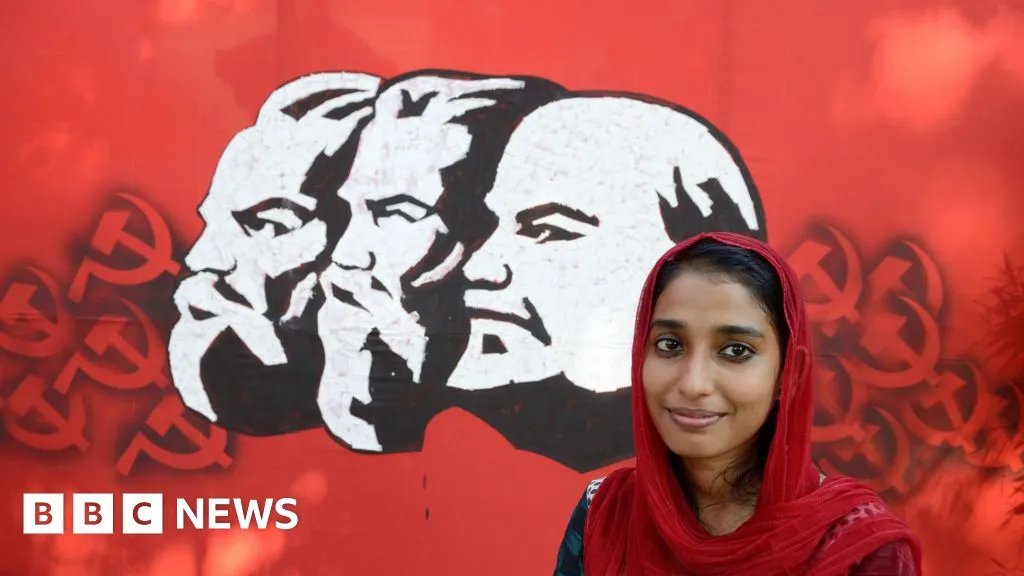
For the first time since 1957, India no longer has a state government led by a communist party. The recent electoral defeat of the Communist Party of India (Marxist)-led Left Democratic Front (LDF) in Kerala, after a decade in power, signifies the conclusion of one of the world's most prolonged experiments with democratic communism. This marks a significant shift from their historical prominence, where communist parties once governed states covering vast geographical areas and influenced the lives of over 100 million people through extensive networks of trade unions, peasant organizations, student wings, and disciplined cadres.
At their zenith, the Communist Party of India (Marxist) and its allies held sway over significant regions of India. The Left Front's continuous governance in West Bengal from 1977 to 2011 represented one of the longest-serving elected communist administrations globally. Similarly, Tripura experienced Left rule for 35 years, including an uninterrupted 25-year period until its ousting by the Bharatiya Janata Party (BJP) in 2018. Kerala, while not a bastion of continuous communist rule, has seen a dynamic alternation of power between the Left and the Congress party since 1957, solidifying the communists as a persistent, though not always dominant, political force.
The Evolving Landscape of Indian Communism
The trajectory of Indian communism has been shaped by both internal party decisions and external political and economic shifts. A pivotal moment occurred in 1996 when Jyoti Basu, the then Chief Minister of West Bengal and a prominent figure in the CPI(M), was reportedly close to becoming India's Prime Minister, leading a coalition government. However, his party's refusal of the offer, later famously termed a "historic blunder" by Basu himself, is often cited as a missed opportunity that could have altered the national political landscape. The communists' influence extended to national politics, notably in 2008 when they withdrew support from the Manmohan Singh government over the Indo-US nuclear deal. At that time, holding 62 seats in the lower house of parliament, their withdrawal forced a confidence vote, illustrating their significant parliamentary leverage.
Beyond parliamentary politics, the communist parties historically exerted considerable influence over intellectual, cultural, and economic discourse in India. Despite facing challenges such as economic stagnation in West Bengal and concerns about educational standards under their rule, their ideological reach persisted. However, many observers note a palpable decline in this influence. The current political scene finds the Left fragmented and unevenly represented. While still a significant force in Kerala and showing grassroots energy in pockets of Bihar, and maintaining a presence in student politics, their electoral footprint has drastically shrunk in traditional strongholds like West Bengal and Tripura.
Factors Contributing to the Decline
The diminishing electoral fortunes of India's communist parties can be attributed to a confluence of evolving political dynamics and socio-economic transformations. The traditional political language of class struggle and mass mobilization has gradually been overshadowed by the rise of identity politics, potent nationalism, charismatic populist leaders, and a focus on direct welfare delivery. Mohammed Salim, the CPI(M)'s West Bengal secretary, highlights the impact of Hindu nationalism and market liberalization since the 1990s, describing it as a "religious, political and economic onslaught" that has squeezed the Left. He notes that the allure of development and modernization, coupled with the fragmentation of class unity due to politics based on caste and religion, has weakened the traditional communist base.
Political scientists also point to structural constraints that limited the effectiveness of communist governance within India's federal system. Unlike more centralized communist states, Indian communist parties primarily operated at the state level, where they faced increasing pressure to attract private investment and foster economic growth. This created inherent contradictions, particularly evident in West Bengal, where the party that championed land reforms was later accused of displacing peasants for industrial development. While Kerala garnered international acclaim for its advancements in social indicators, literacy, and public health through decentralized planning, its economic model faced strains due to reliance on remittances and insufficient job creation. Furthermore, the Kerala communists themselves began to adopt aspects of the economic model they once opposed, with a 2022 policy document embracing private investment and public-private partnerships, leading some to characterize them as more social democratic than truly communist.
The Shifting Political Paradigm
The erosion of the social base that historically supported communist movements is another critical factor. Organized labor, always a minority in India's vast informal economy, has seen its influence wane. Welfare politics has shifted from broad class mobilization towards direct cash transfers and identity-based political alliances. This was evident during the 2020 farmers' protests, where regional parties and independent farm unions, rather than communist organizations, took the lead, highlighting a significant transformation in rural political leadership. Analysts argue that the Left has lost its position as the primary advocate for rights and entitlements, struggling to adapt to the modern economy and experiencing ideological confusion.
Despite the objective conditions—such as rising inequality, high youth unemployment, and deepening economic insecurity—that might seemingly favor Marxist ideologies, the communist parties have struggled to capitalize on them. Experts question their visibility and effectiveness in street-level activism, noting that while they remain a part of broader movements, they are no longer its primary drivers. The challenge is not unique to India; European left-wing parties have also faced difficulties, often outmaneuvered by nationalist populists who leverage immigration and ethnonationalism over class solidarity. The BJP, in India, has similarly mobilized support through nationalist appeals, presenting a significant hurdle for the Left.
Future Prospects and Adaptation
While the current electoral performance of India's communist parties, particularly the CPI(M)'s diminished representation in West Bengal, paints a stark picture, writing their political obituaries may be premature. Indian communism has a history of resilience, having navigated splits, state repression, and electoral setbacks. Though diminished, their organizational networks persist in various parts of the country. The critical question remains whether these residual networks can be transformed into a vehicle for political renewal.
Some strategists within the party advocate for a reinvention that involves working within, rather than merely opposing, the liberalized economic system. In West Bengal, leaders like Mohammed Salim express a commitment to regrouping, repositioning, and rejuvenating the party, emphasizing the need to promote a younger generation of leaders to shed the image of an ageing and inflexible organization. The principle of constant self-renewal is central to their strategy, acknowledging that change is the only constant. While Kerala's electoral results show the communists still hold significant sway, the path to regaining past dominance in states like West Bengal and Tripura remains arduous.
Impact Analysis
The decline of India's traditional communist parties signifies a broader ideological and political realignment within the world's largest democracy. The shift away from class-based politics towards identity, nationalism, and populist appeals reflects global trends but has particular implications for India's diverse social fabric. The ability of parties like the CPI(M) to adapt their ideology and organizational strategies to resonate with contemporary voter concerns, particularly regarding economic inequality and employment, will be crucial for their future relevance. Failure to do so risks further marginalization, leaving a significant segment of the electorate without a strong voice advocating for its specific interests within the evolving political economy of India.