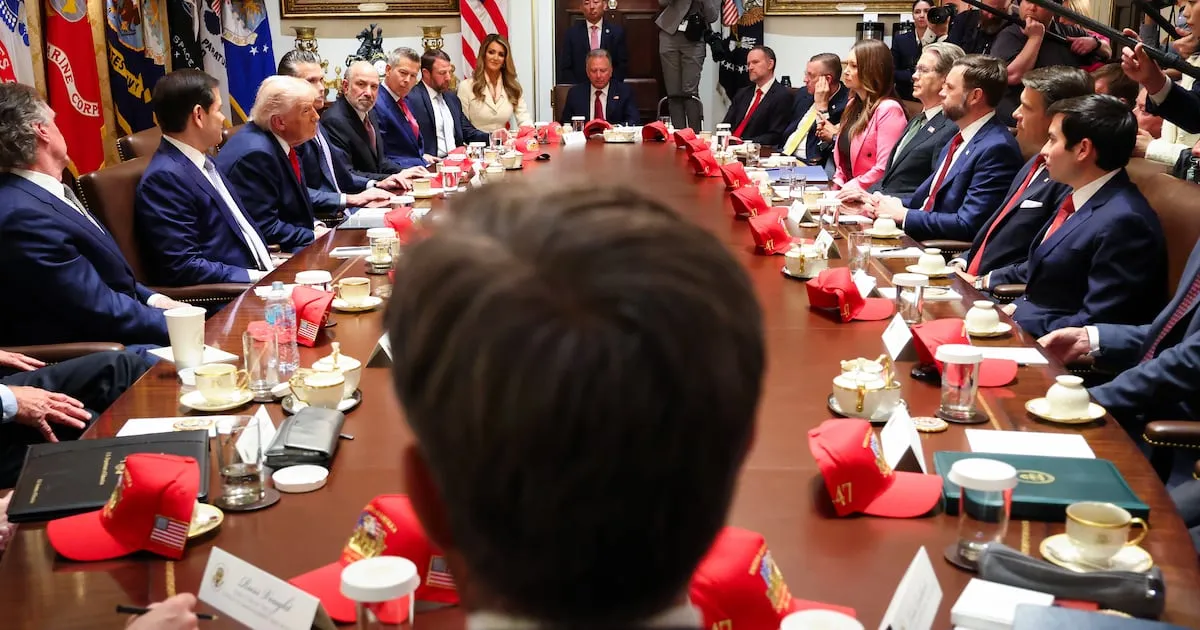
Treasury Secretary Scott Bessent was observed taking notes during a recent Cabinet meeting, with his jottings highlighting key themes of economic strategy and presidential rhetoric. The meeting, characterized by a high degree of political discourse, included President Donald Trump reportedly conflating Iran with Venezuela, making assertive statements about international relations, and promoting branded merchandise. Amidst this backdrop, Bessent's notes appear to focus on the administration's economic approach and its perceived resilience.
The notes themselves reveal a deliberate focus on economic terminology and strategic operations. Prominently featured was the term "Resilience," written at the top of a page and underlined, suggesting its importance as a core concept for the administration's economic messaging. This emphasis on resilience comes at a time when the White House is navigating complex economic challenges and seeking to project stability. Alongside "Resilience," Bessent's notes included the codename "Operation Economic Fury." This term directly references the administration's use of economic sanctions, particularly against Iran, aligning with the broader geopolitical context of "Operation Epic Fury." The inclusion of an upward arrow next to this phrase indicates a perceived positive trajectory or importance associated with these economic measures.
Economic Strategy and Sanctions Focus
'Operation Economic Fury' and Sanctions Efficacy
The specific mention of "Operation Economic Fury" underscores the strategic significance placed on economic sanctions as a tool of foreign policy. This operation, as detailed in Bessent's notes, appears to be a central pillar of the Treasury Department's efforts to exert pressure on targeted nations, notably Iran. The codename itself suggests an aggressive stance, aimed at achieving significant economic impact. Bessent's annotation of "Just in time. Just in case," coupled with a checkmark, points to a cautious yet decisive approach, emphasizing preparedness and timely execution of economic measures. This suggests a dual strategy of proactive engagement and contingency planning, designed to respond to evolving economic and geopolitical landscapes.
The deliberate use of "Economic Fury" as a codename for sanctions implies a calculated effort to frame these actions as potent and impactful. It suggests that the administration views sanctions not merely as a diplomatic tool but as an active instrument for achieving strategic objectives. The upward arrow next to the term further reinforces the idea that the Treasury Department anticipates or is actively pursuing positive outcomes through these economic sanctions. This focus on sanctions efficacy is a critical component of the broader economic policy, aiming to shape international behavior through financial leverage.
Resilience as a Core Economic Message
The repeated emphasis on "Resilience" in Secretary Bessent's notes suggests a deliberate communication strategy centered on the perceived strength and stability of the American economy under the current administration. This theme is likely intended to counter narratives of economic vulnerability and to highlight the administration's successes in maintaining economic stability amidst global uncertainties. The term "Resilience" implies an ability to withstand shocks and recover quickly, a message that the Treasury Department aims to project to domestic and international stakeholders.
This focus on resilience may also be a response to external warnings and analyses regarding potential economic crises. When questioned about such concerns, a spokesperson for the Treasury Department reiterated that the American economy has demonstrated resilience under President Trump's leadership, attributing this to his economic agenda. This suggests a concerted effort to link the concept of resilience directly to the administration's policies and their purported track record of success, framing economic stability as a direct outcome of Trump's economic initiatives.
Presidential Rhetoric and Merchandising Amidst Economic Discussions
Presidential Communications and Strategic Messaging
The context of Bessent's notes is set against a backdrop of distinct presidential communications during the Cabinet meeting. Reports indicate that President Trump engaged in a range of discourse, including apparent geographical misidentifications and strong statements regarding international allies. Furthermore, the promotion of "USA 250 Anniversary" caps, which reportedly featured an inaccurate number of stars on the flag, highlights a dual focus on both geopolitical and domestically-oriented messaging, including commercial endeavors.
The presence of these varied topics within a single meeting underscores the unique communication style and priorities of the administration. While economic strategy is a key focus, as evidenced by Bessent's notes, it coexists with strong political rhetoric and a distinct approach to branding and merchandise. This blend of high-level economic planning with more informal or attention-grabbing public engagements characterizes the administration's multifaceted approach to governance and public perception.
Treasury Secretary's Role and Alignment
Bessent's background as a former economic advisor, fundraiser, and donor for the Trump campaign positions him as a figure deeply aligned with the administration's political and economic objectives. His tendency to offer praise rather than criticism, as noted in qualitative analyses, suggests a strategic approach to his role, focusing on reinforcing the administration's message and bolstering support for its policies. His observed note-taking during the meeting can be interpreted as an effort to meticulously document and internalize the key directives and strategic priorities being discussed.
The secretary's role extends beyond internal strategy; it involves projecting a specific economic narrative. His emphasis on "Resilience" and "Prosperity," along with potentially "sow" (perhaps alluding to sowing seeds for future growth), indicates a forward-looking economic vision. This vision appears to be closely tied to the administration's broader agenda, aiming to foster a perception of robust economic health and strategic economic management. The meticulous nature of his notes suggests a commitment to executing and communicating this agenda effectively.