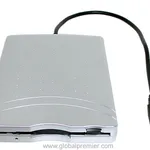
In an era dominated by solid-state drives and cloud storage, the resurgence or continued relevance of legacy storage media might seem counterintuitive. However, for professionals and enthusiasts working with older systems, archival purposes, or specific industrial equipment, the need for a reliable floppy disk drive persists. The NEC 1.44MB External USB Floppy Disk Drive addresses this niche requirement with a straightforward and universally compatible solution. Its plug-and-play functionality via USB makes it an accessible tool for bridging the gap between vintage data formats and modern computing environments.
This external drive offers a compact and portable way to read and write 1.44MB floppy disks, a standard that was once ubiquitous. It leverages the simplicity of USB connectivity, requiring no external power adapter and minimal setup on most operating systems, including Windows and macOS. While its storage capacity is minuscule by today's standards, its value lies in its specific function: accessing data that may exist nowhere else. This review will delve into the practical applications and technical merits of the NEC external floppy drive, analyzing its position in the current market for specialized hardware.
Technical Overview and Market Positioning
The NEC 1.44MB External USB Floppy Disk Drive is a testament to backward compatibility. Its core specification is the support for the 3.5-inch High Density (HD) floppy disk format, boasting a capacity of 1.44MB. The interface is standard USB Type-A, which is widely supported across a vast range of computers, both new and old. This eliminates the need for proprietary interfaces or internal drive bays, making it an ideal peripheral for laptops and desktops alike that lack built-in floppy drives. The drive operates as a standard Human Interface Device (HID), meaning it typically requires no special drivers for modern operating systems like Windows 10/11 or recent macOS versions, simplifying the user experience significantly.
In terms of market positioning, this drive serves a very specific, albeit crucial, segment. It is not a competitor to modern storage solutions but a dedicated tool for data recovery, software distribution on legacy media, or interfacing with industrial machinery that still relies on floppy disks for configuration or data logging. Its primary value proposition is its ability to read and write these specific legacy formats, enabling users to migrate data, verify old backups, or maintain critical systems. The NEC brand, known for its history in computing hardware, lends a degree of reliability to this specialized peripheral.