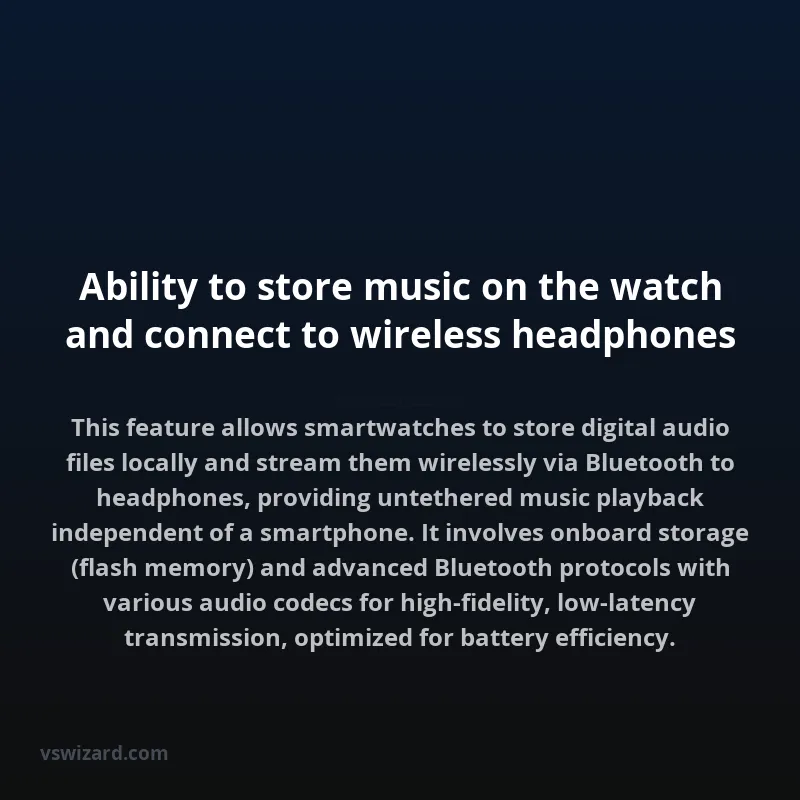
The integration of onboard digital audio storage and wireless audio transmission capabilities within wearable computing devices, specifically smartwatches, represents a significant advancement in personal, untethered audio consumption. This feature enables a user to store a discrete library of audio files, typically compressed digital formats such as MP3, AAC, or FLAC, directly onto the device's internal solid-state storage. The capacity for this storage is a critical parameter, often ranging from a few gigabytes to tens of gigabytes, directly impacting the quantity and quality of audio content that can be retained locally. Crucially, this local storage circumvents the reliance on a paired smartphone or an active internet connection for playback, offering a self-sufficient audio solution.
Complementing local storage is the seamless connectivity to wireless audio peripherals, predominantly Bluetooth Low Energy (BLE) headphones and earbuds. This wireless protocol facilitates a robust, low-latency audio stream from the smartwatch to the listening device, leveraging advanced codecs like aptX or LDAC for enhanced fidelity, depending on hardware support and device pairing. The power efficiency of BLE is paramount for wearable technology, ensuring extended playback times without significant battery drain on either the watch or the headphones. Implementation involves sophisticated firmware managing audio decoding, digital-to-analog conversion (DAC), Bluetooth stack operation, and power management to deliver a high-quality, reliable user experience for on-the-go audio playback.
Mechanism of Operation
Onboard Audio Storage
The storage mechanism relies on non-volatile memory technologies, typically NAND-based flash memory, integrated into the smartwatch's System-on-Chip (SoC) or as a separate component. This memory is partitioned to host the operating system, applications, user data, and the dedicated audio file library. Users typically manage this library through a companion mobile application or directly via the watch interface, employing drag-and-drop functionality or cloud synchronization services (e.g., Spotify Connect, Apple Music sync) that initially transfer licensed or owned audio files to the device's local storage. The file system architecture must be optimized for rapid read access to ensure smooth audio playback, even when background processes are active.
Wireless Audio Transmission (Bluetooth)
The transmission of audio data to wireless headphones is primarily facilitated by the Bluetooth standard, specifically profiles designed for audio streaming. The most common is the Advanced Audio Distribution Profile (A2DP), which supports stereo audio. A2DP mandates the use of audio codecs, which are algorithms for compressing and decompressing digital audio. Codecs like SBC (Subband Coding) are universally supported baseline. More advanced codecs, such as AAC (Advanced Audio Coding), aptX (and its variants like aptX HD, aptX Adaptive), and LDAC, are employed to achieve higher bitrates, reduced latency, and improved sound quality, provided both the source (smartwatch) and sink (headphones) support them. The Bluetooth Low Energy (BLE) implementation ensures minimal power consumption, extending battery life for both devices during extended listening sessions.
Bluetooth Standards and Profiles
- Bluetooth Core Specification: The foundational wireless standard, with versions (e.g., 4.0, 5.0, 5.2) dictating range, speed, and power efficiency.
- A2DP (Advanced Audio Distribution Profile): Enables stereo audio streaming.
- AVRCP (Audio/Video Remote Control Profile): Allows playback control (play, pause, skip) from the source device or headphones.
- HFP (Hands-Free Profile) / HSP (Headset Profile): Used for mono audio and voice communication, often less relevant for dedicated music playback but important for integrated calls.
Audio Processing Pipeline
The audio processing pipeline within the smartwatch involves several stages:
- File Decoding: The smartwatch's CPU or a dedicated digital signal processor (DSP) decodes the audio file format (e.g., MP3, AAC).
- Digital-to-Analog Conversion (DAC): The digital audio stream is converted into an analog signal suitable for transmission. High-fidelity DACs are crucial for audiophile-grade sound.
- Bluetooth Modulation: The analog audio signal is modulated onto the Bluetooth radio frequency for wireless transmission.
- Power Management: Sophisticated power management algorithms optimize the operation of the storage, CPU, DSP, and Bluetooth radio to maximize battery life.
Industry Standards and Formats
Audio File Formats
Commonly supported audio file formats include:
- MP3 (MPEG-1 Audio Layer III): Widely compatible, but can have lower fidelity at lower bitrates.
- AAC (Advanced Audio Coding): Offers better compression efficiency and quality than MP3 at equivalent bitrates. Standard for Apple devices.
- FLAC (Free Lossless Audio Codec): Lossless compression, preserving original audio quality but requiring more storage space and processing power.
- WAV (Waveform Audio File Format): Uncompressed, highest quality, but uses significant storage.
Audio Codecs (Bluetooth)
The choice of Bluetooth audio codec significantly impacts sound quality and latency:
- SBC (Subband Coding): Mandatory for A2DP, but offers the lowest quality and highest latency among common codecs.
- AAC (Advanced Audio Coding): Good quality, efficient, standard on iOS devices.
- aptX (Qualcomm): Offers improved quality over SBC, with variants like aptX HD for higher resolution audio and aptX Adaptive for dynamic bitrate adjustment.
- LDAC (Sony): High-resolution audio codec capable of transmitting audio at up to 990 kbps, offering near-CD quality.
Evolution and Implementation
Historical Context
Early portable music players, such as the iPod, established the concept of dedicated onboard music storage. The integration into smartwatches began as a secondary feature, often reliant on a paired smartphone. The development of lower-power, higher-capacity flash memory and more efficient Bluetooth chipsets, coupled with advancements in SoC capabilities, has enabled true standalone music playback on smartwatches. This evolution has been driven by consumer demand for convenience and a desire to reduce reliance on smartphones during activities like exercise.
Practical Implementation in Smartwatches
Smartwatch manufacturers implement this feature using various approaches:
- Hardware: Incorporation of sufficient flash storage (e.g., 8GB, 16GB, 32GB), dedicated audio hardware or DSPs, and Bluetooth radios.
- Software: Operating system support for audio file management, decoding, and Bluetooth audio streaming. Companion apps on smartphones facilitate library management, playlist creation, and offline music synchronization from streaming services (e.g., Spotify, Apple Music, Deezer).
- User Interface: Intuitive interfaces for browsing local music libraries, controlling playback, and pairing Bluetooth headphones.
User Scenarios
- Fitness and Exercise: Users can leave their smartphones at home and still enjoy music or podcasts during workouts.
- Commuting: Seamless transition to listening without managing a separate device.
- Travel: Access to downloaded music offline without data charges.
Performance Metrics and Considerations
Storage Capacity vs. Audio Quality
There is a direct trade-off between storage capacity, audio file format, and playback duration. Lossless formats like FLAC consume substantially more space than compressed formats like MP3 or AAC. For example, 1GB can store approximately 200-300 MP3 tracks (at 256kbps) but only 50-100 FLAC tracks (at ~1000kbps). Manufacturers must balance the available storage with the target audience's needs and the device's overall cost and form factor.
Battery Consumption
Onboard music playback, especially with Bluetooth active, is a significant drain on smartwatch batteries. Optimized power management is critical. Factors influencing battery life include:
- Screen brightness and usage
- Bluetooth codec used (SBC generally consumes less power than aptX or LDAC)
- Audio file format and decoding complexity
- Volume level
- Simultaneous background processes
Latency and Synchronization
While Bluetooth audio latency has improved, a slight delay between the source and headphones is inherent. This is generally not noticeable for music but can become apparent in applications requiring tight audio-video synchronization or real-time gaming. Advanced codecs and chipsets aim to minimize this.
Connectivity and Pairing Stability
The reliability of the Bluetooth connection is crucial for an uninterrupted listening experience. Factors affecting stability include:
- Distance between the watch and headphones
- Environmental interference (e.g., other wireless devices, physical obstructions)
- Bluetooth version and antenna design
- Quality of the Bluetooth implementation in both devices
Comparison Table: Audio Features in Smartwatches
| Feature | Premium Smartwatches | Mid-Range Smartwatches | Budget Smartwatches |
|---|---|---|---|
| Onboard Music Storage | Typically 8GB - 32GB+ (e.g., Apple Watch Series, Samsung Galaxy Watch) | Typically 4GB - 8GB (e.g., some Garmin, Fitbit models) | Rarely, or 1GB - 4GB for basic MP3s (e.g., older models, specific fitness trackers) |
| Offline Streaming Sync | Extensive support (Spotify, Apple Music, Deezer, YouTube Music) | Limited or service-specific support | Generally not supported |
| Bluetooth Audio Codec Support | SBC, AAC, aptX, aptX HD, LDAC (varies by manufacturer/SoC) | SBC, AAC (common) | SBC (standard) |
| Battery Impact (Estimated playback hours with BT headphones) | 5 - 10 hours (continuous playback) | 3 - 6 hours (continuous playback) | Varies significantly, often much lower or not designed for prolonged use |
| Form Factor Considerations | Designed for high-capacity storage and advanced BT | Balanced capacity and battery life | Prioritizes core watch functions over extensive audio |
Future Outlook
The trend is towards increased storage capacities, enhanced audio fidelity through support for higher-resolution codecs, and more seamless integration with cloud-based music services. Future developments may include spatial audio support, improved active noise cancellation management through watch integration, and even more efficient power management to extend playback times. The 'ability to store music on the watch and connect to wireless headphones' is evolving from a premium feature to a standard expectation in the competitive wearable technology market, underscoring its value proposition for user autonomy and enriched personal audio experiences.