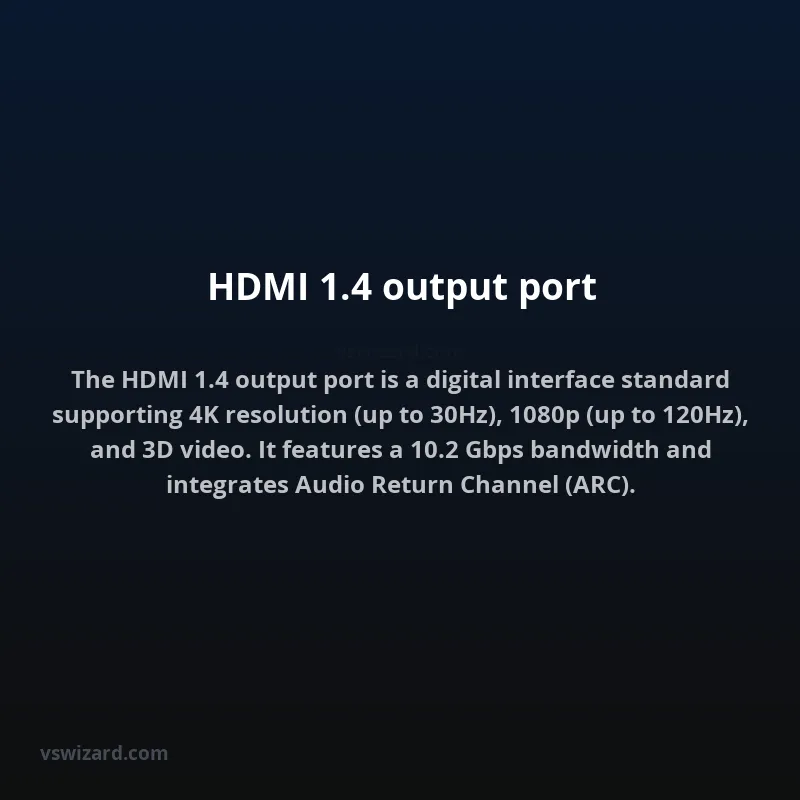
An HDMI 1.4 output port represents a specific implementation of the High-Definition Multimedia Interface standard, version 1.4, designed for transmitting digital audio and video signals between electronic devices over a single cable. This iteration introduced significant enhancements over its predecessors, notably support for higher resolutions and refresh rates, including 4K (4096x2160) at 24/30Hz, 1080p at 120Hz, and Stereoscopic 3D, making it a pivotal standard for the emerging home theater and gaming ecosystems of its time. Furthermore, HDMI 1.4 integrated the Audio Return Channel (ARC), simplifying audio connections by allowing a display to send audio data upstream to an AV receiver or soundbar without a separate audio cable.
The physical interface of an HDMI 1.4 output port utilizes a standardized Type A connector, comprising 19 pins that carry differential pairs for TMDS (Transition Minimized Differential Signaling) data, clock signals, DDC (Display Data Channel) for EDID (Extended Display Identification Data) and HDCP (High-bandwidth Digital Content Protection) communication, and power supply lines. The electrical characteristics and signal integrity requirements for HDMI 1.4 are defined by the HDMI Licensing Administrator, Inc., ensuring interoperability and reliable data transmission up to its specified bandwidth limits of 10.2 Gbps, which accommodates the increased data rates required for 4K resolutions and high frame rates. Proper impedance matching and shielding within the cable and port connectors are critical to mitigate signal degradation and electromagnetic interference.
Core Functionality and Standards
The primary function of an HDMI 1.4 output port is to facilitate the seamless transmission of uncompressed digital video and audio data streams. This is achieved through the TMDS protocol, which encodes the data into packets that are transmitted differentially to minimize noise susceptibility. The 1.4 specification standardized the capabilities for 4K resolution (often referred to as 4K UHD in consumer electronics, specifically 3840x2160) and extended color spaces like xvYCC, enhancing color depth and fidelity. It also defined protocols for stereoscopic 3D, mandating specific frame packing and display synchronization methods to achieve immersive visual experiences.
Data Transmission and Bandwidth
HDMI 1.4 operates with a maximum video bandwidth of 10.2 Gbps. This bandwidth is allocated across three TMDS data channels, each capable of transmitting data at up to 3.4 Gbps, along with a clock channel. The effective data rate for video and audio is approximately 8.16 Gbps after accounting for encoding overhead (8b/10b encoding). This capacity is sufficient for transmitting 1080p signals at refresh rates up to 120Hz, or 4K signals at 30Hz. Advanced features like ARC, Ethernet Channel (HEC), and support for higher color depths (e.g., 30-bit and 36-bit Deep Color) also leverage this bandwidth, though specific configurations may impact maximum achievable resolutions and frame rates.
Audio Return Channel (ARC) and Other Features
The inclusion of ARC in HDMI 1.4 was a significant user-experience enhancement. It allows audio signals from the display's internal tuner or smart applications to be sent back to an external audio system (like a soundbar or AV receiver) via the same HDMI cable that is delivering video to the display. This eliminates the need for a separate optical or coaxial audio cable. HDMI 1.4 also introduced the HDMI Ethernet Channel (HEC), which enables devices to share an internet connection through the HDMI cable, although this feature saw limited adoption. Additionally, support for Consumer Electronics Control (CEC) allows for simplified operation of multiple connected devices using a single remote control.
Technical Specifications Table
| Feature | Specification (HDMI 1.4) |
|---|---|
| Maximum Bandwidth | 10.2 Gbps |
| Maximum Video Resolution | 4096x2160 @ 24/30Hz, 3840x2160 @ 24/30Hz |
| Maximum Refresh Rate (1080p) | 120Hz |
| 3D Support | Yes (Stereoscopic) |
| Audio Return Channel (ARC) | Yes |
| HDMI Ethernet Channel (HEC) | Yes |
| Deep Color Support | Up to 30-bit (10 bits per color channel) |
| Color Space Support | xvYCC |
| Connector Type | Type A |
| TMDS Data Rate per Channel | 3.4 Gbps |
Evolution and Impact
Predecessors and Successors
HDMI 1.4 built upon the foundations laid by earlier HDMI versions (1.0 through 1.3). These prior versions progressively increased bandwidth, introduced Deep Color, and improved audio capabilities. HDMI 1.4's key differentiator was its substantial leap in resolution support (to 4K) and the integration of ARC. Its successors, such as HDMI 2.0, 2.0a, 2.0b, and the more recent HDMI 2.1, have further increased bandwidth dramatically (to 18 Gbps and 48 Gbps respectively), enabling higher resolutions (4K@60Hz and beyond), higher refresh rates (up to 120Hz or more at 4K), expanded color gamuts (HDR support), and advanced features like Dynamic HDR and Variable Refresh Rate (VRR). The 1.4 standard remains relevant for backward compatibility and for devices that do not require the extreme bandwidth of newer specifications.
Industry Adoption and Applications
The HDMI 1.4 standard saw widespread adoption in televisions, Blu-ray players, gaming consoles (e.g., PlayStation 3, Xbox 360 in later models, and early models of PlayStation 4 and Xbox One), set-top boxes, AV receivers, and computer graphics cards. Its ability to support 4K resolutions, albeit at lower frame rates than current standards, was instrumental in driving the market transition towards ultra-high-definition displays. The inclusion of 3D support also aligned with a brief but notable consumer electronics trend. ARC significantly simplified home theater setups, reducing cable clutter and enhancing the user experience for audio output from smart TVs.
Implementation and Interoperability Considerations
Signal Integrity and Cable Requirements
Achieving the full potential of an HDMI 1.4 output port necessitates cables that meet its specifications for bandwidth and signal integrity. The 10.2 Gbps bandwidth requires cables with precise construction, including proper impedance control (100 ohms nominal), effective shielding to prevent electromagnetic interference (EMI), and robust connector termination. Cables are often categorized as 'Standard Speed' for up to 5 Gbps, 'High Speed' for up to 10.2 Gbps (required for HDMI 1.4 features like 4K@30Hz), and 'Premium High Speed' or 'Ultra High Speed' for newer standards. Using uncertified or low-quality cables can lead to intermittent signal loss, visual artifacts, or complete failure to establish a connection, especially at higher resolutions or longer distances.
Device Compatibility and HDCP
Ensuring interoperability between an HDMI 1.4 output port and a connected display or receiver involves verifying compatibility with the required resolution, refresh rate, and audio formats. The implementation of High-bandwidth Digital Content Protection (HDCP) is a crucial aspect. HDMI 1.4 typically supports HDCP 1.4. If either the source device (with the output port) or the display device does not support the same HDCP version or is not properly authenticated, content may be blocked, or the resolution/refresh rate may be downgraded to prevent piracy. This handshake protocol is managed via the DDC channel and is fundamental to protected content playback.
Performance Metrics and Limitations
Resolution, Refresh Rate, and Latency
An HDMI 1.4 output port can deliver resolutions up to 4K (3840x2160 pixels) at 30 frames per second (fps) or 1080p at 120fps. While this was groundbreaking for its time, modern applications, particularly high-fidelity gaming and professional video editing, often demand higher frame rates at 4K or higher resolutions. Signal latency is generally low for HDMI, typically measured in single milliseconds, making it suitable for most consumer applications. However, the specific implementation by the source device and the display can introduce additional processing delays. For competitive gaming, the refresh rate limitations and potential input lag introduced by display processing are more significant factors than the inherent latency of the HDMI 1.4 standard itself.
Limitations Compared to Newer Standards
The primary limitations of HDMI 1.4 stem from its bandwidth ceiling of 10.2 Gbps. This restricts its ability to support newer video formats like High Dynamic Range (HDR) which require significantly more bandwidth, 4K resolution at 60fps or higher, 8K resolutions, or advanced gaming features like Variable Refresh Rate (VRR). While it was a significant step forward for 4K, it does not provide the bandwidth necessary for the full 4K 60Hz experience, nor does it support the expanded color volumes and contrast ratios of modern HDR displays. Devices relying solely on HDMI 1.4 outputs may not be able to take full advantage of the capabilities of the latest high-end televisions and monitors.
Conclusion
The HDMI 1.4 output port stands as a critical milestone in the digital connectivity landscape, fundamentally enabling the widespread adoption of 4K resolution and 3D video in consumer electronics. Its integration of features like ARC streamlined home entertainment systems, demonstrating a forward-thinking approach to user convenience and performance. While superseded by newer, higher-bandwidth HDMI standards that accommodate the demands of HDR, higher refresh rates, and greater resolutions, HDMI 1.4 laid essential groundwork, ensuring backward compatibility and serving as a foundational technology for a generation of digital media devices.