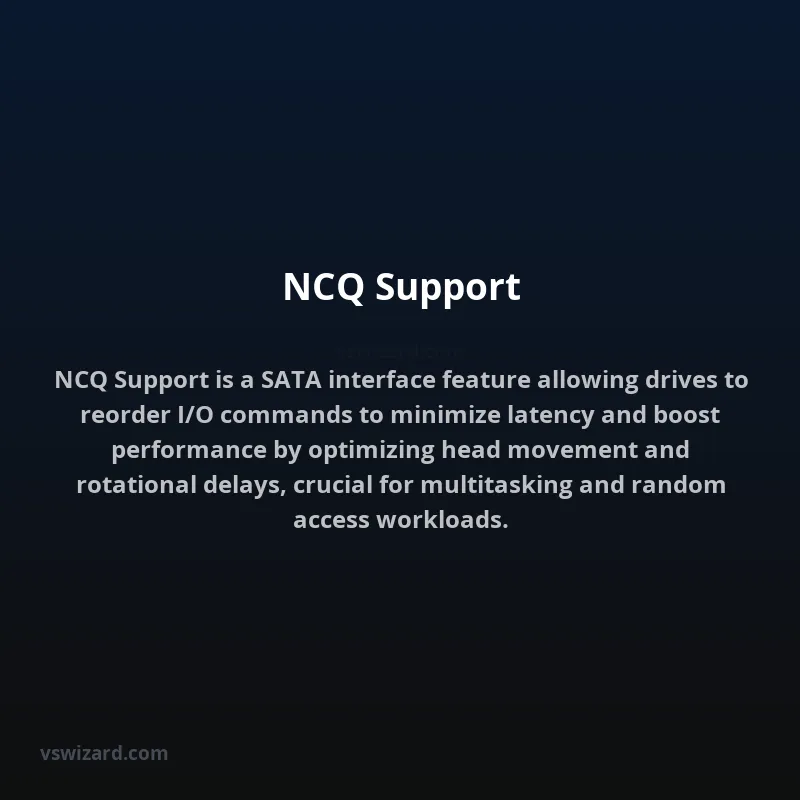
Native Command Queuing (NCQ) Support refers to a specific feature implemented in Serial ATA (SATA) hard disk drives (HDDs) and solid-state drives (SSDs) that optimizes the execution of read and write commands. This functionality allows the drive to internally reorder and prioritize multiple I/O (Input/Output) requests it receives from the host system. Instead of processing commands strictly in the order they arrive, an NCQ-enabled drive can rearrange them to minimize seek times and rotational latency. This is achieved by identifying commands that target adjacent or overlapping sectors on the disk platter, thereby reducing the physical head movement and platter rotation required to service all pending requests efficiently.
The core benefit of NCQ Support lies in its ability to enhance the performance of storage devices, particularly in scenarios involving concurrent or fragmented I/O operations. By intelligently queuing and reordering commands, NCQ can significantly improve the overall throughput and reduce the average latency experienced by the operating system and applications. This is especially pronounced in multitasking environments or when running applications that generate a high volume of random read/write requests, such as database servers, virtualization platforms, and intensive data processing tasks. The underlying mechanism involves a queue depth defined by the ATA standard, allowing for a specified number of commands to be held and optimized by the drive's firmware.
Mechanism of Action
NCQ Support operates by enabling the storage device controller to maintain a queue of pending I/O commands from the host. The ATA specification (specifically, the ATA/ATAPI Command Set) defines the mechanisms for this. When the host system issues multiple read or write commands, the NCQ-enabled drive's firmware analyzes the command queue. It then reorders these commands based on geometric proximity of the data blocks on the disk platters (for HDDs) or other optimization factors. For HDDs, this involves minimizing the physical movement of the read/write heads across the platters and reducing the rotational delay required to position the correct sector under the heads. For SSDs, while physical head movement is not a factor, NCQ can still optimize command scheduling to improve efficiency, potentially by consolidating operations to specific NAND flash blocks or managing internal garbage collection processes more effectively.
Command Reordering Algorithms
The sophistication of the command reordering algorithms employed by different drive manufacturers can vary. Common strategies include:
- Seek Time Optimization: Prioritizing commands that require the least head movement.
- Rotational Latency Reduction: Scheduling commands to minimize the time spent waiting for the correct sector to rotate under the head.
- Address Proximity: Grouping commands that target data located close to each other on the disk.
- Queue Depth Management: The ATA standard defines a maximum queue depth, typically up to 32 commands. Higher queue depths can theoretically allow for more effective reordering but also increase the processing overhead on the drive controller.
Industry Standards and Evolution
NCQ Support is a feature defined within the Serial ATA (SATA) interface specifications. The functionality was introduced as part of the ATA/ATAPI-6 standard (specifically revision 4b) and further refined in subsequent revisions of the SATA specifications. The primary goal was to bridge the performance gap between the increasingly faster interface speeds of SATA and the mechanical or internal limitations of storage devices, particularly HDDs. The evolution saw improvements in the drive firmware's ability to interpret and optimize command queues, leading to tangible performance gains in varied workloads.
| SATA Specification | NCQ Feature Introduction/Refinement |
|---|---|
| SATA/150 (Gen 1) | Initial introduction of NCQ capabilities. |
| SATA/300 (Gen 2) | Refinements in command queue management and increased queue depth support. |
| SATA/600 (Gen 3) | Continued optimization of NCQ algorithms for higher interface speeds. |
Comparison with TRIM (for SSDs)
While NCQ primarily focuses on command ordering for efficiency, it is important to distinguish it from the TRIM command in SSDs. TRIM allows the operating system to inform the SSD which data blocks are no longer in use. This helps the SSD's garbage collection process by identifying pages that can be erased proactively, preventing write amplification and maintaining performance over time. NCQ and TRIM are complementary technologies, with NCQ optimizing the execution of active I/O requests and TRIM optimizing the background management of unused space.
Practical Implementation and Performance Metrics
NCQ Support is typically enabled by default in modern operating systems and storage controllers. For HDDs, the impact of NCQ is most noticeable in random I/O workloads where the drive has to perform numerous small, non-sequential accesses. Metrics commonly used to evaluate NCQ performance include IOPS (Input/Output Operations Per Second), average seek time, and average latency.
Impact on Workloads
- Server Environments: Databases and virtual machines benefit significantly due to high concurrency.
- Desktop Usage: Multitasking, large file transfers, and application loading can see minor to moderate improvements.
- Sequential Access: Performance gains are generally minimal for purely sequential read/write operations as there is less scope for reordering.
Configuration and Troubleshooting
In most cases, no manual configuration is required. However, older operating systems or specific RAID controller configurations might require drivers or firmware updates to properly support and leverage NCQ. Performance discrepancies can sometimes arise if the storage driver or controller firmware incorrectly implements or disables NCQ functionality.
Alternatives and Future Outlook
For HDDs, NCQ was a critical technology to mitigate mechanical limitations. With the widespread adoption of SSDs, the relevance of NCQ's original intent (seek time and rotational latency reduction) diminishes. However, NCQ remains a fundamental part of the SATA interface for SSDs, contributing to command scheduling efficiency within the drive. Newer interfaces like NVMe (Non-Volatile Memory Express), designed specifically for flash storage, incorporate even more advanced command queueing mechanisms with significantly higher queue depths and parallelization capabilities, making them inherently more performant than SATA NCQ.
The technical value of NCQ Support lies in its ability to dynamically optimize I/O operations, enhancing storage device responsiveness within the constraints of the SATA interface. While NVMe has largely superseded SATA for high-performance applications, NCQ remains an integral feature for SATA-based storage, particularly for cost-effective HDDs and many mainstream SATA SSDs, ensuring efficient data handling in a wide range of computing scenarios.