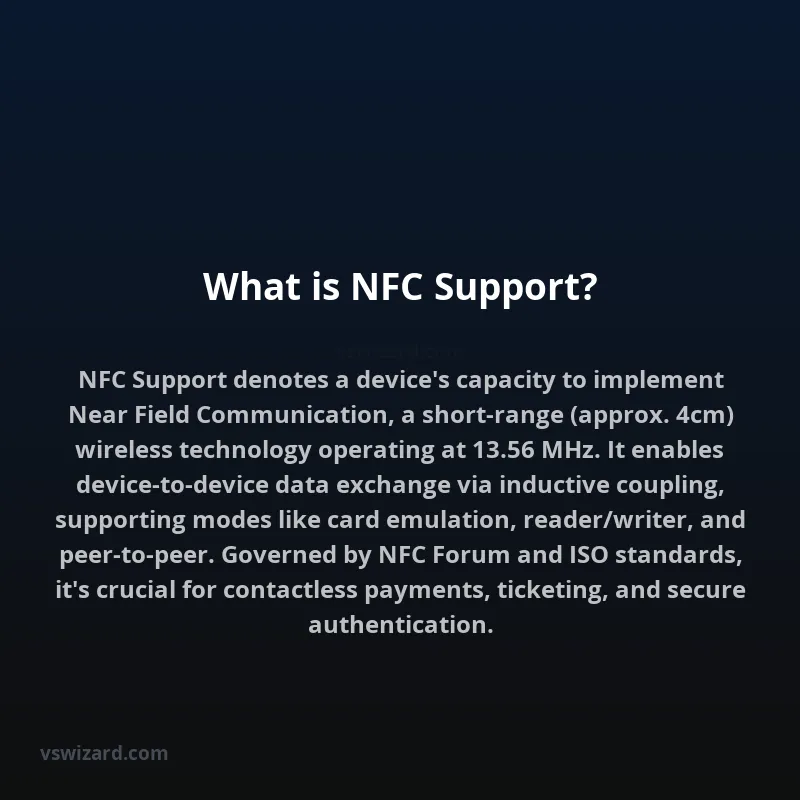
NFC Support refers to the capability of a device, system, or application to implement and utilize Near Field Communication (NFC) protocols. NFC is a set of short-range wireless technologies, typically operating at 13.56 MHz, that enables two electronic devices to communicate by bringing them within a close proximity of about 4 centimeters (1.6 inches) or less. This communication is facilitated through inductive coupling between two loop antennas when they are brought near each other, enabling data exchange without direct physical connection. The functionality encompasses the hardware components, such as the NFC controller and antenna, as well as the software stack and application layer protocols necessary for establishing and managing NFC connections, including peer-to-peer data transfer, card emulation, and reader/writer modes.
Implementing NFC Support involves adherence to a suite of international standards, primarily defined by the NFC Forum, ISO/IEC, and ETSI. These standards dictate the physical layer specifications, protocol formats, data exchange mechanisms, and security considerations crucial for interoperability across diverse devices and platforms. For a device to offer NFC Support, it must possess an integrated NFC chip capable of initiating or responding to NFC field requests, alongside software drivers and APIs that expose NFC capabilities to the operating system and user-facing applications. This allows for a spectrum of use cases, ranging from contactless payments and digital identity verification to data sharing and device pairing, all predicated on the secure and efficient short-range wireless communication enabled by NFC Support.
Mechanism of Action
NFC operates based on the principle of electromagnetic induction, a phenomenon described by Faraday's law of induction. An active NFC device (initiator) generates a radio frequency (RF) field. When a passive NFC device (target) enters this field, it becomes powered through inductive coupling, allowing it to communicate with the initiator. Alternatively, two active devices can communicate by generating their own RF fields and modulating them to exchange data. The data transfer rates are typically low, ranging from 106, 212, to 424 kilobits per second (kbps), reflecting the technology's design for proximity-based, low-volume data exchanges rather than high-bandwidth streaming.
Communication Modes
- Card Emulation Mode: The NFC device emulates a contactless smart card, enabling it to act as a payment card, access card, or transit pass.
- Reader/Writer Mode: The NFC device acts as a reader, interrogating and exchanging data with NFC tags or smart posters.
- Peer-to-Peer Mode: Two NFC-enabled devices can establish a bidirectional communication link to exchange data, such as contact information or Wi-Fi credentials.
Industry Standards and Specifications
NFC Support is governed by several key standards bodies to ensure interoperability and security. The NFC Forum is the primary organization that defines NFC specifications, including the NFC Forum Technical Specifications, which cover the physical characteristics, RF interface, protocol stack, and data objects for NFC devices. These specifications are built upon and interoperate with existing standards from organizations like ISO/IEC (e.g., ISO/IEC 14443 for proximity cards and 15693 for vicinity cards) and ETSI. The NFC Forum also defines certification programs to ensure devices meet these technical requirements.
Key Standards and Specifications
- NFC Forum Specifications: Cover the entire NFC stack, from the RF interface to the application layer.
- ISO/IEC 14443: Defines the standard for contactless proximity cards (Type A, B, F, V).
- ISO/IEC 15693: Defines the standard for contactless vicinity cards.
- ECMA-340 and ECMA-352: Standards related to NFC wireless communication.
Evolution and Development
The evolution of NFC Support traces back to research in the late 1980s and early 1990s, with commercial implementations emerging in the early 2000s. Early applications focused on access control and payment systems. The standardization efforts by the NFC Forum, established in 2004, were pivotal in driving broader adoption. The integration of NFC controllers into mobile devices, notably smartphones, starting around 2010, significantly expanded its consumer-facing applications, leading to widespread use in mobile payments and ticketing. Ongoing development focuses on enhancing security, increasing read range (within NFC constraints), and integrating NFC with other wireless technologies like Bluetooth and Wi-Fi for seamless device interaction.
Practical Implementation and Architecture
Implementing NFC Support in a device requires several hardware and software components. At the hardware level, this includes an NFC controller IC (e.g., NXP PN7150, STMicroelectronics ST25R3916) and an antenna. The NFC controller manages the RF communication, protocol handling, and data buffering. Software implementation involves device drivers that interface the NFC controller with the host operating system (e.g., Android, iOS, embedded Linux). The operating system then exposes NFC capabilities through APIs (e.g., Android's `NfcAdapter`, iOS's Core NFC framework) that application developers can utilize. These APIs abstract the underlying complexity, allowing applications to detect NFC tags, initiate read/write operations, handle tag discovery, and implement payment or other service functionalities.
Hardware Components
- NFC Controller: The central chip managing RF signals, modulation/demodulation, and protocol execution.
- Antenna: A tuned loop antenna designed for 13.56 MHz operation, critical for achieving the required inductive coupling.
- Host Microcontroller/SoC: The main processing unit of the device that communicates with the NFC controller.
Software Stack
- Firmware: Embedded software on the NFC controller.
- Device Drivers: Interface between hardware and the OS.
- NFC Service/Daemon: Background process managing NFC operations on the OS level.
- Application Programming Interfaces (APIs): Allow applications to access NFC functionalities.
Performance Metrics and Considerations
Key performance metrics for NFC Support include read/write speed, range, power consumption, and latency. Read/write speeds are relatively low (up to 424 kbps) due to the underlying technology and standards. The operational range is critically short, typically up to 4 cm, which is a deliberate design choice for security and to prevent accidental activation. Power consumption varies depending on the mode; active devices consume more power than passive tags which are powered by the initiator's field. Latency is also a critical factor, particularly for applications like contactless payments where rapid transaction times are essential.
Applications of NFC Support
NFC Support enables a wide array of applications across various sectors. In consumer electronics, it facilitates contactless payments (e.g., using a smartphone at a payment terminal), digital ticketing for public transport, access control to secure areas, and pairing devices like headphones via simple tap. In the industrial sector, NFC tags can be used for asset tracking, inventory management, and maintenance logging. Healthcare applications include patient identification and secure access to medical records. Retail benefits from NFC for product information display, loyalty programs, and frictionless checkout experiences.
Pros and Cons
Pros
- Security: The short-range requirement enhances security by minimizing the risk of remote interception.
- Convenience: Enables quick and easy interactions with a simple tap or proximity.
- Low Power Consumption: Passive tags require no internal power source.
- Versatility: Supports multiple modes (card emulation, reader/writer, peer-to-peer).
- Interoperability: Standardized protocols ensure compatibility across devices from different manufacturers.
Cons
- Short Range: Limited operational distance requires close proximity, which can be a limitation in some scenarios.
- Low Data Transfer Rate: Not suitable for large data transfers.
- Power Requirements for Active Devices: Active NFC devices (initiators) require a power source.
- Potential for Interference: Strong electromagnetic fields can sometimes interfere with NFC communication.
Alternatives to NFC
While NFC is dominant in its specific use cases, several alternative technologies exist for wireless communication, each with different characteristics and applications. Bluetooth Low Energy (BLE) offers a longer range and higher data rates, suitable for persistent connections and larger data transfers, but typically requires explicit pairing. Radio-Frequency Identification (RFID) systems, particularly higher-frequency variants, share similarities with NFC but often lack the standardized communication protocols for device-to-device interaction and peer-to-peer modes found in NFC. Quick Response (QR) codes provide a visual, non-wireless alternative for information exchange and initiating actions, but require a camera and optical scanning, and are susceptible to damage or obstruction. Wi-Fi Direct enables devices to connect directly without a central access point, offering higher bandwidth and longer range than NFC, but generally consumes more power and has a more complex connection setup.
Future Outlook
The future of NFC Support is intertwined with the continued proliferation of connected devices and the expansion of the Internet of Things (IoT). Advancements in miniaturization and power efficiency will likely lead to broader integration into a wider array of devices, including wearables, sensors, and embedded systems. Enhanced security protocols and the development of new applications, particularly in areas like digital identity, secure authentication, and personalized user experiences, will drive further innovation. As smart cities and connected environments evolve, NFC Support will remain a foundational technology for seamless, secure, and intuitive interactions within close proximity, complementing longer-range wireless technologies.
| Specification | Value | Notes |
|---|---|---|
| Frequency | 13.56 MHz | Standard operating frequency |
| Maximum Range | Approx. 4 cm (1.6 inches) | Dependent on antenna design and power levels |
| Data Transfer Rates | 106, 212, 424 kbps | Standardized rates |
| Protocols Supported | NFC Forum, ISO/IEC 14443, ISO/IEC 15693 | Various standards for different applications |
| Power Source for Tags | Inductive Coupling / Battery-powered | Passive tags are powered by the field; active devices require power |
| Security Features | Short range, encryption protocols (e.g., AES) | Proximity limits interception risk |