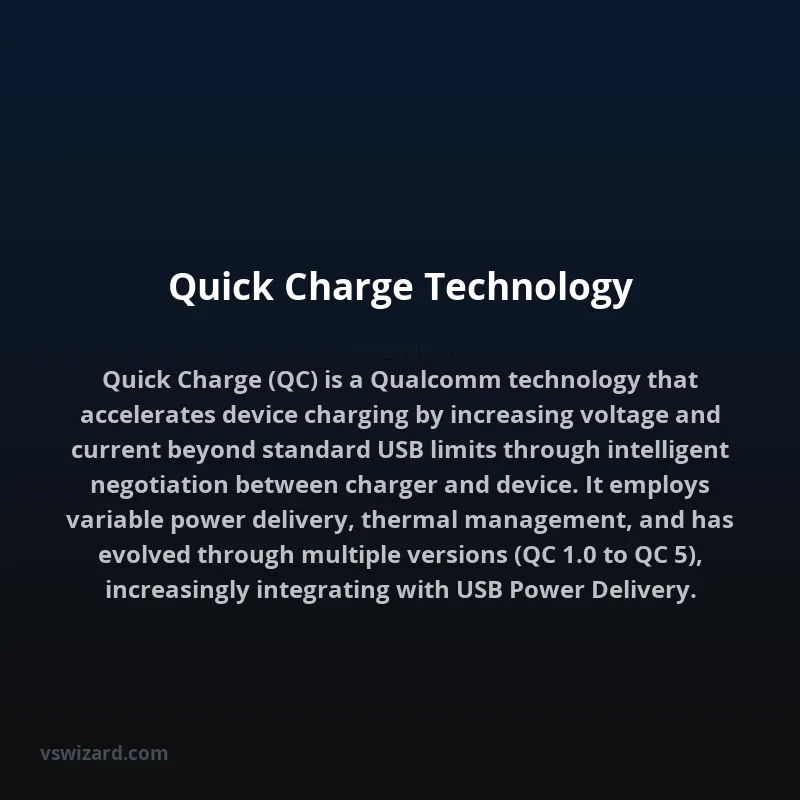
Quick Charge (QC) technology refers to a suite of proprietary charging protocols developed by Qualcomm, designed to significantly reduce the time required to charge battery-powered electronic devices, primarily smartphones and tablets. At its core, QC technology operates by increasing the voltage and/or current delivered to a device’s battery beyond the standard USB power delivery specifications (typically 5V at 0.5A to 2A). This is achieved through intelligent communication between the charging adapter (power source) and the mobile device (load), allowing them to negotiate optimal charging parameters. The primary objective is to deliver higher power levels, thereby accelerating the rate of energy transfer into the battery, while simultaneously managing thermal dissipation and battery health to prevent degradation.
The fundamental principle behind Quick Charge technology involves dynamic voltage and current adjustment. Unlike conventional charging, which adheres to fixed voltage and current outputs, QC enables bidirectional communication protocols. This allows the charger to sense the device's charging requirements and the battery's state of charge. Based on this information, the charger can rapidly adjust its output voltage and current within predefined limits. Higher voltages are often employed, particularly during the constant current (CC) phase of battery charging, to overcome internal battery resistance and deliver more power efficiently. Conversely, as the battery approaches full charge (constant voltage or CV phase), the system intelligently reduces the power delivery to ensure safety and prolong battery lifespan. This adaptive power management is crucial for balancing charging speed with the thermal and electrochemical stresses placed upon the battery.
Mechanism of Action
Power Delivery Negotiation
Quick Charge relies on a handshake protocol between the charging adapter and the device. Initially, the device requests higher power. The charger, if QC-compatible, responds by enabling higher voltage and/or current outputs. This negotiation typically occurs over the data pins of the USB connector (D+ and D- lines) using specific voltage signaling or digital communication protocols, depending on the QC version.
Variable Voltage and Current
The key to accelerated charging lies in the ability to exceed standard USB power levels. Quick Charge versions support a range of output voltages, often stepping up from a standard 5V. For instance, QC 2.0 and 3.0 can support voltages like 9V, 12V, and even 15V or 20V in some profiles, while dynamically adjusting current. QC 4.0 and later versions are designed to be backward compatible with USB Power Delivery (USB PD), leveraging its Advanced Authentication (AA) and Programmable Power Supply (PPS) features for more granular control.
Thermal Management
Delivering higher power generates more heat. Quick Charge implementations incorporate thermal monitoring and throttling mechanisms. If the device or charger detects excessive temperatures, the charging power is automatically reduced to prevent damage to the battery or internal components. This is a critical safety feature that balances speed with longevity.
Industry Standards and Evolution
Quick Charge Versions
Qualcomm has released multiple generations of Quick Charge technology, each introducing improvements in speed, efficiency, and compatibility:
- Quick Charge 1.0: The initial iteration, offering marginal improvements over standard USB charging.
- Quick Charge 2.0: Introduced significantly higher voltages (9V, 12V, 15V, 20V) at up to 2A, doubling charging speeds for many devices.
- Quick Charge 3.0: Focused on granular control by allowing devices to request voltage in increments as small as 0.2V, optimizing charging efficiency and reducing heat. It also introduced Intelligent Negotiation for Optimum Voltage (INOV) technology.
- Quick Charge 4/4+: Designed for greater compatibility, aligning with the USB Power Delivery (USB PD) standard. It supports higher power outputs (up to 100W with USB PD) and features enhanced thermal management and safety protocols. QC 4+ is an optimized version with dual-circuit design for lower temperatures.
- Quick Charge 5: A significant leap, supporting charging speeds of up to 100W, capable of charging a 4500mAh battery from 0% to 50% in under 5 minutes. It leverages USB PD with PPS and offers advanced power, thermal, and safety management features.
Relationship with USB Power Delivery (USB PD)
With the advent of Quick Charge 4, Qualcomm began integrating its technology with the universal USB PD standard. This allows devices and chargers to support both QC and USB PD protocols, offering broader compatibility. USB PD, managed by the USB Implementers Forum (USB-IF), is an open standard that enables higher power transfer and more dynamic voltage and current negotiation, often using the USB Type-C connector.
Practical Implementation
Hardware Requirements
For Quick Charge functionality, both the charging adapter (wall charger, car charger, power bank) and the device being charged (smartphone, tablet, laptop) must be Quick Charge-compatible. This involves specific integrated circuits (ICs) within both the charger and the device that can communicate and manage the power negotiation process.
Connector Types
While early versions of Quick Charge primarily utilized the standard USB Type-A connector, newer versions (QC 4 and later) are predominantly associated with the USB Type-C connector due to its higher power delivery capabilities and support for the USB PD standard.
Charging Performance Metrics
The effectiveness of Quick Charge technology is measured by metrics such as:
- Charging Time: The duration required to reach a specific battery percentage (e.g., 0-80%) or a full charge.
- Power Output (Watts): The maximum power (Voltage x Current) that can be delivered.
- Efficiency: The ratio of power delivered to the battery versus power drawn from the source, indicating energy loss as heat.
- Temperature Rise: The increase in temperature of the device and charger during the charging cycle.
| Quick Charge Version | Max Voltage (V) | Max Current (A) | Max Power (W) | Key Feature | Connector Type |
|---|---|---|---|---|---|
| QC 1.0 | 5 | 2 | 10 | Basic faster charging | USB-A |
| QC 2.0 | 20 | 2 | Up to 30 | Higher fixed voltages | USB-A |
| QC 3.0 | 12 | 3 | Up to 36 | INOV - variable voltage in 0.2V increments | USB-A |
| QC 4/4+ | 20 | 5 | Up to 100 | USB PD compatibility, PPS | USB-C |
| QC 5 | 20 | 5 | Up to 100 | Advanced power management, ultra-fast charging | USB-C |
Advantages and Disadvantages
Advantages
- Reduced Charging Time: The primary benefit is significantly faster recharging of devices.
- Convenience: Less time tethered to a power outlet.
- Wide Adoption: Integrated into numerous smartphones and accessories.
- Backward Compatibility: Newer QC versions generally support older QC standards.
Disadvantages
- Proprietary Nature: Primarily a Qualcomm technology, though versions 4+ and 5 are designed for broader compatibility with USB PD.
- Heat Generation: Higher power levels can lead to increased temperatures, potentially impacting battery lifespan if not managed properly.
- Requires Compatible Hardware: Both the charger and the device must support the same Quick Charge version for optimal performance.
- Potential for Battery Degradation: Aggressive charging profiles, especially if unchecked by thermal management, can accelerate battery wear over the long term.
Alternatives and Related Technologies
USB Power Delivery (USB PD)
An open industry standard that allows for high power charging and data transfer over USB Type-C. It is widely adopted and supports even higher power levels than some QC versions, making it a strong competitor and often integrated with QC.
MediaTek Pump Express
A proprietary fast-charging technology developed by MediaTek, a competitor to Qualcomm in the mobile chipset market. It also employs negotiation protocols to increase voltage and current.
Samsung Adaptive Fast Charging (AFC)
Samsung's proprietary fast-charging technology, similar in principle to Quick Charge, utilizing voltage and current adjustments.
OnePlus Warp Charge / VOOC Flash Charge (Oppo)
These technologies, originating from Oppo (VOOC) and adopted by OnePlus (Warp Charge), often focus on maintaining lower charging temperatures by delivering higher current at a standard voltage (e.g., 5V) and offloading some charging circuitry to the adapter. This approach aims to minimize heat generated within the device.
Future Outlook
The trend in fast-charging technologies, including Quick Charge, is towards higher power outputs, enhanced safety mechanisms, and greater interoperability. The convergence with USB Power Delivery, particularly over the USB Type-C interface, is a key direction. Future advancements will likely focus on optimizing charging profiles for specific battery chemistries, improving thermal management through advanced materials and cooling designs, and ensuring long-term battery health even with rapid charging capabilities. The emphasis will continue to be on delivering a balance of speed, safety, and device longevity.