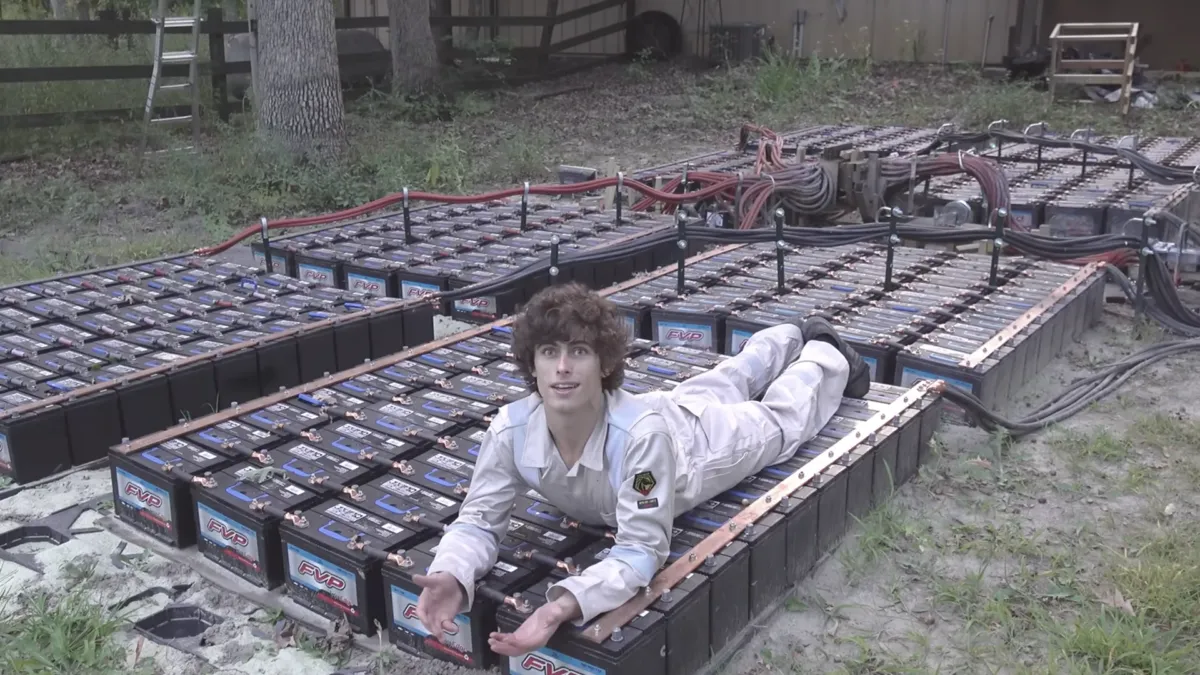
Drake Anthony, widely known as 'Styropyro' on YouTube, has unveiled his most ambitious project to date: a colossal setup utilizing 400 car batteries wired in series. This follows his previous experiment with 100 batteries, pushing the boundaries of DIY high-current electrical engineering. The project, which took two months to assemble, generates a relatively low voltage of 65V, but an astonishingly high current that can exceed 150,000 amps. Anthony equates the discharge power of this setup to that of an entire thunderstorm's worth of lightning bolts, highlighting the immense potential energy available for his experiments.
Anthony's channel is renowned for its daring and often dangerous scientific explorations, including past videos on high-powered lasers and repurposed military technology. This latest endeavor, however, focuses on the sheer power of extreme electrical current. The core of his experimental setup involves a gap that can be bridged by a conductive object. Upon closing a custom-built switch, an immense current surges through the object, leading to dramatic effects such as vaporization, burning, or violent ejection due to powerful magnetic fields. The visual results are spectacular, featuring billowing plasma clouds, explosive events, and showers of molten metal as various elements like zinc, aluminum, copper, and iron are subjected to these forces.
Harnessing Extreme Electromagnetism
Vaporization and Plasma Generation
The primary application of this massive current is the rapid vaporization of conductive materials. When an object bridges the gap in the circuit, the intense current rapidly heats it to extreme temperatures, causing it to disintegrate into a plasma state. The footage showcases this process with striking visual effects, from the instantaneous melting of metals to the formation of incandescent plasma plumes. This controlled destruction demonstrates the raw power of electricity when unleashed in such extreme quantities. The process is not just about destruction; it's a dramatic visualization of energy transfer and material transformation at a fundamental level, offering viewers a glimpse into the physics of high-energy phenomena.
The sheer energy involved allows Anthony to vaporize a range of metals, creating visually arresting displays of plasma and explosive reactions. Each material responds differently, offering a comparative study in material science under extreme electrical stress. The experiments are meticulously documented, capturing the rapid transition from solid to plasma, accompanied by significant sound and light emissions. This methodical approach to such volatile experiments underscores Anthony's dedication to scientific demonstration, even when dealing with inherently dangerous forces.
The Z-Pinch Effect and Custom Switch Design
Beyond simple vaporization, the experiments delve into advanced electromagnetic phenomena. The immense current generates equally powerful magnetic fields, which play a critical role in the experiments. One notable demonstration involves the implosion of a hollow copper pipe, showcasing the force exerted by these fields. These magnetic forces also significantly impact the experimental apparatus, including the cameras and, crucially, the custom-designed switch. Anthony elaborates that standard switches are incapable of handling such currents, necessitating the construction of a specialized component using two heavy copper blocks.
Over the course of the experiments, this custom switch undergoes extreme stress. The high current vaporizes copper at the contact points, forming a plasma. The intense magnetic fields then compress this plasma, a phenomenon known as a z-pinch. This effect causes the plasma to collapse into a narrow filament, channeling an extraordinary amount of power and heat. Anthony draws a parallel between this z-pinch effect and the formation of lightning bolts, explaining that such focused electrical discharges are rare outside of controlled fusion reactors. This highlights the sophisticated physics at play in his DIY setup.
Safety, Ethics, and YouTube's Role
Despite the high-risk nature of his projects, Anthony emphasizes a meticulous approach to safety. He states that he doesn't undertake potentially dangerous activities without a thorough understanding and mitigation of the risks. He also cautions viewers against attempting such experiments at home, noting that even a single car battery can be hazardous if mishandled. His history with YouTube has been complex, with some videos being demonetized or removed, reflecting the platform's ongoing challenges in moderating content involving potentially dangerous activities.
Anthony's dedication to his craft and his ability to engage a large audience with complex scientific demonstrations are noteworthy. His unique content, blending high-risk experiments with accessible explanations, has cultivated a dedicated fanbase. The fact that he can continue to produce and monetize such videos in the current digital landscape is a testament to his originality and the enduring public fascination with extreme science. The presence of his pet squirrel, Ophelia, in the video adds a personal touch, underscoring the human element behind these high-voltage displays.
Impact Analysis
Pushing the Boundaries of DIY Electromagnetism
Drake 'Styropyro' Anthony's latest project with 400 car batteries represents a significant escalation in amateur high-current experimentation. By generating currents in the hundreds of thousands of amperes, he not only visualizes fundamental physics principles like vaporization and the z-pinch effect but also provides a compelling case study in electrical engineering under extreme conditions. The project challenges conventional understanding of DIY capabilities and highlights the potential for accessible, albeit hazardous, scientific exploration outside traditional academic and industrial settings. His work serves as both a spectacle and an educational tool, demonstrating the dramatic consequences of manipulating vast amounts of electrical energy and magnetic fields, while simultaneously underscoring the critical importance of rigorous safety protocols and a deep understanding of the underlying science.