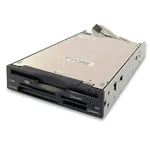
In an era dominated by high-speed digital storage, the re-emergence of legacy media interfaces can seem counterintuitive. However, for professionals and enthusiasts dealing with archival data, vintage computing, or specialized industrial equipment, the need for reliable floppy disk access remains. The Axagon 3.5" Floppy Disk Drive (FDD) & Card Reader in black addresses this niche requirement by integrating a functional 3.5-inch FDD with a multi-format card reader, offering a singular solution for bridging past and present data formats.
This external drive unit connects via USB, providing a straightforward plug-and-play experience for modern operating systems. Its primary function is to read and write standard 3.5-inch floppy disks, a capacity increasingly rare in today's hardware landscape. Beyond its floppy drive capabilities, the integrated card reader supports a variety of common memory card formats, enhancing its utility for users who still utilize or need to access data from older digital cameras or other portable devices. The compact, black enclosure ensures it can blend discreetly into most desktop setups.
Bridging the Digital Divide with Legacy Support
The core value proposition of the Axagon 3.5" FDD & Card Reader lies in its ability to provide access to data stored on 3.5-inch floppy disks. This is critical for sectors such as industrial automation, scientific research, and historical data archiving where legacy systems might still rely on this media. The USB interface ensures compatibility with a wide range of contemporary computers, from desktops to laptops running Windows, macOS, or Linux, without requiring internal installation.
Integrated Card Reading Functionality
Complementing the floppy drive, the built-in card reader offers a convenient way to transfer data from various memory card types. While specific supported formats are not detailed in the provided specifications, typical integrated readers of this nature often include slots for SD, microSD, and potentially CompactFlash or Memory Stick. This dual functionality reduces the need for multiple external devices, streamlining the workflow for users who manage a diverse array of storage media.