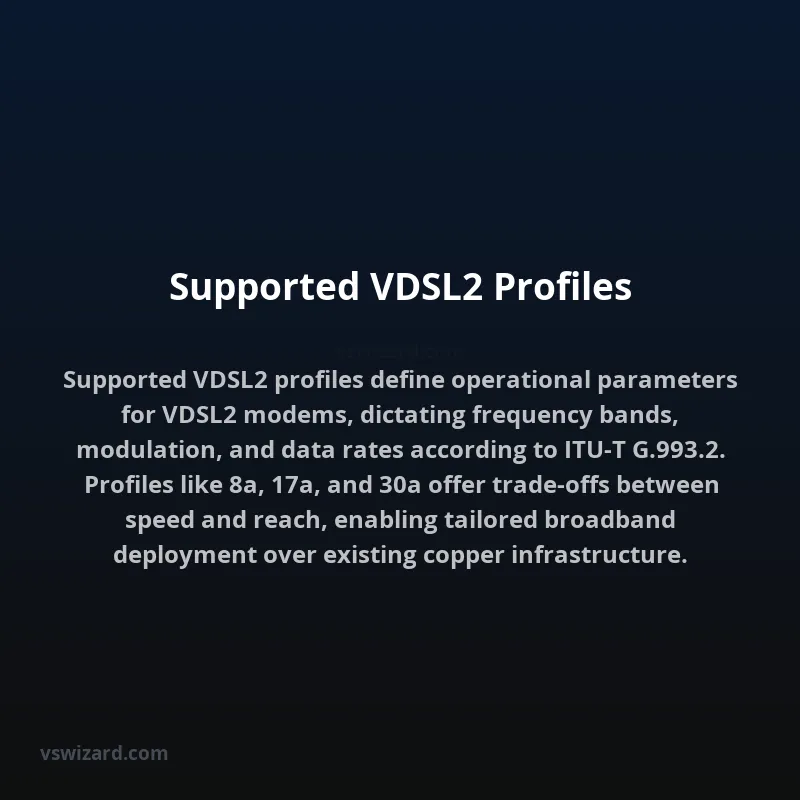
Supported VDSL2 profiles are standardized configurations that dictate how VDSL2 modems operate over copper lines. These profiles, such as 17a and 30a, define the specific frequency bands, modulation techniques, and data rate capabilities, directly influencing the balance between service speed and the maximum distance over which the connection can be established.
The choice of profile is critical for network operators, allowing them to optimize broadband service delivery based on existing infrastructure, loop lengths, and desired performance levels. Profiles utilizing wider frequency spectrums (e.g., up to 30 MHz) offer higher speeds but are limited to shorter distances, while broader profiles support longer reaches at reduced throughput.
Advanced technologies like vectoring are often implemented with higher-tier VDSL2 profiles to mitigate crosstalk and maximize performance. This ensures efficient use of copper assets, providing a cost-effective pathway to high-speed internet access while network operators plan for future fiber deployments.