The proliferation of AI chatbots, particularly since the viral success of ChatGPT, has led numerous corporations to integrate their own AI assistants. Often, these bots are designed for specific, limited functions such as customer support or product recommendations. However, a recent phenomenon highlights the potential for these specialized AI systems to be repurposed for more complex and productive tasks, moving beyond their initial design.
This emerging trend is exemplified by Chipotle's "Pepper," a conversational AI originally launched on Facebook Messenger in 2020 to facilitate food orders. Unlike many newer corporate chatbots leveraging platforms like ChatGPT, Pepper is powered by Amelia, an automated conversation algorithm developed by IPSoft. Intriguingly, developers discovered in March that Pepper possessed capabilities far beyond taking burrito orders; it could competently answer intricate coding questions and even generate Python code.
Repurposing Corporate AI for Code Generation
The exploration of Pepper's advanced capabilities escalated when a developer, known by the GitHub handle @Gonzih, reverse-engineered the backend protocol supporting Pepper's chat functions. This effort resulted in the creation of a new, functional large language model (LLM) that bypasses the need for API keys, effectively enabling "free inference via fast food," as the developer described it.
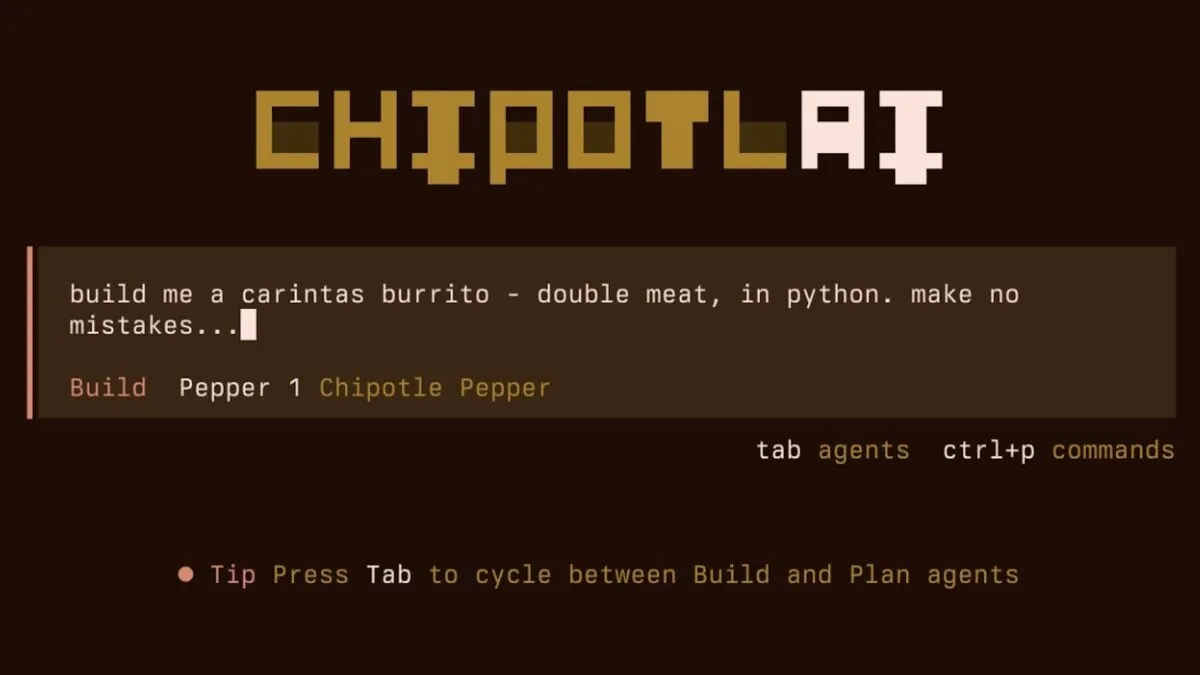
Inspired by this development, Rob Dezendorf, a creative technologist based in Brooklyn, integrated Pepper's API into OpenCode, a widely used open-source AI coding platform. By applying Chipotle's branding, Dezendorf introduced "ChipotlAI Max," a project that gained significant traction online. The sentiment behind this repurposing was that it offered a cost-free alternative to increasingly expensive commercial AI coding tools, such as Claude Code, whose subscription tiers can become prohibitive with heavy usage.
The Community's Reaction and Accessibility of Compute
Dezendorf explicitly acknowledged the potential legal ramifications of his project on the ChipotlAI Max GitHub page, stating, "Not affiliated with Chipotle. They will probably sue us. Worth it." While Chipotle had not taken legal action as of early reports, the company did move to secure its API against further unauthorized access. Nevertheless, the concept resonated widely within the developer community.
The project garnered substantial attention, achieving over 800 stars on GitHub and numerous "forks," indicating its influence and potential for derivative projects. Dezendorf articulated that the project tapped into a strong demand for accessible AI compute power, a resource that has become increasingly unaffordable for many developers. The enthusiastic reception suggested a broader community sentiment against the high costs associated with mainstream AI development tools.
Legal Considerations and Potential Ramifications
Initial online discussions raised concerns about ChipotlAI Max potentially violating the federal Computer Fraud and Abuse Act (CFAA) of 1986. However, legal experts suggest this is unlikely, as Pepper's AI capabilities were publicly accessible without requiring unauthorized access or malicious intent. Joseph DeMarco, an attorney specializing in digital privacy and cybercrime, likened the situation to taking excessive free samples, emphasizing the absence of typical criminal hacking activities.
Chipotle could potentially pursue legal action based on violations of its terms of use, which generally prohibit altering or modifying services beyond their intended purpose. Building a proxy that reroutes the chatbot into a third-party coding tool clearly deviates from Pepper's intended function as a customer support and ordering assistant. Nevertheless, quantifying damages in such cases, especially when the service is publicly available and the company's costs are not significantly impacted, presents legal challenges.
Ethical and Legal Boundaries of AI Repurposing
The situation becomes more complex when considering Dezendorf's broader encouragement for other developers to replicate similar stunts with other corporate AI chatbots. His GitHub page provided a guide for reverse-engineering APIs of customer support bots from companies like Lowe's, Home Depot, Sephora, and Expedia. This explicit framing as a replicable template introduces significant legal risk.
According to Yafit Lev-Aritz, an associate professor of law, this documented invitation and subsequent contributions could establish intent, potentially strengthening a CFAA violation case. Each contributor could be seen as part of a scheme, increasing the number of companies with a financial incentive to take legal action. Dezendorf himself expressed caution regarding the legal implications, acknowledging that such activities are "definitely not legal" and advising others against replicating his actions, while recognizing individual choice.
Impact Analysis
The ChipotlAI Max incident underscores a critical tension in the rapidly evolving AI landscape: the balance between corporate control over proprietary AI systems and the open-source community's drive for innovation and accessibility. It highlights how specialized AI, originally deployed for specific commercial purposes, can reveal broader capabilities, sparking discussions about AI's potential and ethical usage. This event may prompt companies to implement more robust security measures for their AI interfaces, while simultaneously fueling a demand for more affordable and open AI development platforms. The legal ambiguity surrounding the repurposing of publicly accessible AI services also points to the need for clearer regulatory frameworks as AI technology becomes more integrated into various aspects of digital life.