


Advanced Technical Guide to Pressure Cooker Accessory Performance and Maintenance
Optimizing Pressure Cooker Performance Through Superior Accessories
Understanding Sealing Rings and Gaskets: Material Science and Longevity
The sealing ring, or gasket, is arguably the most critical accessory for any pressure cooker, directly impacting its ability to build and maintain pressure. Typically manufactured from high-grade silicone or specialized EPDM rubber, these rings must withstand extreme thermal cycling and sustained pressure differentials without degradation. Silicone gaskets offer superior flexibility and chemical inertness, making them resistant to food acids and oils, thus extending their operational life. EPDM alternatives, while often more rigid, provide excellent tear resistance and can be suitable for frequent, heavy-duty use. Proper fit is non-negotiable; even minute discrepancies in diameter or cross-section can compromise the seal, leading to pressure leakage, extended cooking times, or complete operational failure. Routine inspection for cracks, hardening, or stretching is essential, with replacement recommended every 6-12 months for frequent users, irrespective of visible damage, to preempt performance decline.
The Mechanics of Pressure Regulators and Safety Valves
Pressure regulators and safety valves are sophisticated mechanisms designed to maintain desired internal pressure and prevent over-pressurization, respectively. Modern pressure regulators often employ spring-loaded mechanisms that lift and vent steam incrementally to sustain a pre-set PSI (pounds per square inch). Technical specifications detail the exact pressure ranges (e.g., 5 PSI, 10 PSI, 15 PSI) at which these valves operate. Safety valves, conversely, are emergency devices, typically fusible plugs or spring-loaded pins, engineered to activate only when primary pressure regulation fails, releasing steam at dangerously high levels to avert an explosion. Materials used are critical, often involving heat-resistant alloys or specialized polymers. Regular cleaning to prevent food particle buildup is vital for both components to ensure unobstructed operation, as blockages can lead to inaccurate pressure readings or, more critically, safety valve malfunction. Periodic calibration checks, though often beyond home user capabilities, highlight the precision engineering involved.
Enhancing Versatility with Trivets, Baskets, and Canning Racks
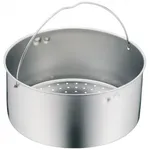
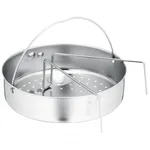
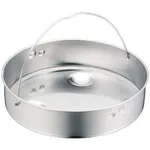
Beyond fundamental sealing and pressure regulation, accessories like trivets, steamer baskets, and canning racks significantly expand a pressure cooker's functional repertoire. Trivets, often constructed from durable stainless steel, elevate food above the cooking liquid, enabling steaming or preventing scorching. Their design must ensure stability under load and adequate water circulation. Steamer baskets, featuring finely perforated walls, allow for efficient steam penetration while retaining small food items, requiring rust-resistant materials and robust construction. Canning racks are specifically designed to hold multiple jars securely during pressure canning, necessitating precise dimensions and robust wire gauges to support substantial weight and ensure even heat distribution. Material choices like 18/8 or 18/10 stainless steel are preferred for their corrosion resistance and inertness, preventing leaching into food or reacting with acidic canning solutions. The design of these accessories influences not only the cooking method but also the ease of placement and removal, impacting the overall user experience and food safety during high-temperature processing.