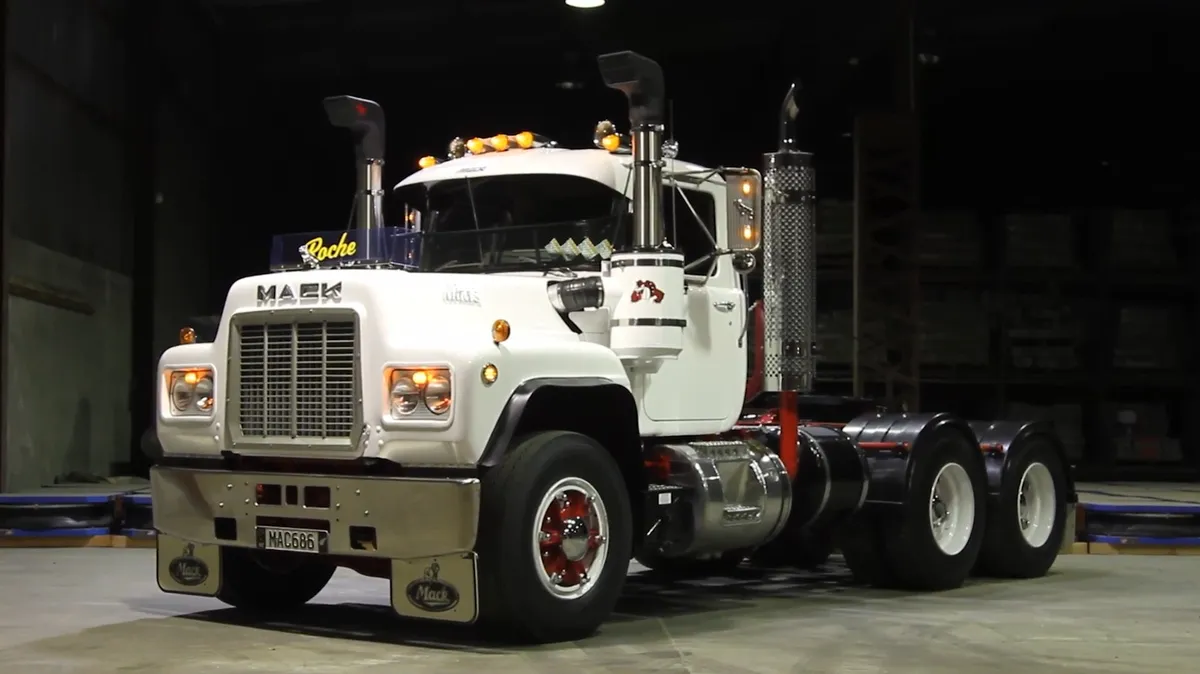
In the mid-1960s, Mack Trucks faced a precarious situation. Beset by cash-flow problems, a dwindling market share, and an uncompetitive engine lineup against rivals like Cummins and Detroit Diesel, the company's future hung in the balance. Mack's leadership in Allentown, Pennsylvania, made a bold gamble, pinning the company's survival on a radical new engine concept: the Maxidyne. Developed for the then-new Mack R-Model, this single engine not only rescued the company but fundamentally redefined how heavy-duty trucks generated power.
To grasp the Maxidyne's significance, it's crucial to understand the prevailing diesel engine technology of the era. Conventional diesel engines typically produced their peak torque within a narrow operational band, usually between 1,600 and 1,800 RPM. If a truck encountered a steep incline, causing the engine speed to drop below this optimal window, performance would suffer dramatically. Drivers were compelled to downshift through complex transmissions – often 11, 13, or even 15-speed units, with some extreme cases requiring 18 speeds – to prevent the engine from lugging and to maintain forward momentum.
The Constant-Power Revolution of the Maxidyne
The Maxidyne engine shattered these conventional limitations. Initially designated the ENDT 675, this 11-liter inline-six produced a seemingly modest 237 horsepower. However, its true innovation lay in its torque characteristics. Unlike its competitors, which struggled at lower revolutions, the Maxidyne achieved a remarkable peak torque of 906 pound-feet at an incredibly low 1,200 RPM. This low-end grunt was further enhanced by an extraordinary 52% torque rise – meaning the engine delivered 52% more torque at low RPM than at its peak horsepower. This figure dwarfed the typical 15-20% torque rise found in contemporary engines.
This substantial torque rise was achieved through innovative engineering. As the engine speed decreased, an exhaust-driven turbocharger and a sophisticated mechanical fuel injection system worked in concert. In a departure from conventional designs, the Maxidyne simultaneously increased the fuel charge and air supply per cylinder stroke as the engine slowed. The outcome was an impressively flat and consistent horsepower output across a vast, usable operating range from 1,200 to 2,100 RPM, providing a much broader and more effective power band than its rivals.
Simplified Drivetrain and Enhanced Performance
The Maxidyne's exceptional power delivery enabled Mack to implement a revolutionary simplification of the drivetrain. Instead of the multi-gear transmissions common on competing trucks, the Maxidyne engine was paired with a robust, straightforward 5-speed Maxitorque transmission. The engine's ample low-end torque meant that only five widely spaced gears were necessary to handle demanding tasks. This allowed drivers to start fully loaded trucks from a standstill in fourth or even fifth gear without stressing the clutch or drivetrain. Crucially, when facing challenging inclines, such as a 6% grade, a Maxidyne-equipped R-Model could maintain a steady 25 mph by simply keeping the engine speed at 1,200 RPM in fourth gear, a feat that would have forced competitors into multiple downshifts and a crawl.
The success of the Maxidyne forced other manufacturers, including Cummins, Caterpillar, and Detroit Diesel, to re-evaluate their engine strategies. They subsequently invested heavily in developing engines with high torque rise characteristics, effectively playing catch-up to Mack's groundbreaking design. Mack, however, continued to refine its technology, focusing on managing the increased thermal and mechanical stresses associated with delivering high torque at lower engine speeds.
Intercooling and the Tip Turbine Breakthrough
In 1973, Mack Trucks pioneered what is widely recognized as the world's first air-to-air intercooled highway truck engine series: the Maxidyne 300. To integrate this intercooler system without requiring extensive, cumbersome plumbing, Mack's engineers developed an ingenious, self-contained solution known as the "Tip Turbine." This system was notably applied to engines like the acclaimed intercooled ENDT 676 "Cool Power" engine.
The Tip Turbine design featured a turbocharger that compressed air from the engine's airbox. A small auxiliary pipe then diverted a portion of this compressed air to spin a compact, high-speed turbine with 66 blades. This turbine was directly linked to a 10-blade fan responsible for drawing cool, ambient air across the intercooler's fins before expelling it into the engine bay. This innovative arrangement allowed the intercooler core to be mounted directly atop the intake manifold, significantly shortening the air intake path and enhancing engine response under load.
This advanced system enabled the 11-liter inline-six to produce between 285 and 315 horsepower, along with an impressive 1,080 pound-feet of torque, rivaling the performance of Mack's larger 14-liter ENDT 865 V8 engine. Subsequent iterations of the 4-valve 300 series engines eventually achieved an extraordinary 1,425 pound-feet of torque. During the 1980s, the Maxidyne family evolved into the E6 series, followed by the 11.9-liter EM7, which began production in 1989 and continued for 15 years. These engines became legendary for their robust construction and mechanical longevity, built to withstand the rigors of heavy-duty trucking.
Impact Analysis
The Mack Maxidyne engine was more than just an incremental improvement; it was a paradigm shift in heavy-duty diesel engine design. By prioritizing low-end torque and a broad, flat power band, Mack not only saved itself from financial distress but also set a new industry standard. Competitors were forced to adapt, leading to widespread adoption of similar high-torque-rise engine architectures across the trucking industry. Furthermore, Mack's innovation in air-to-air intercooling with the Tip Turbine demonstrated a commitment to managing the challenges of higher power outputs, influencing future engine development and solidifying Mack's reputation for engineering excellence in the demanding world of commercial transport.