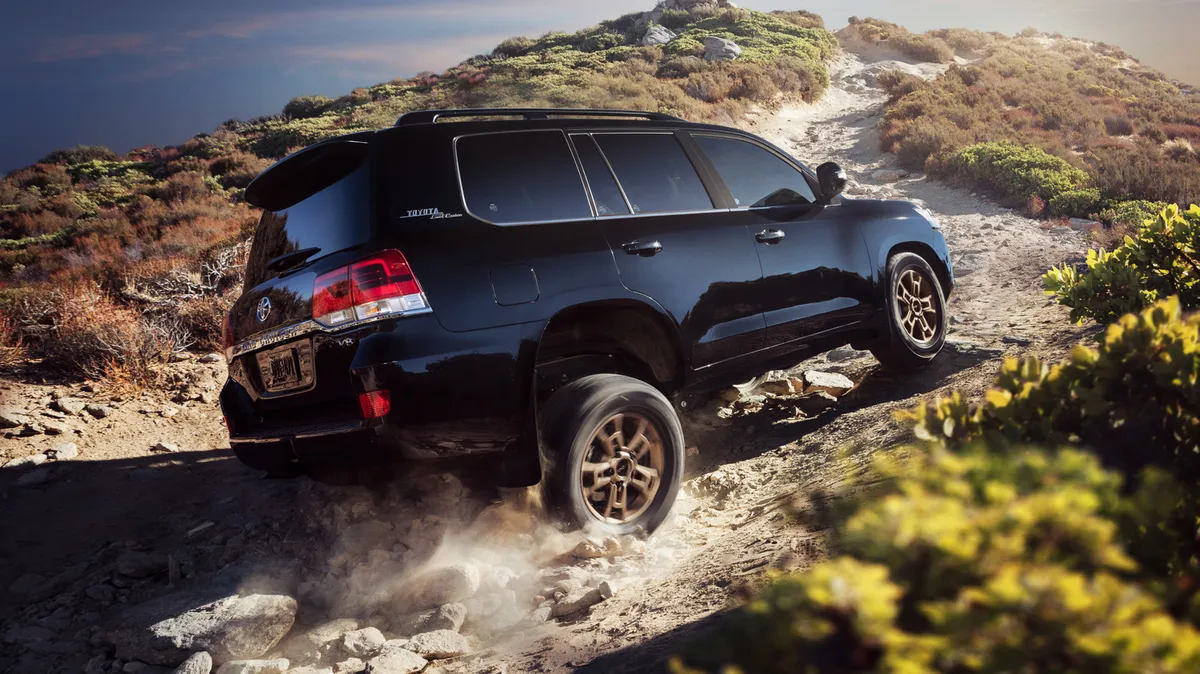
The Toyota Land Cruiser boasts a heritage spanning over seven decades, evolving from a rugged Jeep CJ derivative into a premium, full-size SUV. The 2021 model year represents a significant point in its lineage, marking the last iteration to feature a V8 engine and a three-row seating configuration before its redesign. This eighth-generation model was succeeded by the 2024 Land Cruiser, which adopted a retro aesthetic and a more compact, hybrid four-cylinder powertrain. For prospective buyers seeking the established prowess of the V8 Land Cruiser, understanding its depreciation curve is crucial, especially given its reputation for robust build quality and enduring appeal.
While depreciation is an inevitable aspect of vehicle ownership, the Land Cruiser often defies typical market trends due to its inherent durability and high demand in the used vehicle market. The initial anticipation of a significant value drop, often cited around 35% over five years, may not fully translate into real-world transaction prices. This analysis aims to provide a comprehensive view of the 2021 Land Cruiser's depreciation, comparing it with key competitors and examining current market listings to offer a clearer picture of its long-term value retention.
Analyzing the 2021 Toyota Land Cruiser's Depreciation
Industry data from sources like CarEdge suggests that a 2021 Toyota Land Cruiser is projected to lose approximately 35.4% of its original MSRP over a five-year ownership period. With a starting MSRP of $87,030 for the base trim (inclusive of destination charges), this estimate places its projected resale value around $56,200. Interestingly, this projected resale value is remarkably close to the base price of the completely redesigned 2025 Toyota Land Cruiser, which debuted at $56,700. This proximity highlights the strong residual value characteristic of the outgoing model.
Furthermore, current retail marketplace observations from platforms like Autotrader and CarGurus present a different, and perhaps more optimistic, scenario for sellers. Listings for 2021 Land Cruisers in good condition, with average or below-average mileage, frequently command prices ranging from $74,000 to $80,000. Even models with higher mileage typically retain values in the mid-$60,000s, significantly above the depreciation forecasts. The limited production numbers for the 2021 model year, with only 3,711 units sold in the U.S., contribute to its scarcity on the used market, thereby bolstering its resale value.
Looking beyond the five-year horizon, CarEdge's projections indicate a further decline in value. Over seven years, the 2021 Land Cruiser is estimated to depreciate by 44.7% of its original MSRP. This trend continues to a 54.2% depreciation rate after a decade of ownership. While these long-term forecasts provide a statistical outlook, the enduring demand and legendary reliability of the Land Cruiser suggest that actual market values might continue to outperform these conservative predictions.
Comparative Depreciation: Land Cruiser vs. Competitors
When examining the depreciation of the 2021 Toyota Land Cruiser against its segment rivals, its value retention stands out. On average, all 2021 Toyota models experienced a depreciation rate of about 32.1%, a figure slightly better than the Land Cruiser's individual 35.4% rate. However, this comparison needs to be contextualized within the specific vehicle segments and their respective market dynamics.
The Chevrolet Tahoe, another prominent body-on-frame SUV with a V8 engine, presents a stark contrast in depreciation. While Chevrolet vehicles from 2021 have an overall depreciation rate of 41.5%, the 2021 Tahoe specifically loses an estimated 52% of its value over five years. The long-term outlook for the Tahoe is also less favorable, with a seven-year depreciation estimate of 58.3%, positioning it significantly behind the Land Cruiser in terms of value retention.
The Nissan Armada faces even more substantial depreciation. Across the Nissan brand for 2021 models, depreciation averages 45.5%. The 2021 Armada, however, depreciates at a much steeper rate of 66.2% over five years. This pattern is consistent with its luxury platform mate, the Infiniti QX80, which is known for its rapid depreciation. The Armada's value loss is projected to climb to 71.6% after seven years and 77.5% after ten years, demonstrating a considerably less robust holding of value compared to the Land Cruiser.
Market Realities and Long-Term Value
The robust demand for the 2021 Toyota Land Cruiser in the pre-owned market is a testament to its reputation for exceptional durability and off-road capability, attributes that command a premium even as the vehicle ages. Unlike many luxury SUVs that suffer significant value erosion due to technological obsolescence or rapidly changing styling, the Land Cruiser's functional design and proven engineering contribute to its sustained desirability.
Potential buyers considering a used 2021 Land Cruiser are often seeking a vehicle that offers a blend of ruggedness, comfort, and reliability, often for applications such as overland expeditions, demanding family use, or simply as a dependable long-term asset. The relatively low volume of sales in the U.S. for this specific model year means that well-maintained examples become increasingly sought after, creating a competitive used market that supports higher resale values.
The divergence between statistical depreciation forecasts and actual market prices underscores the unique position of the Land Cruiser. While financial models predict a certain percentage of value loss based on historical data and general market trends, the specific appeal and perceived longevity of the Land Cruiser can create a market anomaly. Owners who have maintained their vehicles meticulously, particularly those with lower mileage and comprehensive service records, are likely to achieve prices that significantly exceed theoretical depreciation models.
Impact Analysis
The exceptional value retention of the 2021 Toyota Land Cruiser has significant implications for both the used car market and consumer purchasing decisions. For owners, it signifies a sound investment, with lower overall cost of ownership when accounting for resale value. This stability in the used market can encourage more buyers to consider the Land Cruiser as a viable long-term asset rather than a rapidly depreciating luxury item. Conversely, for competitors, it highlights the challenge in matching the Land Cruiser's combination of durability, brand prestige, and market demand, forcing them to innovate further in areas like build quality and long-term reliability to counter Toyota's established stronghold.