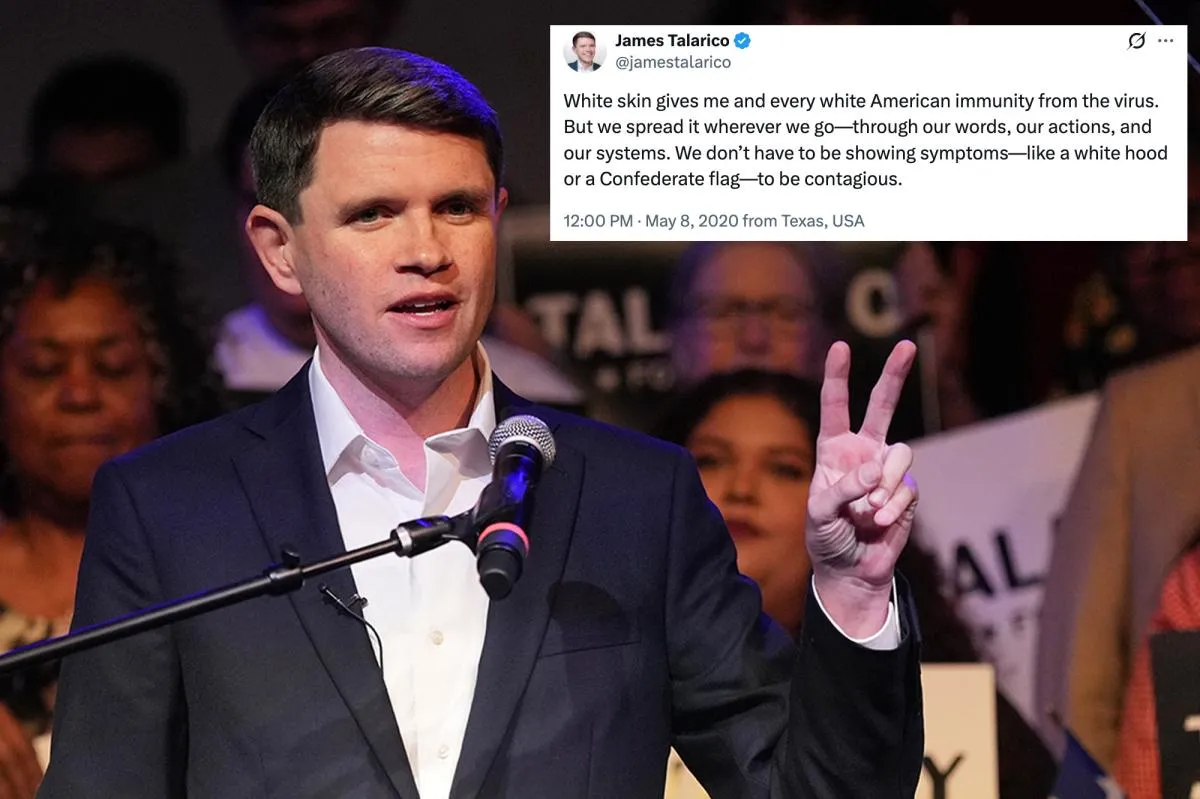
A resurfaced social media post from Texas Democratic Senate nominee James Talarico, written in May 2020, has ignited significant backlash from Republican counterparts and political commentators. The post, which framed white skin as granting "immunity" from the "virus of racism" but also as a vector for its spread, has been widely criticized as "peak woke" and overtly racist. This controversy emerges as Talarico secured his party's nomination, intensifying the political stakes in a state where Democrats have not held a US Senate seat since 1988.
The remarks, made during the initial phase of the COVID-19 pandemic and shortly after the high-profile murder of Ahmaud Arbery, drew immediate and sharp condemnation. Talarico, a state legislator who defeated US Representative Jasmine Crockett in the primary, articulated a complex, metaphorical argument linking systemic racism to infectious disease. His full statement read: "White skin gives me and every white American immunity from the virus. But we spread it wherever we go—through our words, our actions, and our systems. We don’t have to be showing symptoms—like a white hood or a Confederate flag—to be contagious." This particular phrasing has become the focal point of criticism.
Political Repercussions and Criticisms
Gubernatorial Response and 'Woke' Accusations
Texas Governor Greg Abbott was among the first to publicly denounce Talarico's statement. Labeling the post as proof that Talarico was politically vulnerable, Abbott stated, "If this is a real Talarico post, he is toast." He further suggested that such sentiments might resonate in a more liberal state like Minnesota but would not succeed in Texas, highlighting a perceived ideological divide. The governor's swift reaction underscored the Republican Party's strategy to leverage Talarico's past comments against him in the upcoming general election.
 The Republican narrative quickly coalesced around the idea that Talarico's remarks were not just misguided but represented a broader trend of "woke" ideology within the Democratic Party. This framing aims to alienate moderate voters and paint the party as out of touch with mainstream concerns. The governor's intervention amplified the criticism, setting a combative tone for the general election campaign.
Senate Colleagues and Legal Figures Weigh In
US Senator Ted Cruz, also a Republican from Texas, joined the chorus of criticism, characterizing left-wing political figures as "open racists." His statement suggested a fundamental difference between "zealots" and "ordinary Americans." Similarly, Iowa Solicitor General Eric Wessan criticized the notion of treating individuals differently based on skin color, asserting that complexion itself is not inherently "infectious, evil, or bad." Wessan also condemned the stereotyping of "whiteness" as inherently linked to symbols of hate like the KKK or Confederate flag.
 These critiques from prominent political figures and legal professionals aimed to delegitimize Talarico's argument and cast it as discriminatory. By framing the issue as one of reverse racism or an attack on white Americans, the opposition sought to mobilize their base and create doubt among undecided voters about Talarico's suitability for public office.
Media Pundits and Calls for Apology
Beyond the political realm, conservative and centrist media pundits offered their analyses, with some describing Talarico's comments as "comically woke." Journalist Josh Barro suggested that Talarico could learn from other politicians who have navigated past controversial statements by issuing sincere apologies. He referenced figures like former New York City Council member Zohran Mamdani and Vice President Kamala Harris, implying that a direct apology could mitigate damage.
 Commentary editor John Podhoretz linked the social media post to another past statement by Talarico, "God is non-binary," suggesting a pattern of controversial rhetoric that could be exploited by Republicans. Fox News contributor Mary Katharine Ham noted the broader Democratic challenge of finding candidates who have not made similar statements during a period of heightened social and political discourse, referencing the "silence was violence" sentiment prevalent at the time.
Campaign Response and Strategic Defense
Accusations of Fear and Misdirection
In response to the escalating criticism, Talarico's campaign spokesman, JT Ennis, issued a statement defending the candidate and attacking his potential Republican opponents. Ennis accused Senator John Cornyn, Attorney General Ken Paxton, Governor Abbott, and their financial backers of being "scared of James Talarico for good reason." The campaign framed the criticisms as "stale attacks" intended to "mislead Texans" and distract from Talarico's progressive agenda.
 The campaign's strategy appears to be one of defiance, characterizing the attacks as fear-driven tactics from entrenched political and economic interests. By reframing the narrative, the Talarico campaign aims to portray him as an agent of change challenging the status quo, rather than a candidate making problematic statements.
Building a Movement for November
Ennis asserted that the campaign is "building a movement poised to change the politics of this state and take power back for working people." This rhetoric positions Talarico not just as a candidate, but as the figurehead of a broader political transformation in Texas. The campaign is attempting to rally supporters around a vision of progress and empowerment, contrasting it with what they describe as the divisive tactics of their opponents.
The outcome of the Republican primary runoff between John Cornyn and Ken Paxton will determine Talarico's opponent in the November general election. Regardless of the opponent, the controversy surrounding his 2020 social media post is likely to remain a significant factor in the campaign narrative, testing the electorate's response to his message and the criticisms leveled against it.
Impact Analysis
This controversy highlights the enduring impact of social media pronouncements from years past on contemporary political careers. Talarico's situation underscores the challenge faced by candidates in navigating the complex discourse around race and systemic issues, particularly in a politically polarized environment like Texas. The Republican strategy of weaponizing past statements represents a common tactic to define opponents before they can effectively shape their own public image. For Democrats, it raises questions about candidate vetting and the potential for progressive rhetoric to be perceived as alienating by a broader electorate. The effectiveness of Talarico's defense and his ability to pivot back to his core policy platform will be crucial in determining whether this controversy becomes a defining moment or a temporary setback in his Senate bid.