A comprehensive analysis of U.S. occupational data has uncovered significant disparities in divorce rates across various professions. The study, which synthesized data from the American Community Survey, highlights that certain job sectors exhibit divorce rates considerably higher than others, pointing to a complex interplay of professional demands and personal life stability.
While anecdotal evidence and broader societal trends often discuss marital success, this data provides a quantitative perspective, ranking over 500 occupations based on their associated divorce rates. The findings reveal a wide spectrum, from professions with remarkably low divorce percentages to those where divorce is nearly twice as common.
Understanding the Occupational Divorce Rate Divide
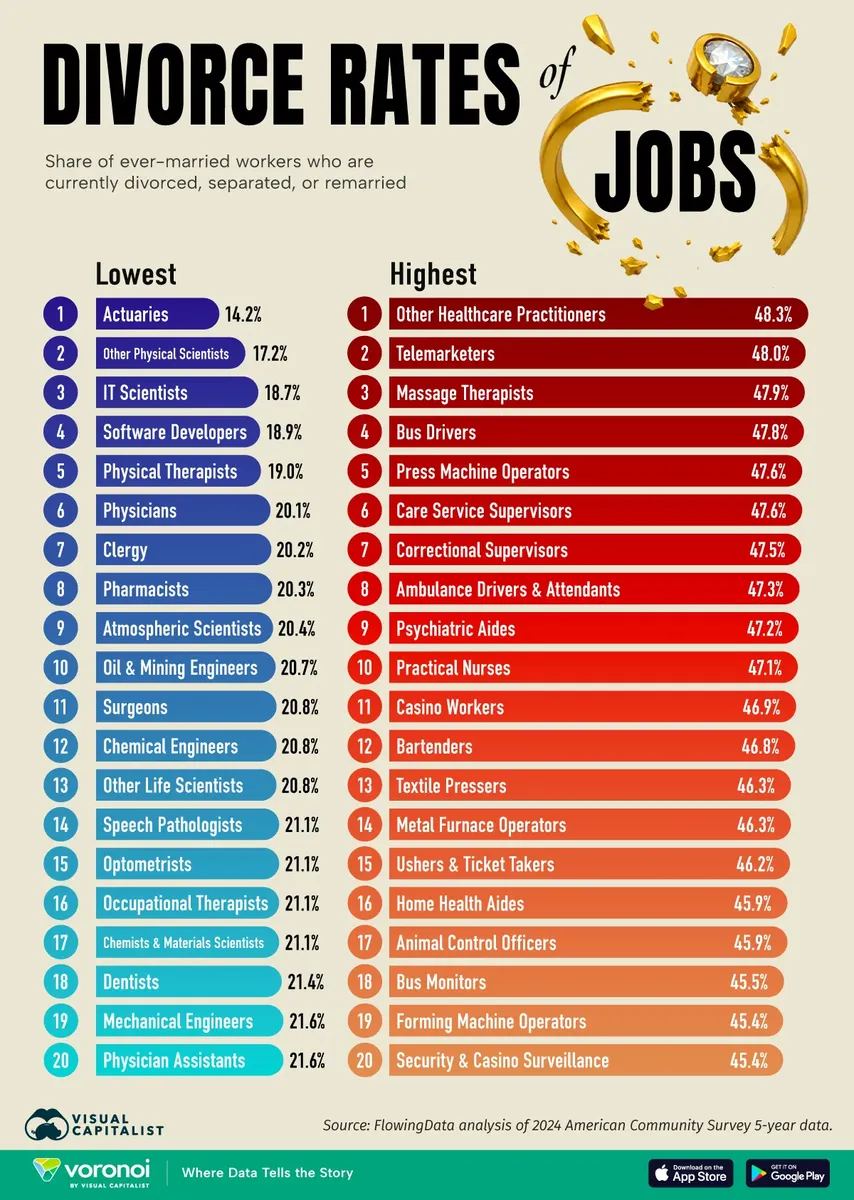
The research, drawing from FlowingData's compilation of American Community Survey data, meticulously ranked over 500 occupations to identify those with the highest and lowest divorce rates. A key finding is the substantial average difference: the 20 occupations with the highest divorce rates average a rate of 46.8%, in stark contrast to the 20 occupations with the lowest rates, which average 20.1%. This significant gap underscores how professional environments and demands can correlate with marital outcomes.
The data also points to a fascinating nuance within specific industries. For instance, the healthcare sector appears on both ends of the spectrum. While professions like physicians and dentists exhibit low divorce rates, roles such as home health aides and psychiatric aides are found among those with the highest rates. This suggests that factors beyond the industry itself, such as working conditions, schedules, and emotional labor, play a critical role in the stability of marriages within these fields.
Occupations with Low Divorce Rates
The occupations that consistently show the lowest divorce rates are often characterized by requirements for advanced education, specialized licensing, or significant technical expertise. These roles frequently involve structured work environments and high levels of professional autonomy.
Among the top occupations with the lowest divorce rates are actuaries, who lead the list with a divorce rate of 14.2%. Other professions in this category include various physical scientists, IT scientists, and software developers, all demonstrating rates below 19%. Therapists, physicians, and pharmacists also feature prominently, with divorce rates in the low 20% range. This group is further bolstered by clergy, highlighting that factors beyond income or educational attainment might contribute to marital stability.
| Rank | Occupation | Divorce Rate |
|---|---|---|
| 1 | Actuaries | 14.2% |
| 2 | Other Physical Scientists | 17.2% |
| 3 | IT Scientists | 18.7% |
| 4 | Software Developers | 18.9% |
| 5 | Physical Therapists | 19.0% |
| 6 | Physicians | 20.1% |
| 7 | Clergy | 20.2% |
| 8 | Pharmacists | 20.3% |
| 9 | Atmospheric Scientists | 20.4% |
| 10 | Oil & Mining Engineers | 20.7% |
| 11 | Surgeons | 20.8% |
| 12 | Chemical Engineers | 20.8% |
| 13 | Other Life Scientists | 20.8% |
| 14 | Speech Pathologists | 21.1% |
| 15 | Optometrists | 21.1% |
| 16 | Occupational Therapists | 21.1% |
| 17 | Chemists & Materials Scientists | 21.1% |
| 18 | Dentists | 21.4% |
| 19 | Mechanical Engineers | 21.6% |
| 20 | Physician Assistants | 21.6% |
The correlation between higher education levels and lower divorce rates is also observable in broader societal data. Studies indicate that individuals with advanced degrees tend to have lower divorce rates compared to those with only a high school diploma. This reinforces the idea that factors associated with higher education, such as critical thinking skills, career stability, and potentially income, may contribute to marital resilience.
Occupations with High Divorce Rates
Conversely, occupations reporting the highest divorce rates often share common characteristics, including irregular work schedules, demanding emotional labor, and public-facing roles that can lead to significant stress. These roles may also involve less autonomy and more unpredictable work environments.
The data indicates that roles such as telemarketers, bus drivers, bartenders, home health aides, psychiatric aides, and casino workers face divorce rates exceeding 45%. These professions often involve shift work, customer service demands, or emotionally taxing interactions, which can place considerable strain on personal relationships.
| Rank | Occupation | Divorce Rate |
|---|---|---|
| 1 | Other Healthcare Practitioners | 48.3% |
| 2 | Telemarketers | 48.0% |
| 3 | Massage Therapists | 47.9% |
| 4 | Bus Drivers | 47.8% |
| 5 | Press Machine Operators | 47.6% |
| 6 | Care Service Supervisors | 47.6% |
| 7 | Correctional Supervisors | 47.5% |
| 8 | Ambulance Drivers & Attendants | 47.3% |
| 9 | Psychiatric Aides | 47.2% |
| 10 | Practical Nurses | 47.1% |
| 11 | Casino Workers | 46.9% |
| 12 | Bartenders | 46.8% |
| 13 | Textile Pressers | 46.3% |
| 14 | Metal Furnace Operators | 46.3% |
| 15 | Ushers & Ticket Takers | 46.2% |
| 16 | Home Health Aides | 45.9% |
| 17 | Animal Control Officers | 45.9% |
| 18 | Bus Monitors | 45.5% |
| 19 | Forming Machine Operators | 45.4% |
| 20 | Security & Casino Surveillance | 45.4% |
Research has indicated that irregular work schedules, such as those common in shift work, are associated with increased marital instability. The demands of working non-traditional hours can create challenges in maintaining work-life balance and consistent couple time, potentially leading to increased marital conflict and separation.
The Healthcare Paradox
The divergent divorce rates within the healthcare sector present a particularly compelling finding. While highly educated and specialized roles like physicians and dentists are associated with low divorce rates, frontline support roles such as practical nurses, home health aides, and psychiatric aides face significantly higher rates.
This paradox suggests that the nature of the work environment, the level of autonomy, patient interaction demands, and specific scheduling patterns within different healthcare roles can profoundly influence marital stability. It highlights that a broad industry classification may not capture the nuanced realities faced by individuals in distinct professional capacities within that sector.
Factors Influencing Marital Stability Across Occupations
The overall analysis indicates that several key factors are consistently linked to divorce rates across occupations. These include the level of education required for a profession, the predictability of work schedules, the emotional intensity of the job, and the degree of professional autonomy granted to individuals.
Occupations demanding extensive education and offering stable, predictable schedules tend to correlate with lower divorce rates. Conversely, roles with unpredictable hours, high stress, or significant emotional labor, regardless of their sector, tend to be associated with higher divorce rates. This suggests that the structure and demands of a job significantly impact an individual's capacity to maintain a stable personal life.