The global economy's reliance on tourism varies dramatically, with some nations depending on international visitor spending for a significant portion of their Gross Domestic Product (GDP), while for others, it remains a supplementary industry. Recent data, compiled from UN Tourism international tourism receipts and IMF GDP figures, offers a comprehensive ranking of countries based on the percentage of their economy derived from tourism. This analysis highlights the intricate relationship between global travel and national economic health, revealing how vulnerable certain economies are to fluctuations in the tourism sector.
While tourism is a burgeoning global industry, projected to contribute substantially to the world economy in the coming years, its impact is far from uniform. This disparity underscores the importance of understanding tourism's role not just as a source of revenue and employment, but as a fundamental economic driver for many, particularly smaller nations. The following analysis delves into these rankings, identifying the countries most dependent on tourism and examining the broader economic implications.
The Dominance of Small Economies in Tourism Reliance
Macao stands at the apex of this ranking, with international tourism accounting for an astonishing 70.8% of its GDP. This figure, derived from $32.4 billion in visitor spending against a total economy of $45.8 billion, clearly illustrates the city's profound dependence on international travel. Following closely are Aruba, where tourism represents 69.7% of GDP, and the Maldives and Andorra, both with tourism contributing over two-thirds of their respective economic outputs at 68.1% and 66.5%.
Saint Lucia ranks fifth, with tourism comprising 53.8% of its GDP. The pattern is striking: eight of the top ten most tourism-dependent economies are small island nations. This geographical concentration suggests that these nations, often with limited domestic markets and fewer diverse industrial sectors, find international tourism to be a primary engine for foreign exchange earnings and employment opportunities. The data reveals a clear correlation between smaller economies and a higher percentage of GDP attributed to tourism.
Understanding the Ranking of Tourism-Dependent Nations
The ranking is based on international tourism receipts from UN Tourism and GDP data from the International Monetary Fund (IMF). The analysis highlights a significant concentration of tourism-dependent economies in island nations and smaller territories. Macao leads with 70.8% of its GDP from tourism, followed by Aruba (69.7%), the Maldives (68.1%), and Andorra (66.5%). Saint Lucia rounds out the top five at 53.8%.
Other nations in the top ten include Grenada (48.1%), Antigua and Barbuda (47.8%), Seychelles (46.6%), the Bahamas (35.0%), and Saint Kitts and Nevis (32.9%). This clustering emphasizes the critical role tourism plays in the economic structure of many small island developing states, where it often forms the backbone of their economies. 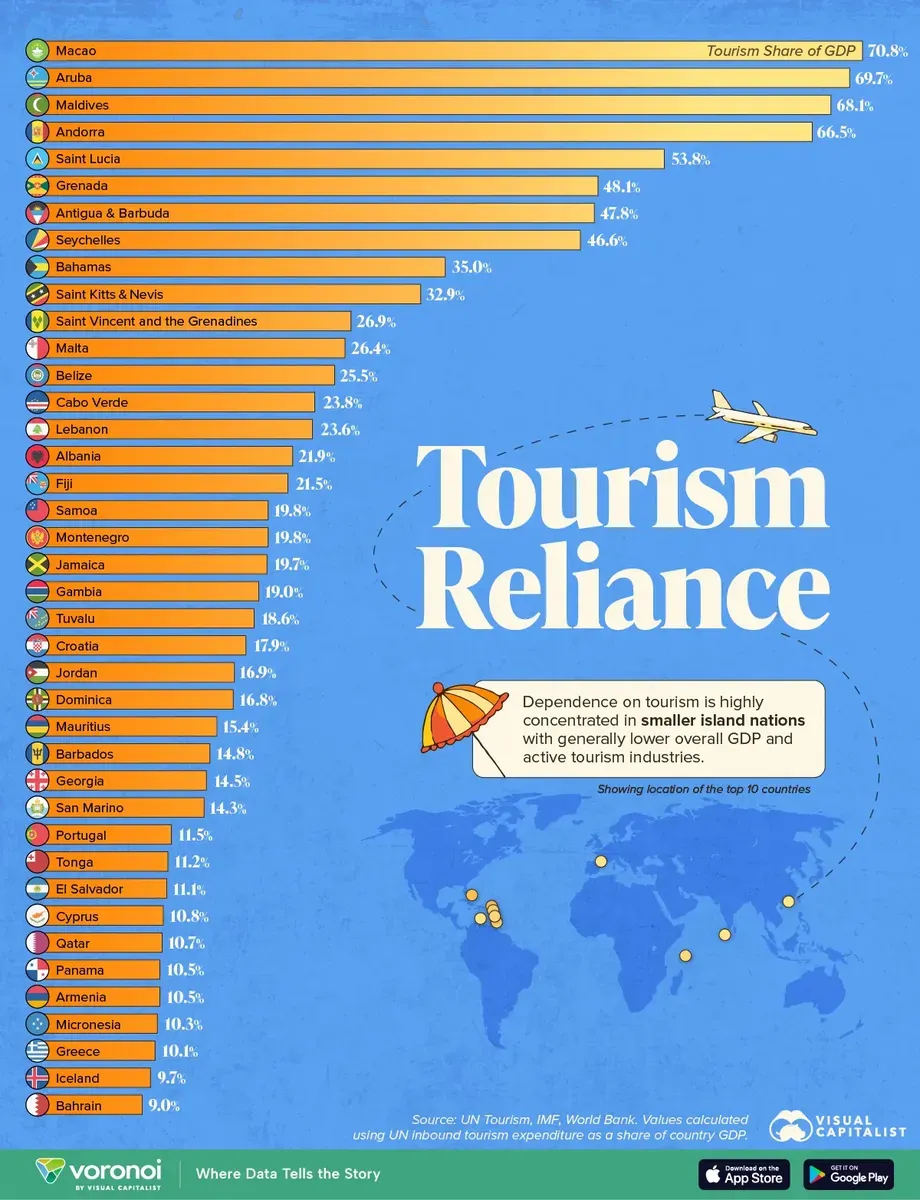
Economic Vulnerabilities and Diversification Strategies
Economies that are heavily reliant on tourism are inherently more vulnerable to global shocks, such as pandemics, economic downturns, or geopolitical instability. The COVID-19 pandemic starkly illustrated this vulnerability, as widespread travel restrictions brought global tourism to a standstill. For instance, Aruba's real GDP experienced a contraction of 24% in 2020 due to the halt in tourism, leading to significant economic hardship.
While such dependence offers potential for rapid growth during favourable times, it also necessitates robust diversification strategies. Countries with less diversified economies may face greater challenges in weathering economic storms. In contrast, nations with more varied economic bases, where tourism contributes a smaller percentage to GDP, are generally more resilient to such disruptions. The United States, for example, derives only 0.86% of its GDP from international tourism, despite significant absolute revenue, showcasing a much more diversified economic structure.
Low Reliance in Larger, Diversified Economies
In stark contrast to the small island nations, larger economies with diversified industrial and service sectors typically show a much lower percentage of GDP attributed to tourism. The United States, for example, ranks 151st on the list, with international tourism contributing a mere 0.86% to its GDP, despite generating $251.6 billion in absolute terms. This indicates a robust and multifaceted economy where tourism is one component among many.
The country least reliant on tourism in the dataset is Papua New Guinea, where tourism accounts for just 0.01% of its economic output. Guinea and Angola also exhibit very low dependency, at 0.02% of their respective GDPs. In total, 47 countries in the dataset generate less than 1% of their GDP from tourism, highlighting the vast differences in economic structure and reliance on international travel across the globe.
Geographic Clusters of Tourism Dependence
Beyond the top-tier nations, geographical clusters of higher tourism reliance are evident. Central America, Eastern Europe, and Southeast Asia, known for their popular backpacking destinations and often more affordable travel options, exhibit higher dependencies. These regions demonstrate how tourism can be a significant economic driver, particularly for countries offering unique cultural experiences and competitive pricing.
However, this reliance also brings challenges. Over-tourism, where the sheer volume of visitors strains local infrastructure and resources, can lead to social tensions and environmental degradation. Balancing the economic benefits of tourism with the need for sustainable practices and resident well-being remains a critical challenge for these regions.
Impact Analysis
The data on tourism's share of GDP underscores a critical vulnerability for many small economies. Their high dependence makes them susceptible to external shocks, as evidenced by the severe economic impact of the COVID-19 pandemic. This reliance highlights the need for economic diversification and the development of resilient policies to mitigate risks associated with a single dominant industry. For larger, diversified economies, tourism represents a significant but manageable sector, contributing to overall economic activity without posing systemic risks. The findings also point to evolving travel trends and the economic significance of popular tourist regions, emphasizing the complex interplay between global connectivity, economic policy, and national prosperity.