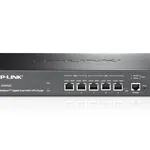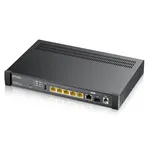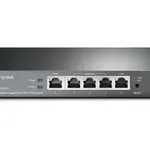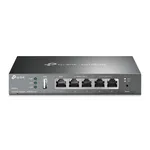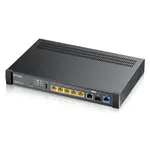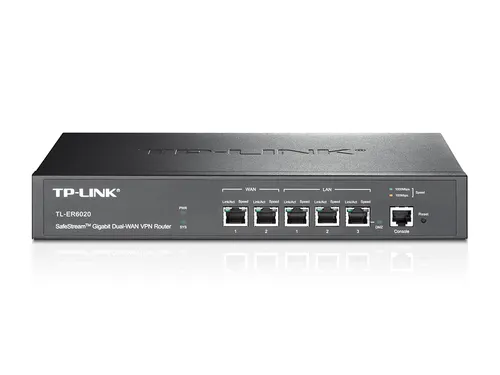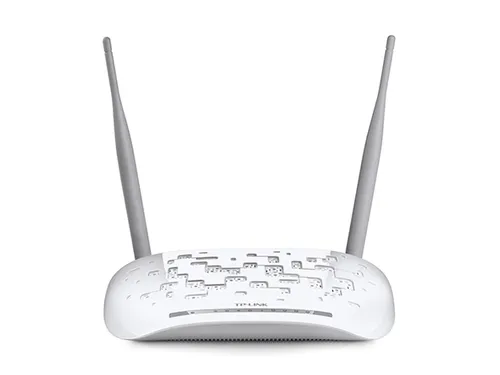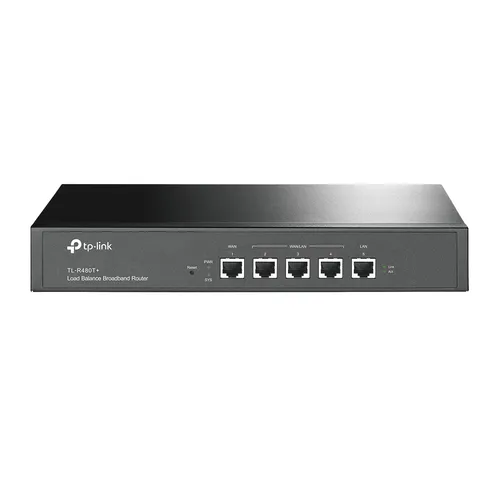


TP-Link Load Balance Broadband Wired Router (Model Not Specified)
TP-Link Load Balance Broadband Wired Router (Model Not Specified)
No stores registered at this time
Contact Us
Specifications
WAN connection
WAN connection
| Ethernet WAN |
Yes
64% have it
|
|---|---|
| DSL WAN |
No
18% do not have it
|
| SIM card slot |
No
26% do not have it
|
| 3G/4G USB modem compatibility |
No
27% do not have it
|
Network
Network
| Networking standards |
IEEE 802.3, IEEE 802.3u, IEEE 802.3x
|
|---|---|
| Ethernet interface type |
Fast Ethernet
|
| Cabling technology |
10/100Base-T(X)
|
| Ethernet LAN data rates |
10,100 Mbit/s
|
| Full duplex |
Yes
55% have it
|
| Static route |
Yes
55% have it
|
| VLAN support |
Yes
79% have it
|
| Port forwarding |
Yes
74% have it
|
| Policy-based routing |
Yes
82% have it
|
| Concurrent connections |
30000
19% better than others
|
Management features
Management features
| Web-based management |
Yes
56% have it
|
|---|---|
| Quality of Service (QoS) support |
Yes
56% have it
|
| Universal Plug and Play (UPnP) |
Yes
95% have it
|
| Reset button |
Yes
63% have it
|
| Firmware upgradeable |
Yes
95% have it
|
Ports & interfaces
Ports & interfaces
| Ethernet LAN (RJ-45) ports |
5
|
|---|---|
| Fast Ethernet (copper) ports quantity |
5
|
| RS-232 ports |
1
|
| DC-in jack |
Yes
76% have it
|
Protocols
Protocols
| DMZ support |
Yes
59% have it
|
|---|---|
| DHCP client |
Yes
60% have it
|
| DHCP server |
Yes
61% have it
|
| Supported network protocols |
TCP/IP, ICMP, PPPoE, SNTP, HTTP
|
Security
Security
| Security algorithms |
802.1x RADIUS
|
|---|---|
| MAC address filtering |
Yes
65% have it
|
| URL filtering |
Yes
83% have it
|
| IP address filtering |
Yes
89% have it
|
| DoS attack prevention |
Yes
75% have it
|
| ARP attack prevention |
Yes
55% have it
|
| Network address translation (NAT) |
Yes
68% have it
|
| System event log |
Yes
87% have it
|
Certificates
Certificates
| Compliance certificates |
RoHS
|
|---|
Packaging content
Packaging content
| Cables included |
AC, LAN (RJ-45)
|
|---|---|
| User Guide on CD-ROM |
Yes
55% have it
|
Features
Features
| Flash memory |
4
MB
23% better than others
|
|---|---|
| Internal memory |
64
MB
89% better than others
|
| Internal memory type |
DRAM
|
| Certification |
CE, FCC, RoHS
|
Design
Design
| Product colour |
Black
|
|---|---|
| Rack mounting |
Yes
85% have it
|
| LED indicators |
Yes
57% have it
|
Power
Power
| Power source type |
AC
|
|---|---|
| AC input voltage |
220 - 240 V
|
| AC input frequency |
50 - 60 Hz
|
Operational conditions
Operational conditions
| Operating temperature (T-T) |
0 - 40 °C
|
|---|---|
| Storage temperature (T-T) |
-40 - 70 °C
|
| Operating relative humidity (H-H) |
10 - 90%
|
| Storage relative humidity (H-H) |
5 - 90%
|
Weight & dimensions
Weight & dimensions
| Width |
294
mm
79% better than others
|
|---|---|
| Depth |
180
mm
27% better than others
|
| Height |
44
mm
75% better than others
|
| Weight |
2.35
kg
75% better than others
|
Packaging data
Packaging data
| Package width |
250
mm
39% better than others
|
|---|---|
| Package depth |
400
mm
19% better than others
|
| Package height |
80
mm
85% better than others
|
| Package weight |
1.8
kg
58% better than others
|
Logistics data
Logistics data
| Harmonized System (HS) code |
85176990
45% better than others
|
|---|
Disclaimer: Information on this page may need review. If you notice any discrepancies, please report them

In the realm of network infrastructure, particularly for small to medium-sized businesses or demanding home networks, the need for robust and reliable internet connectivity is paramount. Load balancing routers are designed to aggregate multiple internet connections, distributing traffic intelligently to ensure optimal performance, redundancy, and uptime. This TP-Link Load Balance Broadband Wired Router, while specific model details are elusive in the provided context, represents a category of devices crucial for maintaining seamless online operations.
The core function of a load balancing router is to prevent bottlenecks and single points of failure. By utilizing multiple WAN (Wide Area Network) ports, it can connect to different Internet Service Providers (ISPs) or even multiple connections from a single ISP. This not only increases overall bandwidth but also provides a critical failover mechanism. Should one internet connection experience an outage, the router automatically redirects traffic through the remaining active connections, ensuring business continuity and uninterrupted service for users. This makes it an indispensable tool for environments where downtime is costly.
Key Features and Market Positioning
While the exact specifications for this particular TP-Link model are not detailed, typical load balancing routers from reputable brands like TP-Link offer features such as multiple Gigabit WAN ports, VPN support (for secure remote access), advanced Quality of Service (QoS) controls for traffic prioritization, and robust firewall capabilities for network security. The emphasis is on reliability, performance, and manageability. For businesses that rely heavily on cloud services, VoIP, or constant data transfer, a load balancing solution mitigates the risks associated with single-link internet dependence. Its market positioning is firmly within the professional and prosumer segments, offering a tangible upgrade in network resilience and efficiency over standard single-WAN routers.
Pros & Cons
Pros
What we love about this product
- Enhanced Network Redundancy: Capable of utilizing multiple WAN connections to provide automatic failover, ensuring continuous internet access.
- Increased Bandwidth Aggregation: Distributes internet traffic across multiple links, potentially increasing overall available bandwidth.
- Improved Network Stability: Intelligent traffic management helps prevent congestion and ensures smoother data flow for critical applications.
- Cost-Effective Solution: Offers a more resilient and performant network without necessarily requiring a single, high-cost, high-speed internet line.
Cons
Points to consider before buying
- Limited Specifics: The absence of detailed specifications (e.g., number of WAN/LAN ports, throughput speeds, specific VPN protocols) makes a precise technical evaluation challenging.
- Potential Complexity: Advanced features like load balancing and QoS can require a steeper learning curve for initial setup and ongoing management compared to basic routers.
- Hardware Limitations: Without knowing the specific hardware, it's impossible to ascertain its capacity for handling very high traffic loads or advanced security features.