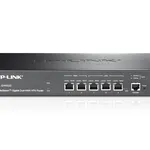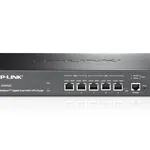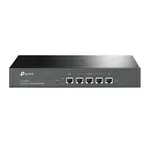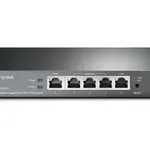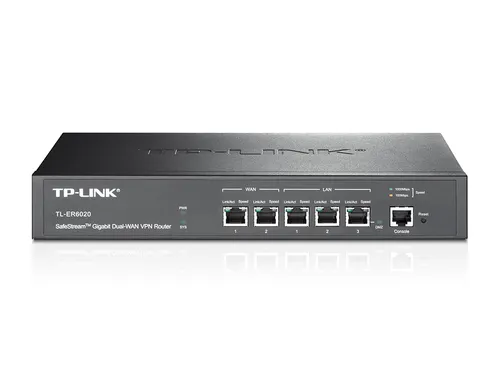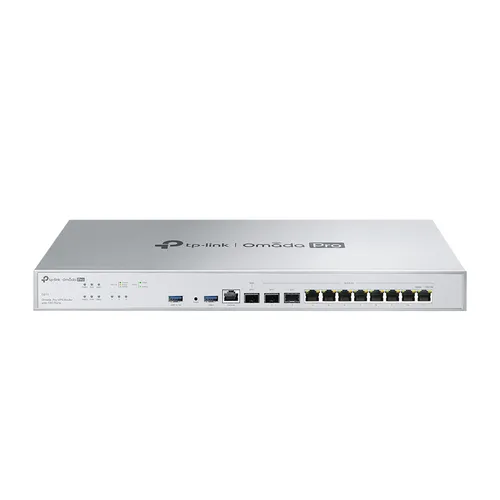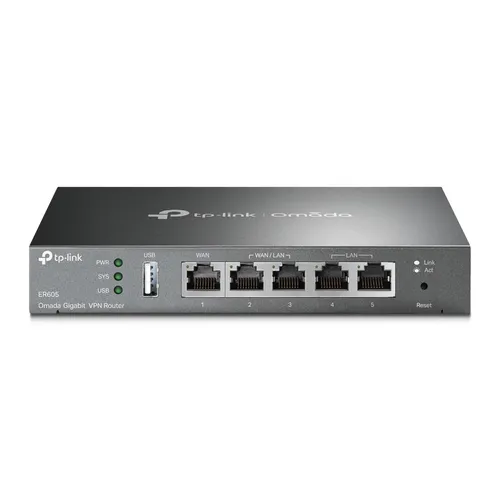


TP-Link Omada ER605 Gigabit VPN Wired Router
Specifications
WAN connection
WAN connection
| Ethernet WAN |
Yes
65% have it
|
|---|---|
| DSL WAN |
No
43% do not have it
|
| SIM card slot |
No
17% do not have it
|
| 3G/4G USB modem compatibility |
No
14% do not have it
|
Network
Network
| Networking standards |
IEEE 802.1Q, IEEE 802.3, IEEE 802.3ab, IEEE 802.3u, IEEE 802.3x
|
|---|---|
| Ethernet interface type |
Gigabit Ethernet
|
| Cabling technology |
10/100/1000Base-T(X)
|
| Ethernet LAN data rates |
10,100,1000 Mbit/s
|
| VLAN support |
Yes
73% have it
|
| Traffic control |
Yes
63% have it
|
| Policy-based routing |
Yes
82% have it
|
| Concurrent connections |
150000
82% better than others
|
Management features
Management features
| Web-based management |
Yes
83% have it
|
|---|---|
| Universal Plug and Play (UPnP) |
Yes
85% have it
|
| Reset button |
Yes
76% have it
|
Ports & interfaces
Ports & interfaces
| Ethernet LAN (RJ-45) ports |
5
|
|---|---|
| USB ports quantity |
1
|
Protocols
Protocols
| DMZ support |
Yes
90% have it
|
|---|---|
| Routing protocols |
RIP-1, RIP-2
|
| Management protocols |
Telnet
|
| DHCP client |
Yes
55% have it
|
| DHCP server |
Yes
64% have it
|
| Supported network protocols |
TCP/IP, DHCP, ICMP, NAT, PPPoE, SNTP, HTTP, DNS, IPsec, PPTP, L2TP
|
| Supported protocols |
IPsec/PPTP/L2TP
|
Security
Security
| Security algorithms |
3DES, 128-bit AES, 192-bit AES, 256-bit AES, DES, MD5, SHA-1
|
|---|---|
| Firewall |
Yes
71% have it
|
| Authentication method |
SHA-1, MD5
|
| URL filtering |
Yes
90% have it
|
| DoS attack prevention |
Yes
71% have it
|
| ARP attack prevention |
Yes
94% have it
|
| Network address translation (NAT) |
Yes
71% have it
|
| System event log |
Yes
91% have it
|
| VPN tunnels quantity |
20
54% better than others
|
| VPN support |
• 20 IPsec VPN Tunnels
• LAN-to-LAN, Client-to-LAN
• Main, Aggressive Negotiation Mode
• DES, 3DES, AES128, AES192, AES256 Encryption Algorithm
• IKEv1/v2
• MD5, SHA1 Authentication Algorithm
• NAT Traversal (NAT-T)
• Dead Peer Detection (DPD)
• Perfect Forward Secrecy (PFS)
• PPTP VPN Server
• 10 PPTP VPN Clients
• 16 Tunnels
• PPTP with MPPE Encryption
• L2TP VPN Server
• 10 L2TP VPN Clients
• 16 Tunnels
• L2TP over IPSec
• OpenVPN Server
• 10 OpenVPN Clients
• 16 OpenVPN Tunnels
|
| NAT functionality |
• One-to-One NAT
• Multi-Net NAT
• Virtual Server
• Port Triggering
• NAT-DMZ
• FTP/H.323/SIP/IPSec/PPTP ALG, UPnP
|
Certificates
Certificates
| Compliance certificates |
RoHS
|
|---|
Packaging content
Packaging content
| Cables included |
AC
|
|---|---|
| Manual |
Yes
73% have it
|
| Quick start guide |
Yes
80% have it
|
| Quick installation guide |
Yes
61% have it
|
Features
Features
| Flash memory |
128
MB
67% better than others
|
|---|---|
| Internal memory |
256
MB
43% better than others
|
| Internal memory type |
DRAM
|
| Windows operating systems supported |
Windows 10, Windows 2000, Windows 7, Windows 8, Windows 8.1, Windows 98SE, Windows NT, Windows Vista, Windows XP
|
| Mac operating systems supported |
MacOS
|
| Linux operating systems supported |
Yes
85% have it
|
| Certification |
CE, FCC, RoHS
|
Design
Design
| Product colour |
Black
|
|---|---|
| Rack mounting |
Yes
88% have it
|
| Rack capacity |
1U
|
| LED indicators |
Activity, LAN, System, USB, WAN
|
Power
Power
| Power consumption (typical) |
7.94
W
94% better than others
|
|---|---|
| Power source type |
AC
|
| AC input voltage |
120 - 240 V
|
| AC input frequency |
50 - 60 Hz
|
Operational conditions
Operational conditions
| Operating temperature (T-T) |
0 - 40 °C
|
|---|---|
| Storage temperature (T-T) |
-40 - 70 °C
|
| Operating relative humidity (H-H) |
10 - 90%
|
| Storage relative humidity (H-H) |
5 - 90%
|
Weight & dimensions
Weight & dimensions
| Width |
158
mm
42% better than others
|
|---|---|
| Depth |
101
mm
73% better than others
|
| Height |
25
mm
67% better than others
|
Packaging data
Packaging data
| Package width |
190
mm
79% better than others
|
|---|---|
| Package depth |
254
mm
43% better than others
|
| Package height |
60
mm
55% better than others
|
| Package weight |
650
g
71% better than others
|
Disclaimer: Information on this page may need review. If you notice any discrepancies, please report them

The TP-Link Omada ER605 stands as a robust and highly capable wired router designed for small to medium-sized businesses and advanced home networks demanding reliable and secure connectivity. As a core component of the Omada Software Defined Networking (SDN) platform, it offers centralized cloud management, simplifying deployment and administration for a unified network experience. Its Gigabit Ethernet ports ensure high-speed data transfer, crucial for bandwidth-intensive applications and smooth operation of connected devices.
Beyond its impressive speed capabilities, the ER605 excels in security and versatility. It supports multiple VPN protocols, including OpenVPN, L2TP, and PPTP, alongside IPSec VPN tunnels, providing secure remote access and site-to-site connections. This makes it an ideal solution for businesses with distributed workforces or multiple office locations. The router's integration with the Omada SDN controller allows for advanced features like VLAN segmentation, traffic prioritization (QoS), and robust firewall capabilities, all manageable through an intuitive interface. This combination of performance, security, and centralized management positions the ER605 as a compelling choice for network professionals seeking a scalable and efficient routing solution.
Key Features and Performance
Equipped with 1 WAN Gigabit Ethernet port and 4 LAN Gigabit Ethernet ports, the TP-Link Omada ER605 is engineered for high-throughput network traffic. The inclusion of multiple VPN capabilities is a significant advantage, allowing for up to 3 WAN ports to be utilized for load balancing or redundancy, enhancing network uptime and performance. The router's ability to manage up to 50 Omada devices, including access points and switches, through its integrated SDN controller underscores its scalability. Firewall throughput is rated at 1 Gbps, ensuring that even demanding internet connections are handled efficiently without becoming a bottleneck. This makes it suitable for environments with high internet subscription speeds.
Security and Management
Security is paramount with the ER605, featuring robust firewall protection and comprehensive VPN support. The integration with the Omada SDN controller, accessible via cloud or on-premise management, provides a single pane of glass for monitoring, configuration, and troubleshooting. This simplifies network management significantly, especially for IT teams managing multiple sites. The router also supports VLANs for network segmentation, improving security and performance by isolating different types of traffic. Its advanced features, such as policy-based routing and load balancing, further enhance network control and reliability.
Pros & Cons
Pros
What we love about this product
- High-Speed Gigabit Connectivity: Features 1 WAN and 4 LAN Gigabit Ethernet ports for fast and reliable data transfer.
- Versatile VPN Support: Offers multiple VPN protocols (IPSec, L2TP, PPTP, OpenVPN) for secure remote and site-to-site connectivity.
- Omada SDN Integration: Enables centralized cloud management for simplified deployment, monitoring, and control of the entire Omada network ecosystem.
- Load Balancing and Redundancy: Supports up to 3 WAN ports for advanced load balancing and failover capabilities, enhancing network uptime.
- Robust Security Features: Includes comprehensive firewall protection and VLAN support for network segmentation and enhanced security.
Cons
Points to consider before buying
- Limited Wi-Fi Capability: As a wired-only router, it does not provide integrated Wi-Fi functionality, requiring separate access points.
- No USB Port: Lacks a USB port, limiting options for direct storage or firmware update functionalities.
- On-Premise Controller Required for Full Features: While cloud management is available, some advanced features might be best utilized with an on-premise OC200/OC300 controller for optimal performance and control.