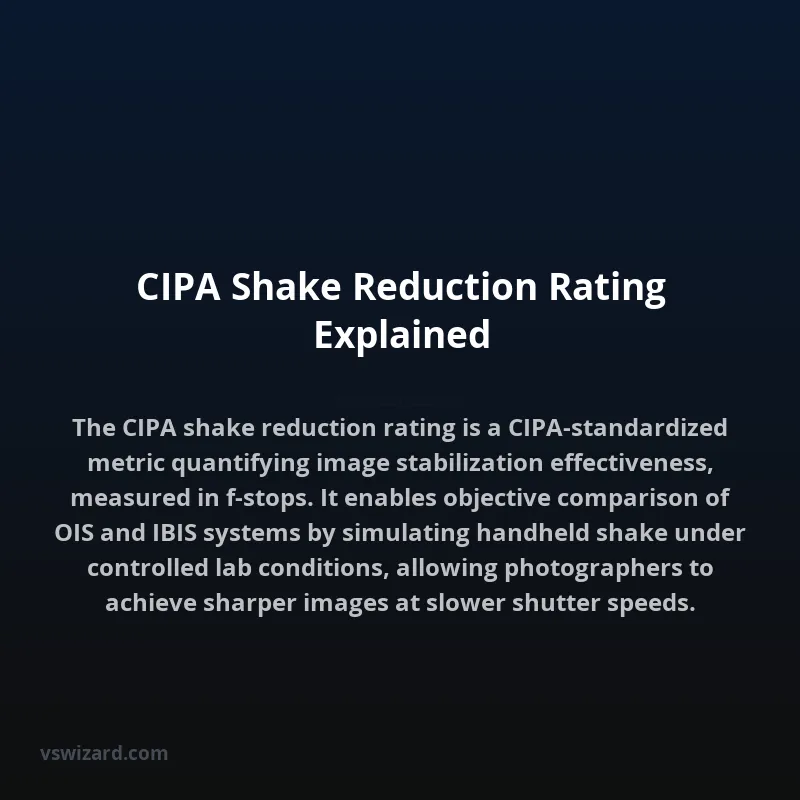
The CIPA shake reduction rating is a standardized metric developed by the Camera & Imaging Products Association (CIPA) to quantify the effectiveness of in-camera or in-lens image stabilization systems. This rating is crucial for consumers and professionals alike, providing an objective basis for comparing the performance of different stabilization technologies across various camera bodies and interchangeable lenses. It is derived from rigorous laboratory testing protocols designed to simulate real-world handholding conditions and measure the degree to which camera shake is counteracted. The rating is typically expressed in a numerical value, representing the number of f-stops of stabilization achieved, which directly correlates to the shutter speed at which blur can be effectively avoided.
The methodology behind the CIPA rating involves precisely inducing controlled vibrations on a test camera-lens assembly and then measuring the resultant image displacement. This displacement is analyzed across multiple frequencies and amplitudes representative of typical handheld camera motion. By comparing the image quality (specifically, the absence of motion blur) of stabilized shots against unstabilized reference shots taken at progressively slower shutter speeds, the system's ability to compensate for shake is determined. A higher CIPA rating signifies superior stabilization performance, allowing photographers to achieve sharper images at slower shutter speeds than would otherwise be possible, thereby expanding creative possibilities in low-light environments or when using telephoto focal lengths.
Mechanism of Action in Image Stabilization
Image stabilization (IS) systems, whether optical (OIS) or sensor-shift (IBIS), aim to counteract the inherent motion blur caused by involuntary camera movement during image capture. OIS systems typically employ gyroscopic sensors to detect angular acceleration and deceleration. These sensors then drive micro-actuators that shift a lens element or group of elements in the opposite direction of the detected movement, effectively neutralizing the shake relative to the image sensor. IBIS systems operate similarly but instead move the image sensor itself along multiple axes (pitch, yaw, and sometimes roll or X-Y translation) to maintain its position relative to the optical path. Advanced systems may also incorporate electronic image stabilization (EIS) or hybrid approaches that combine optical and digital processing, often utilizing data from image sensors to refine stabilization algorithms.
Industry Standards and CIPA's Role
The Camera & Imaging Products Association (CIPA) plays a pivotal role in establishing and maintaining technical standards within the digital imaging industry. The CIPA shake reduction rating standard (often referred to as the CIPA DC-010 standard for image stabilization) provides a uniform testing procedure, ensuring that performance claims are comparable across manufacturers. Prior to standardized ratings, manufacturers often used proprietary metrics or qualitative descriptions, leading to confusion and difficulty in direct comparison. CIPA's involvement mandates specific testing conditions, including vibration frequencies, amplitudes, shutter speeds, and image analysis criteria, to ensure the integrity and reproducibility of the shake reduction measurements. This standardization facilitates informed purchasing decisions and promotes technological advancement through fair competition.
Evolution of Shake Reduction Technologies
The evolution of shake reduction technologies has progressed significantly from early optical image stabilization implementations. Initially, stabilization was primarily integrated into lenses, offering benefits specific to that lens's focal length and optical design. The advent of in-body image stabilization (IBIS) revolutionized system flexibility, allowing any lens, including vintage or manual-focus optics, to benefit from stabilization. More recent advancements include the integration of AI and machine learning algorithms to predict and counteract shake more effectively, as well as the development of 5-axis stabilization that compensates for a broader range of motion. Hybrid systems, combining optical and electronic stabilization, further enhance performance, particularly for video capture where smooth motion is paramount. The CIPA rating has adapted to reflect these advancements, although the core principle of measuring compensation in f-stops remains consistent.
Practical Implementation and Performance Metrics
Implementing shake reduction involves sophisticated hardware and software integration. Gyroscopic sensors, accelerometers, and sophisticated control processors are essential for detecting and compensating for motion. The performance is empirically validated using a Modulation Transfer Function (MTF) analysis or similar image quality metrics. The CIPA rating specifically quantifies this performance in terms of 'stops' of stabilization. For example, a rating of 4 stops means that a photographer can theoretically shoot handheld at a shutter speed four full stops slower than the reciprocal of the focal length (e.g., 1/30s instead of 1/250s for a 50mm lens) and achieve comparable sharpness to an image taken at the faster, blur-free speed without stabilization. Real-world performance can vary based on individual user technique, the specific shooting scenario (e.g., panning vs. static subject), and the presence of other environmental factors.
Comparative Performance: CIPA Rating vs. Real-World Effectiveness
| Manufacturer/System Type | Example CIPA Rating (Stops) | Typical Application | Notes |
|---|---|---|---|
| Optical Image Stabilization (OIS) - Lens Based | 2-5 Stops | Telephoto lenses, specific camera bodies | Effective at specific focal lengths; can be turned off for tripod use. |
| In-Body Image Stabilization (IBIS) - Sensor Based | 3-8.5 Stops | Wide range of camera bodies, compatible with all lenses | Stabilizes entire imaging plane; offers flexibility for prime lenses and legacy optics. |
| Hybrid Stabilization (IBIS + OIS) | 5-10 Stops | High-end camera bodies and lenses | Combines sensor and lens-based compensation for maximum effectiveness. |
| Electronic Image Stabilization (EIS) - Digital | Variable (often software-based) | Video recording, smartphone cameras | Crop factor introduced; can introduce digital artifacts; less effective for stills. |
Advantages and Limitations
The primary advantage of a CIPA-rated shake reduction system is the ability to capture sharper images at slower shutter speeds, significantly reducing motion blur. This is particularly beneficial in low-light conditions, when using telephoto lenses that magnify camera shake, or when a tripod is impractical. It expands the handheld shooting envelope, enabling greater creative freedom. However, limitations exist. The CIPA rating is a standardized lab metric and may not perfectly reflect real-world performance, which is influenced by individual user steadiness, panning motion, and the specific frequencies of shake encountered. Furthermore, stabilization systems are less effective against subject motion blur and cannot compensate for shake beyond their designed compensation range. Very high stabilization levels can sometimes introduce their own subtle artifacts or lag, especially in video.
Future Outlook
The trajectory of shake reduction technology points towards even more sophisticated and integrated systems. Expect continued advancements in the predictive capabilities of AI-driven algorithms, enhanced multi-axis stabilization that addresses a wider spectrum of motion, and improved synergy between IBIS, OIS, and digital processing. The CIPA rating system will likely evolve to encompass new performance metrics or testing scenarios that better represent emerging capture modalities and user needs, such as ultra-high-resolution sensors or advanced video stabilization requirements. The pursuit of greater stabilization efficacy remains a core engineering challenge, driving innovation in sensor technology, actuator precision, and computational photography.