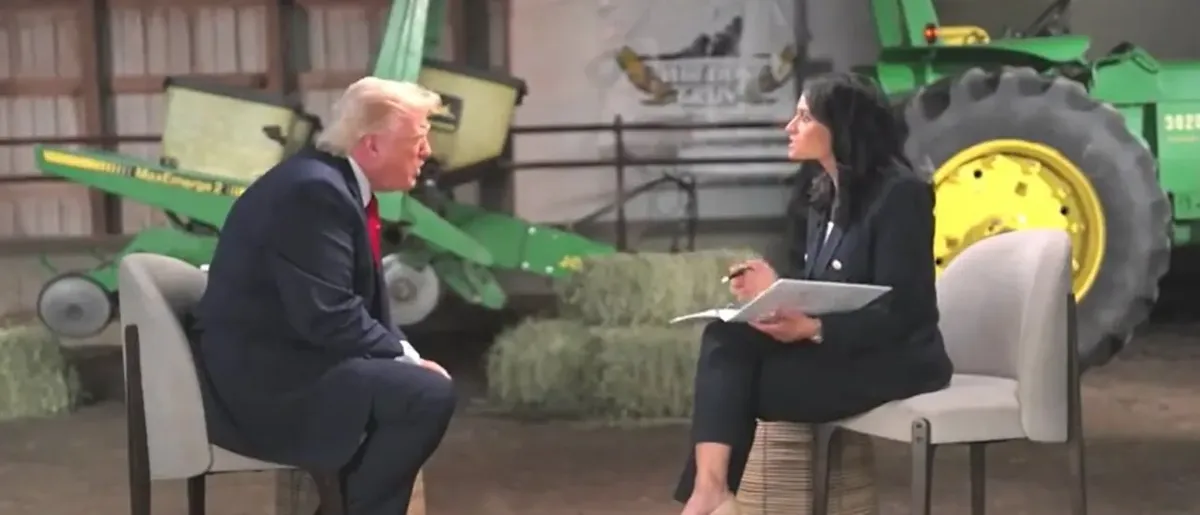
President Donald Trump engaged in a tense interview with "Meet the Press" host Kristen Welker, touching upon the ongoing geopolitical situation with Iran, economic challenges facing American farmers, and his allegations of election fraud, ultimately concluding the interview prematurely. The discussion unfolded against a backdrop of stormy weather, mirroring the contentious nature of the exchange.
Trump's interview occurred during a visit to Wisconsin, where he aimed to discuss agricultural policy and his broader economic agenda. The conversation quickly became confrontational as Welker pressed the President on rising energy prices, linking them to the U.S. military's operations against Iran. Trump countered that these prices would decrease once the conflict de-escalated.
Economic Impacts and Agricultural Concerns
Welker highlighted the plight of American farmers, citing that approximately 70% reported an inability to afford essential fertilizer. This assertion was made as the sound of rain intensified on the interview's location. She directly questioned Trump about his message to these struggling agricultural producers, many of whom are vocal supporters.
Responding to the concerns, Trump stated, "You know, I gave farmers $28 billion because China took advantage." He emphasized his commitment to the farming community, adding, "I love the farmers, the farmers trust me." This statement alluded to previous trade disputes and support measures implemented during his administration.
The availability and cost of agricultural inputs, particularly fertilizers, are intricately linked to global trade routes and geopolitical stability. Key precursors for urea and sulfur, essential for many fertilizers, are heavily reliant on transit through the Strait of Hormuz. Roughly half of the world's supply of these precursors passes through this critical waterway. Furthermore, Saudi Arabia plays a significant role as a primary supplier of phosphates to the United States, underscoring the international dimensions of agricultural economics.
Data from AAA indicated that the average price for a gallon of gasoline in the U.S. was $4.174 at the time of the interview. This represented a substantial increase from $2.98 per gallon recorded shortly before the commencement of U.S. military operations concerning Iran. However, prices had seen a slight decrease from their peak in late May. Similarly, diesel fuel, a crucial commodity for both the agricultural and trucking sectors, had risen significantly, averaging $5.341 a gallon, though also showing a recent dip from its highest point.
Allegations of Election Irregularities
The interview also delved into President Trump's persistent claims of election fraud, particularly focusing on the vote-counting processes in California's primary elections. Specific attention was given to the tight race in Los Angeles, where a surge in late-counted ballots appeared to benefit progressive Democratic candidate Nithya Raman, potentially impacting the chances of Republican contender Spencer Pratt in the upcoming general election.
"The election was rigged. It was a dirty election and it’s happening again right now in California," Trump asserted to Welker. He expressed strong skepticism about the prolonged counting process, stating, "Because they’re cheating on the election." Trump characterized the situation as ongoing and indicative of systemic issues within the electoral process.
Welker attempted to challenge Trump's assertions by noting the absence of evidence presented to support his claims of a rigged election. In response, Trump broadly criticized major news networks, including NBC, ABC, CNN, and CBS, labeling them as "crooked networks." This rhetoric reflects a recurring pattern of distrust and criticism directed at established media outlets by the President.
The interview concluded abruptly when Trump declared, "Let’s call it quits because I’ve had enough," before bidding Welker farewell. The President's decision to terminate the interview early underscored the deep-seated disagreements and the challenging dynamic between him and the "Meet the Press" host.
Impact Analysis
The exchange between President Trump and Kristen Welker highlights several critical areas of public discourse: the economic ramifications of foreign policy decisions, the vulnerability of the agricultural sector to global disruptions, and the ongoing debate surrounding election integrity. The President's strong stance on alleged fraud in California, coupled with his defense of his administration's support for farmers amidst rising input costs, signals key themes likely to resonate in future political messaging.
Furthermore, the connection drawn between energy prices, the conflict with Iran, and their impact on the agricultural supply chain underscores the interconnectedness of global events. The President's assertion that market fluctuations are temporary and tied to geopolitical resolutions suggests a narrative focused on eventual economic recovery. The interview's abrupt end, however, reflects the often-polarized nature of political interviews and the challenges of achieving consensus or detailed explanations on complex issues.