In the 1970s, paleontologist John Ostrom reignited the theory that modern birds evolved from theropod dinosaurs, a group that includes the formidable Tyrannosaurus rex. However, a crucial piece of evidence remained elusive: fossilized feathered dinosaurs. This gap in understanding was dramatically bridged by a serendipitous discovery in China, which fundamentally altered the scientific perspective on avian evolution.
The unearthed fossil, a small, chicken-sized dinosaur, was meticulously preserved in volcanic ash, offering an unprecedented glimpse into a lost world. The most striking feature was not just the skeletal structure, but the halo of delicate, filament-like strands encircling the bones. These structures bore a remarkable resemblance to the downy feathers of modern birds, providing compelling visual evidence of a direct link between dinosaurs and avian species.
The Discovery That Rewrote Paleontology
The pivotal moment occurred in the autumn of 1996. Paleontologists gathered for the annual meeting of the Society of Vertebrate Paleontology in New York City. Among them was Phil Currie, a renowned dinosaur hunter who had recently been in China. While visiting a Beijing museum, Currie noticed an extraordinary fossil that had been unearthed by a farmer named Yumin Li two months prior. This fossil was a small coelurosaur theropod, remarkably similar to Compsognathus, a species previously suggested by paleontologist Thomas Henry Huxley in the 1860s as a potential transitional form for bird evolution.
Currie and his Chinese colleague Pei-ji Chen captured photographs of the specimen. These images, presented at the conference, quickly generated immense excitement. John Ostrom, whose earlier work on Deinonychus had been instrumental in proposing the dinosaur-bird link, was shown the photographs. The emotional impact was profound; Ostrom was visibly moved, recognizing the discovery as the definitive evidence he had long sought.
The Significance of Sinosauropteryx
The fossilized creature, later formally described and named Sinosauropteryx, meaning "Chinese reptilian wing," became the cornerstone for a paradigm shift in paleontology. This discovery triggered an intense search for more feathered dinosaur fossils, particularly in China's Liaoning Province. The region's unique geological history, marked by rapid volcanic eruptions during the Jurassic and Cretaceous periods, had created ideal conditions for preserving soft tissues like feathers, effectively creating a "dinosaurian Pompeii."
The implications of Sinosauropteryx were far-reaching. It provided concrete proof for Ostrom's hypothesis and confirmed the evolutionary lineage of birds from theropod dinosaurs. This discovery validated the theory that feathered dinosaurs were not an anomaly but rather a widespread phenomenon across various dinosaur groups, fundamentally changing how scientists perceived these ancient creatures.
A Renaissance in Feathered Dinosaur Discoveries
Following the discovery of Sinosauropteryx, paleontologists and fossil hunters in China unearthed a plethora of feathered dinosaur specimens. These findings spanned a wide range of species, from the simple filament-like structures found on Beipiaosaurus to the more complex, paintbrush-like feathers of Sinosauropteryx itself. The specimens revealed an astonishing diversity in feather types and arrangements, adorning creatures of various sizes and diets.
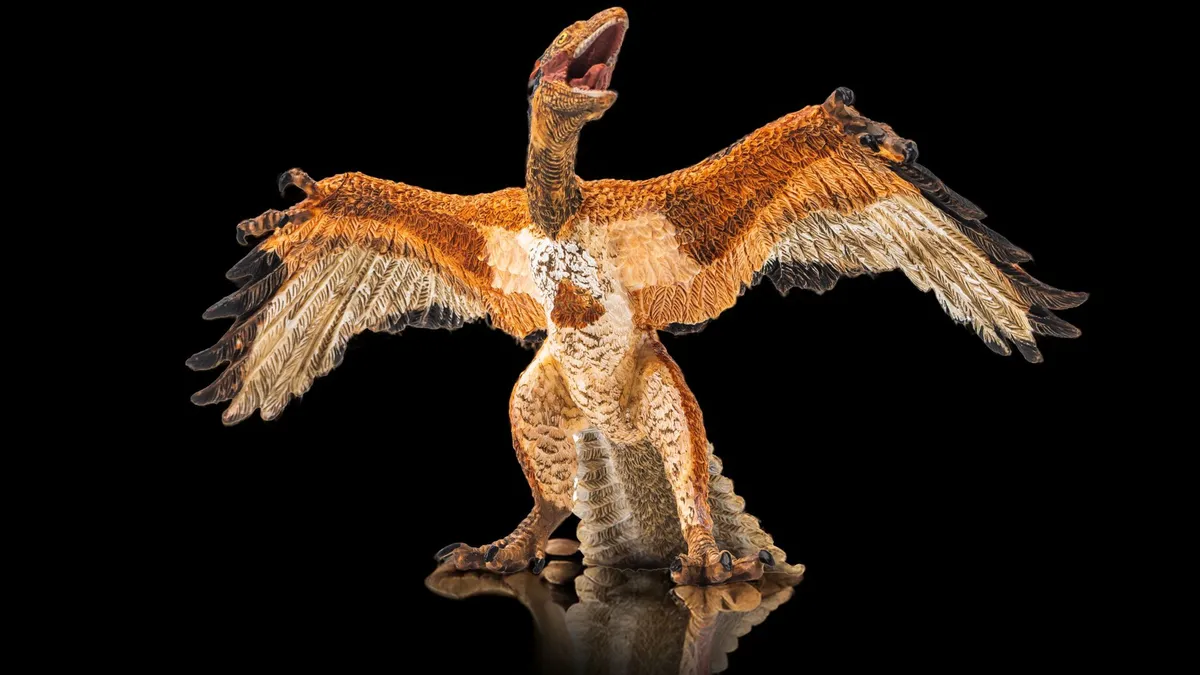
More elaborate feathers, including true quill pens with shafts, barbs, and vanes, were discovered in species such as Caudipteryx and Sinornithosaurus. These advanced feathers, similar to those found on modern birds, were observed lining the arms of creatures like Microraptor, forming primitive wings. This evidence further solidified the connection between dinosaurs and birds, suggesting that feathers evolved for purposes beyond flight, potentially for insulation, display, or brooding.
Expanding the Scope: Feathered Dinosaurs Beyond China
While China became a hotspot for feathered dinosaur discoveries, similar fossils began to emerge from other parts of the world. The discovery of Kulindadromeus in Siberia, a plant-eating dinosaur with a remarkable array of feathers and scales, demonstrated that feather-like structures were not exclusive to theropods. This finding expanded the evolutionary narrative, indicating that the origins of feather-like structures might predate the diversification of theropod dinosaurs or were acquired independently by other dinosaur lineages.
The presence of diverse feather types, from simple filaments to complex vaned feathers, across numerous dinosaur species, both carnivorous and herbivorous, provided irrefutable evidence for the dinosaur-bird link. The scientific community largely accepted the consensus that birds are living dinosaurs, a testament to the power of fossil discoveries to reshape our understanding of prehistoric life.
Verifying Feathered Fossils: Scientific Scrutiny and Proof
Initially, some scientists questioned whether the delicate fossilized structures were indeed true feathers. Concerns were raised that they might be degraded skin or artifacts of fossilization. However, subsequent discoveries of unequivocally pennaceous feathers in species like Caudipteryx and Microraptor bolstered the case for genuine feathers in other specimens.
Further analysis, including microscopic examination and chemical composition studies, confirmed the nature of these structures. They shared key characteristics with modern bird feathers, such as hollow shafts, the presence of CBP proteins, and melanosomes – the pigment-carrying organelles. These scientific validations solidified the interpretation of these structures as true feathers, reinforcing the evolutionary narrative.
The Irrefutable Evidence in Amber
One of the most compelling pieces of evidence comes from a fossil discovered in Myanmar in 2016: a tail of a juvenile theropod preserved in amber. This specimen, shrouded in feathers that retain remarkable three-dimensional detail, offers an unparalleled look at these ancient structures. The feathers, complete with central shafts, branching barbs, and barbules, are clearly shown growing from follicles in the dinosaur's skin.
This amber-encased fossil fulfills all the criteria used to define feathers in modern birds. Its pristine preservation provides an almost "living" impression of these structures, leaving no doubt that they are indeed feathers, unequivocally attached to a dinosaur. This extraordinary find serves as a powerful, tangible link in the evolutionary chain connecting dinosaurs to birds.
Impact Analysis
The discovery and subsequent analysis of feathered dinosaur fossils have irrevocably transformed our understanding of life's history on Earth. It has not only provided definitive proof for the dinosaur-to-bird evolutionary link, a theory debated for decades, but has also revealed the incredible diversity and complexity of dinosaur integument. The findings have spurred new research avenues into the evolution of flight, feather function, and dinosaur coloration, fundamentally reshaping paleontological research and public perception of these magnificent creatures.