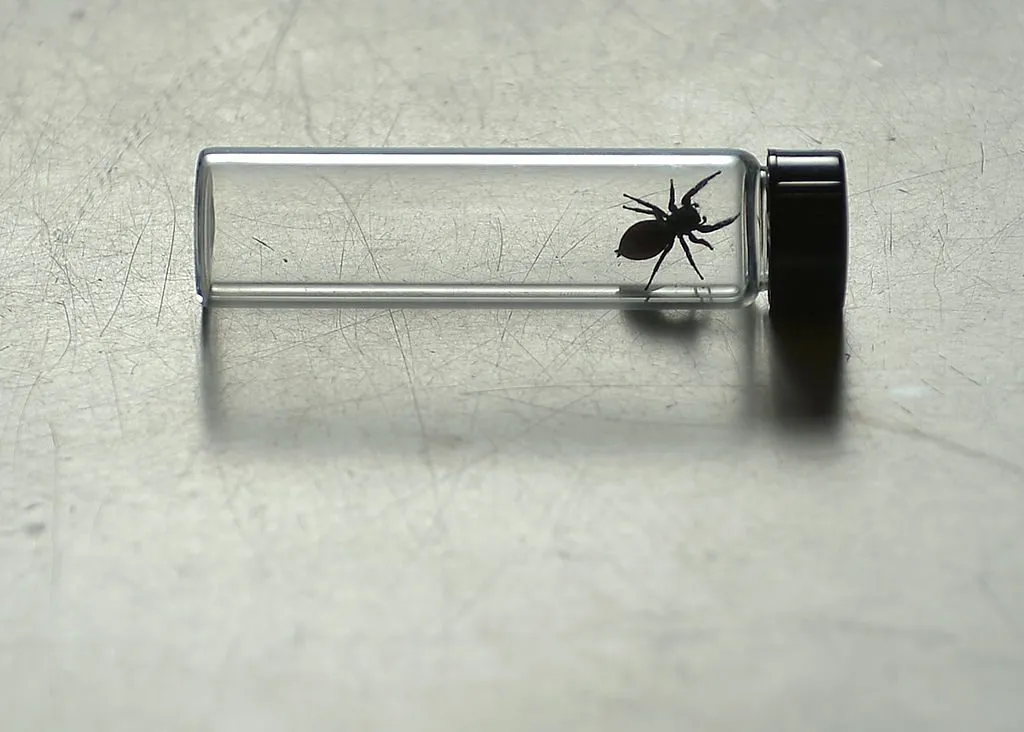
In 2012, two pioneering arachnids embarked on an extraordinary journey beyond Earth, venturing aboard the International Space Station (ISS). These intrepid 'spidernauts' included Nefertiti, a Johnson jumping spider, and Cleopatra, a zebra jumping spider. Their mission was to meticulously study how these small creatures adapted to the unique challenges of a microgravity environment. This scientific endeavor marked a significant step in understanding invertebrate responses to extraterrestrial conditions, offering valuable insights for future biological research in space.
The presence of these spiders on the ISS was not merely symbolic; it represented a controlled experiment designed to observe fundamental behaviors under unprecedented physical conditions. Researchers were particularly keen to see if the absence of typical gravitational cues would impair their hunting instincts and spatial orientation. The results of this mission provided crucial data on the resilience and adaptability of terrestrial life when exposed to the rigors of spaceflight.
Arachnids in Orbit: The ISS Spider Mission
Behavioral Adaptations in Microgravity
It was quickly observed that Nefertiti, one of the spidernauts, demonstrated remarkable agility and effectiveness in her hunting pursuits. Despite the potential for disorientation that microgravity might impose, she successfully captured her prey, which consisted of fruit flies. This observation was critical, as it indicated that fundamental predatory behaviors, honed over evolutionary timescales on Earth, could remain largely intact even when subjected to the extreme conditions of orbital space. The spiders' ability to orient themselves and execute complex hunting maneuvers without the familiar pull of gravity was a key finding of the mission.
Furthermore, the study aimed to document any changes in the spiders' web-building activities or their methods of locomotion. While the provided details focus on Nefertiti's hunting success, the broader implications for spider behavior in space remained a subject of ongoing analysis. Understanding these adaptations is vital for potential future applications, such as using spiders in controlled environments for scientific research or even considering their role in long-duration space missions.
Record-Breaking Durations and Survival
The mission achieved a significant milestone, setting a new record for the longest duration any spider had spent in space, with Nefertiti remaining aboard the ISS for an impressive 100 days. This extended period allowed for comprehensive observation of her adaptation and behavior over a considerable timeframe. The success of the mission was further underscored by Nefertiti's ability to not only survive but also thrive in orbit for this record duration, providing invaluable data for researchers.
Upon returning to Earth, Nefertiti became the first spider to successfully complete a space voyage and re-acclimate to Earth's gravitational pull. While her companion, Cleopatra, unfortunately, did not survive the return journey, Nefertiti's survival and subsequent readjustment highlighted the species' resilience. Her ability to reintegrate into a gravity-bound environment after such a prolonged absence was a testament to her physiological adaptability.
Post-Mission Life and Legacy
Following her groundbreaking mission, Nefertiti was afforded a unique retirement. She was transferred to the Smithsonian National Museum of Natural History in Washington, D.C., where she was placed in a specially designed enclosure for public display. This marked the final chapter of her remarkable journey, transitioning from a scientific subject to an ambassador for interspecies exploration in space. Her presence at the museum offered the public a tangible connection to the fascinating intersection of biology and space science.
Tragically, Nefertiti's retirement was brief, as she passed away just four days after being put on display. Despite her short time in public view, her legacy as the first spider to endure and return from a 100-day space mission is firmly established. Her journey contributed significantly to our understanding of how terrestrial invertebrates cope with the space environment, paving the way for future investigations into the limits of life beyond our planet.
Impact Analysis
The pioneering mission of Nefertiti and Cleopatra aboard the ISS, while focused on a specific species of arachnid, carries broader implications for astrobiology and the future of space exploration. Demonstrating that complex behaviors like hunting can persist in microgravity challenges assumptions about the fundamental requirements for life in space. This research provides a crucial baseline for understanding the physiological and behavioral adaptations of terrestrial organisms to extraterrestrial environments.
Furthermore, the success of Nefertiti's long-duration stay and subsequent readaptation offers valuable data for designing future missions, especially those involving biological experiments or potentially even long-term human habitats where diverse life forms might coexist. The insights gained from these 'spidernauts' contribute to the growing body of knowledge needed to support life, and study its resilience, beyond Earth.