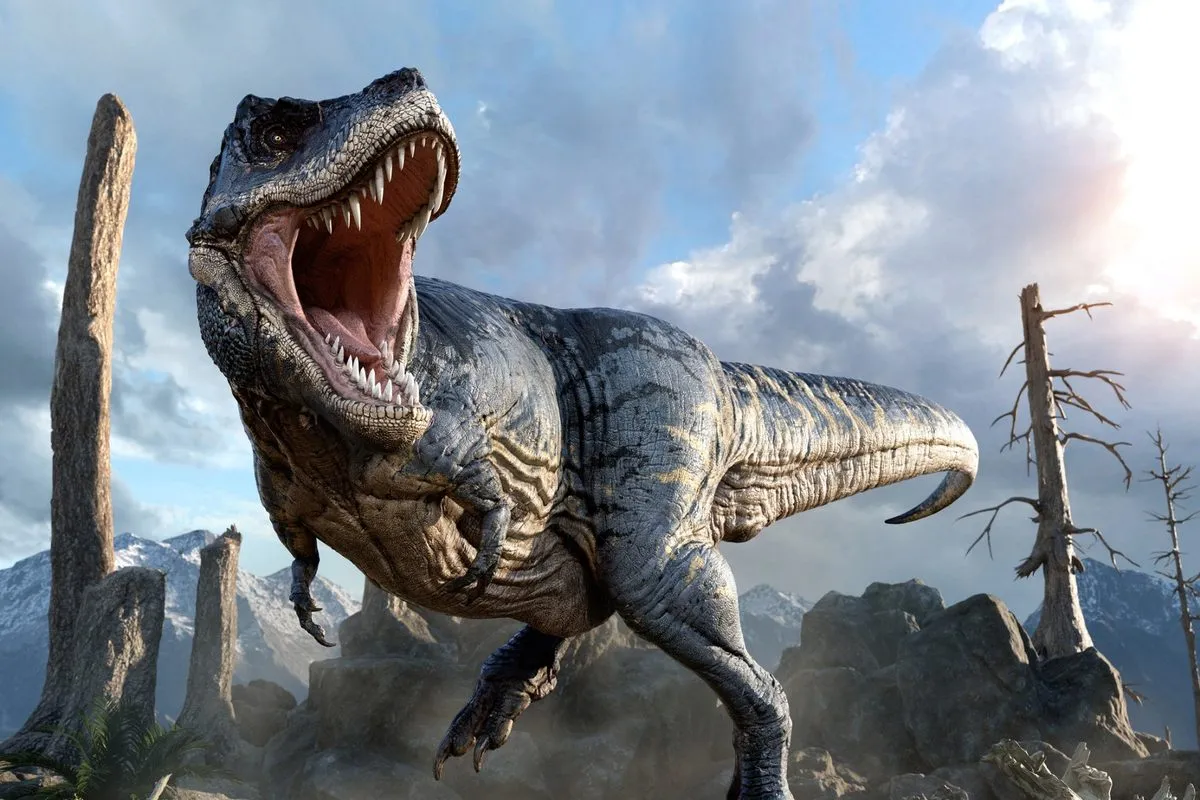
The diminutive forelimbs of the Tyrannosaurus Rex have long been a subject of fascination and ridicule, often perceived as evolutionary quirks with little functional purpose. While the scientific consensus has generally acknowledged their vestigial nature, the precise evolutionary pressures driving their reduction remained a point of considerable debate. However, recent research offers a compelling new perspective, suggesting a direct correlation between the development of the T. Rex's formidable skull and jaws and the diminishing size of its arms.
This groundbreaking study, conducted by researchers from University College London (UCL) and Cambridge University, meticulously examined 82 different theropod species, the bipedal, predominantly carnivorous dinosaur group to which the T. Rex belongs. The findings indicate that as these dinosaurs evolved larger and more powerful heads and jaws, their arms underwent a proportional reduction. This evolutionary trade-off points towards a strategic shift in predatory behavior, where the head and jaws became the primary tools for subduing prey, rendering the arms increasingly less essential.
The Evolutionary Arms Race: Head vs. Limbs
Jaw Power and Skull Development as Primary Weapons
The research posits that the escalating size and strength of the theropod skull and jaw were directly linked to a shift in hunting strategies. As prey animals became larger and more formidable, an evolutionary advantage was conferred upon those dinosaurs capable of delivering devastating bites with powerful jaws. This hypothesis suggests that the head and jaws evolved into the dinosaur's main offensive weapon, enabling them to tear and crush with immense force. The need for forelimbs to grasp or manipulate prey diminished significantly as the bite force became the decisive factor in a kill.
Consequently, over successive generations, the arms of these predatory dinosaurs experienced a gradual reduction. This evolutionary process, often described by the principle of "use it or lose it," led to the arms becoming progressively smaller and less functional. The study highlights that this reduction wasn't merely a byproduct of overall body growth but a specific adaptation driven by the increasing dominance of cranial weaponry.
Vestigial Limbs and the Concept of Evolutionary Disuse
For a considerable period, paleontologists have recognized the arms of the T. Rex as vestigial – anatomical features that have largely lost their original function through evolutionary time. However, this new study proposes a more nuanced understanding by establishing a clear correlation between the shrinking arms and the concurrent expansion of the skull and jaws. It challenges the notion that the arms simply became proportionately smaller as the rest of the dinosaur's body grew larger.
The findings, published in the esteemed journal *Proceedings of the Royal Society B*, indicate that the size of the arms was more strongly associated with the development of robust skulls and jaws than with overall body mass. This suggests that the diminutive arms of the T. Rex were not an arbitrary outcome of general growth patterns but a specific evolutionary adaptation driven by the enhanced capabilities of their heads.
Beyond Tyrannosaurus Rex: A Theropod Trend
Carnotaurus and Other Theropods with Reduced Forelimbs
While the T. Rex is perhaps the most iconic example of a dinosaur with disproportionately small arms, the study notes that this phenomenon was not unique to this particular species. Many other theropods evolved similarly reduced forelimbs. The Carnotaurus, for instance, is mentioned as possessing even smaller arms relative to its body size than the T. Rex, further supporting the hypothesis that arm reduction was a common evolutionary strategy among certain theropod lineages.
This widespread trend implies that the evolutionary pressures favoring powerful jaws and skulls over functional forelimbs were prevalent across various theropod groups. The effectiveness of a bone-crushing bite and a strong head as predatory tools likely outweighed any significant advantage that more developed arms could offer in their specific ecological niches.
Size Discrepancies and Arm Reduction
Interestingly, the research also indicates that the overall body size of a theropod dinosaur did not appear to be a determining factor in the degree of arm reduction. Several smaller theropod species exhibited well-developed, robust skulls and jaws accompanied by similarly tiny arms, despite being considerably smaller than a T. Rex. This observation further strengthens the argument that the evolution of predatory weaponry, specifically the head and jaw structure, was the primary driver of forelimb reduction, irrespective of the dinosaur's total mass.
This finding challenges simplistic explanations that might attribute small arms solely to gigantism. Instead, it emphasizes the selective advantages conferred by specialized cranial adaptations for predation, a pattern observed across a range of theropod sizes.
Impact Analysis
Rethinking Predatory Adaptations in Dinosaurs
The implications of this research extend beyond simply explaining the T. Rex's peculiar anatomy. It prompts a significant re-evaluation of how we understand predatory adaptations in theropod dinosaurs. By highlighting the central role of the skull and jaws as the primary offensive tools, the study provides a more sophisticated model of predator-prey dynamics during the Mesozoic Era. This shift in focus from forelimb function to cranial prowess offers new avenues for research into the biomechanics, evolutionary strategies, and feeding behaviors of these ancient predators.
Furthermore, this hypothesis could influence our understanding of the ecological roles these dinosaurs played. The emphasis on jaw-based predation suggests specialized hunting techniques and interactions with prey species that may not have been previously considered. It underscores the complex interplay of evolutionary forces that shape the diverse and often surprising forms of life found in the fossil record.