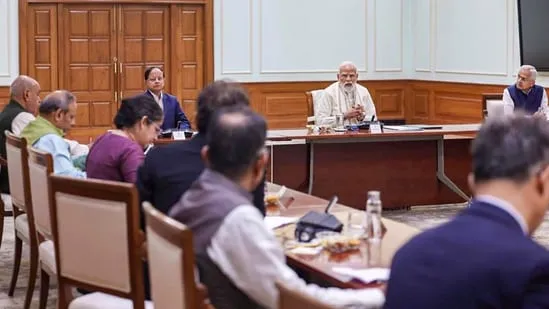
Prime Minister Narendra Modi convened a critical meeting with his Economic Advisory Council (EAC) to deliberate on India's economic trajectory and long-term development strategies. This session occurred in the wake of newly released official data indicating a robust 7.7% economic growth for the fiscal year 2025-26, coupled with the government's recent announcement of foreign investment reforms. The Prime Minister used the platform to underscore the importance of accelerating the ongoing reform agenda and enhancing both the 'Ease of Living' and 'Ease of Doing Business' for citizens and enterprises alike.
The meeting's agenda was particularly significant given the prevailing economic headwinds and criticisms from opposition parties regarding the rupee's depreciation against the US dollar and escalating domestic fuel prices, which they attributed to policy shortcomings. Discussions within the EAC meeting focused on identifying innovative ideas and concrete measures to further invigorate economic expansion, especially within the context of a volatile global economic landscape. This strategic alignment aims to bolster investor confidence and ensure sustained economic momentum.
Economic Strategy and Policy Discussions
During the meeting, Prime Minister Modi and the EAC members engaged in a comprehensive review of various economic indicators and policy frameworks. The deliberations were geared towards identifying proactive measures to counter existing economic challenges and capitalize on emerging opportunities. Emphasis was placed on fostering an environment conducive to sustained growth, innovation, and inclusive development. The council's input is crucial for shaping fiscal and monetary policies designed to navigate the complexities of the international economic climate and solidify India's position as a growing global economic power.
Further discussions revolved around the recent policy announcements made by the finance ministry and the Reserve Bank of India (RBI). These included measures to broaden investment avenues for international individuals and portfolio investors in Indian equities, alongside initiatives to make government bonds more attractive through tax incentives. The RBI's monetary actions, such as offering subvention on hedging costs for external commercial borrowings and establishing a concessional swap window for FCNR(B) deposits, were also highlighted. These steps are intended to enhance foreign exchange inflows and provide crucial support to the Indian rupee, addressing structural competitive disadvantages compared to peer emerging markets.
Growth Data and Future Outlook
The timing of the EAC meeting was also pertinent, following the National Statistics Office's provisional Gross Domestic Product (GDP) estimates for 2025-26, which showed a full-year growth of 7.7%, with the fourth quarter registering an impressive 7.8% expansion. Prime Minister Modi reiterated his government's commitment to continuously improving the 'Ease of Living' and 'Ease of Doing Business,' while simultaneously focusing on expanding opportunities for the nation's youth. This forward-looking approach aims to translate economic growth into tangible benefits for all segments of society.
The official data on GDP growth underscores the resilience and dynamism of the Indian economy. However, the government acknowledges the need for continuous monitoring and adaptive policy-making to sustain this growth trajectory amidst global uncertainties. The EAC's role is pivotal in providing strategic advice and analytical support to ensure that economic policies remain aligned with national development goals and are responsive to evolving domestic and international economic conditions. The council's diverse membership brings a wealth of expertise from various economic domains, enabling a holistic assessment of challenges and opportunities.
Composition and Mandate of the Economic Advisory Council
The Economic Advisory Council to the Prime Minister (EAC-PM) functions as an independent body dedicated to advising the Prime Minister on critical economic matters. Its core responsibilities include analyzing complex economic issues, providing recommendations on macroeconomic stability, and undertaking research on emerging economic trends. The council can also proactively address issues of national economic importance or respond to specific mandates assigned by the Prime Minister, ensuring a focused and strategic approach to economic governance.
The current composition of the EAC-PM includes a Chairman, three full-time members, and eleven part-time members, representing a broad spectrum of economic expertise. Professor S Mahendra Dev serves as the Chairman, with Sanjay Kumar Mishra, Sanjeev Sanyal, and Shamika Ravi as full-time members. The part-time members bring diverse perspectives from academia, industry, and financial markets, including distinguished figures like Rakesh Mohan, Sajjid Z. Chinoy, Neelkanth Mishra, Nilesh Shah, and others. This broad expertise enables the council to offer well-rounded and informed advice on a wide array of economic challenges and policy initiatives.
Impact Analysis
The Prime Minister's proactive engagement with the Economic Advisory Council, particularly during a period of global economic uncertainty and domestic policy adjustments, signals a strong commitment to prioritizing economic growth and stability. The focus on both short-term measures to support the rupee and long-term reforms aimed at enhancing the business and living environment is designed to create a resilient economic foundation. This strategic approach is expected to bolster investor confidence, stimulate domestic consumption and investment, and ultimately contribute to India's sustained economic development and its integration into the global economy.
The emphasis on 'Ease of Living' and 'Ease of Doing Business' indicates a policy direction that aims to translate macroeconomic gains into tangible improvements in the daily lives of citizens and the operational efficiency of businesses. By addressing the concerns raised by opposition parties through concrete policy actions and strategic consultations, the government seeks to foster a more unified national approach to economic challenges. The council's recommendations will be instrumental in refining these policies and ensuring their effective implementation, thereby driving India towards its ambitious economic goals.