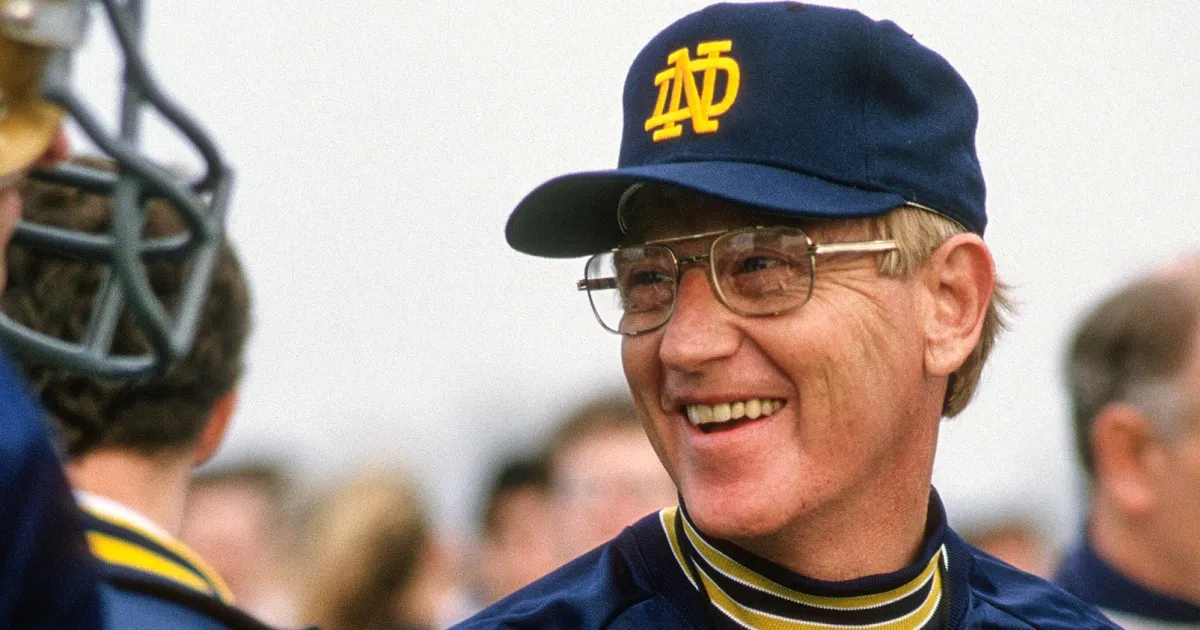
Legendary college football coach Lou Holtz, celebrated for guiding the Notre Dame Fighting Irish to their last national championship in 1988, has passed away, the university confirmed on Wednesday. He was 89 years old. Holtz had been in declining health in recent months, with his family previously announcing his move to hospice care in Orlando, Florida.
Throughout his illustrious 33-season career on the collegiate sidelines, Holtz amassed a remarkable record of 249 wins, 132 losses, and 7 ties. A significant portion of his coaching tenure was spent in South Bend, Indiana, where he led the Irish to a formidable 100-30-2 record between 1986 and 1996. Current Notre Dame coach Marcus Freeman expressed his deep sorrow, stating, "We are deeply saddened to learn of the passing of Lou Holtz." Freeman further acknowledged Holtz's profound impact, noting, "Lou's impact at Notre Dame has gone well beyond the football field. He and his wife, Beth, are respected across campus for their generous hearts and commitment to carry out Notre Dame's mission."
A Storied Coaching Career
Holtz's journey as a head coach included significant stints at William & Mary, North Carolina State, Arkansas, Minnesota, and most famously, Notre Dame. His coaching acumen was tested briefly in the professional arena when he led the New York Jets for one season, posting a 3-10 record before resigning with one game remaining in the 1976 season. Reflecting on this period, Holtz famously quipped, “God did not put Lou Holtz on this Earth to coach in the pros,” a sentiment that proved prescient as he immediately found success at Arkansas.
At Arkansas, Holtz achieved a 60-21-2 record, with only one coach surpassing his win total since his departure. Despite his successes elsewhere, his legacy is inextricably linked with Notre Dame, a program boasting five coaches who have collectively secured 11 national championships. Holtz stands among giants like Knute Rockne, Frank Leahy, Ara Parseghian, and Dan Devine in the pantheon of Irish coaching legends.
Innovations and Traditions at Notre Dame
During Holtz's influential tenure, Notre Dame introduced iconic traditions that continue to resonate within the program. The renowned "Play Like A Champion" sign, a staple in the Irish locker room, was first displayed under his leadership. Additionally, Holtz made the pivotal decision to remove players' names from the back of their football jerseys, a move intended to foster a stronger emphasis on team unity and collective effort. This tradition of nameless jerseys remains a core element of the team's identity during all regular-season games.
Following his departure from coaching at Notre Dame after the 1996 season, Holtz transitioned to broadcasting, serving as an analyst for CBS Sports. However, his passion for coaching led him to a subsequent role reviving the South Carolina program. Taking over a struggling Gamecocks team that finished 1-10 in 1998 and 0-11 in his inaugural 1999 season, Holtz orchestrated a significant turnaround, guiding them to a respectable 33-26 record over the subsequent five seasons in Columbia.
Later Years and Legacy
His second retirement from coaching marked a return to television analysis, this time with ESPN. Andrea Adelson of ESPN shared a fond recollection of Holtz's final public appearances, noting his sharp wit and enduring humor. "He and Lee Corso told epic stories, and Lou was as sharp and funny as ever," Adelson recalled. "He knew he didn’t have much time left, but that didn’t stop him from filling the room with joy."
Lou Holtz is survived by his four children: Luanne, Lou Jr. (known as “Skip”), Kevin, and Elizabeth. His wife, Beth Holtz, an honorary monogram winner and philanthropist, passed away in 2020 at the age of 82.
Impact Analysis
The passing of Lou Holtz marks the end of an era in college football. His strategic brilliance, motivational prowess, and enduring impact on programs like Notre Dame and Arkansas have left an indelible mark on the sport. Beyond his coaching achievements, Holtz's influence extended to shaping team culture and fostering traditions that continue to define storied athletic programs. His ability to connect with players, instill discipline, and articulate a clear vision for success cemented his status as one of the game's most respected and memorable figures.