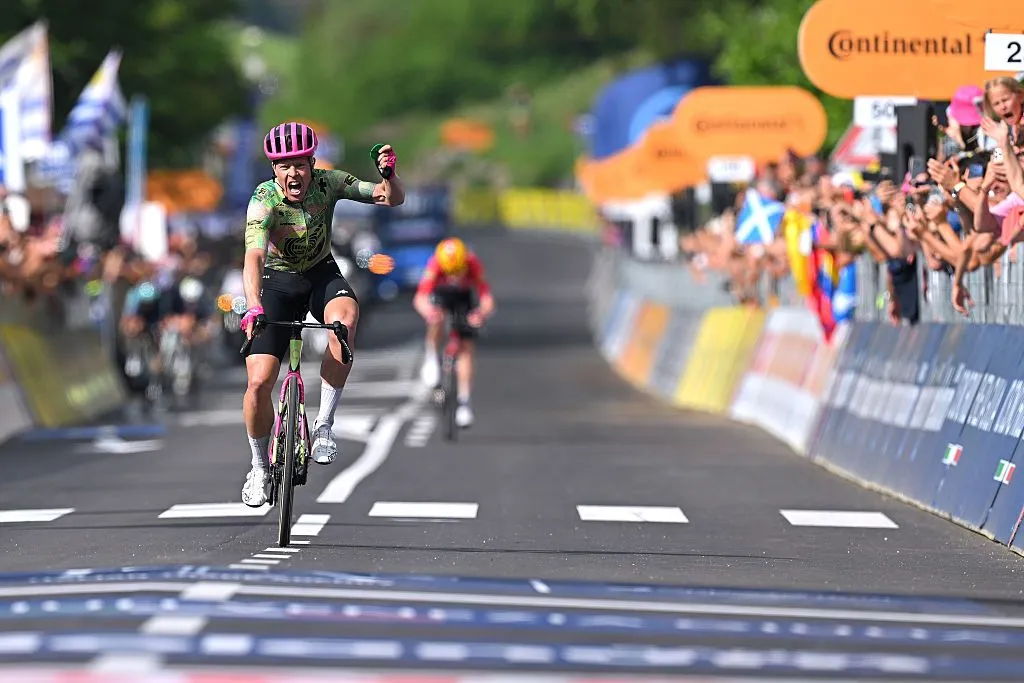
After twelve attempts across twelve Grand Tours, Danish cyclist Michael Valgren of EF Education-EasyPost has finally achieved his long-sought maiden stage victory at a major three-week race. Valgren triumphed in a dramatic Stage 17 of the Giro d'Italia, an arduous 202km journey from Cassano d'Adda to Andalo, emerging victorious from a challenging breakaway that tested the resolve of all involved.
The defining moment of Valgren's career milestone came from a breakaway that formed early in the stage, a group comprising 29 riders. Despite facing multiple attacks in the latter half of the race, particularly from Einer Rubio (Movistar) and Damiano Caruso (Bahrain Victorious) in the final 45km, Valgren showcased remarkable resilience and tactical acumen. As the group fragmented and reformed multiple times in the closing 20km, it was Valgren's perfectly timed surge 1100 meters from the finish line that broke the deadlock, securing him the coveted stage win. He was closely followed by Andreas Leknessund (Uno-X Mobility) and Caruso, who rounded out the podium.
A Hard-Fought Victory for Valgren
The finale was a tense affair, with Valgren and Rubio finding themselves in a leading duo as they approached the final ascent to Andalo-Lever. However, the dynamics shifted as Igor Arrieta (UAE Team Emirates-XRG) and other chasers closed the gap. Valgren, known for his punchy, explosive riding style rather than raw sprinting power, explained that this tactic is his forte when his legs are feeling strong. The emotional celebration over the finish line included a lucky Pokemon charm, a keepsake from his son, highlighting the personal significance of this victory after a career marked by both spectacular highs and significant challenges.
Valgren's journey back to the top has been particularly poignant. A former champion of prestigious one-day races like the Amstel Gold Race and Omloop Het Nieuwsblad, his career was nearly derailed by a severe crash in 2022. His return to winning form earlier this year at Tirreno-Adriatico marked a significant comeback, and this Giro d'Italia stage win is the crowning achievement of his determined rehabilitation and return to elite racing. He expressed his relief and happiness, noting that a Grand Tour stage win was a missing piece in his accomplished career, and that Italy has historically been a fortunate ground for his victories.
The Breakaway's Strategic Dynamics
Stage 17 was characterized by its unpredictable nature, driven by the dwindling opportunities for breakaway specialists in the final days of the Giro. The stage's profile, featuring two categorized climbs within the first 90km and a predominantly undulating profile towards the finish, offered ample opportunities for riders to initiate attacks. The high initial pace, exceeding 50 kph in the opening hour, underscored the urgency felt by many to establish a decisive breakaway.
A substantial group of 29 riders ultimately formed, significantly impacting the general classification landscape. Teams with multiple riders in the break, such as Movistar and UAE Team Emirates-XRG, played crucial roles in its formation and progression. The breakaway established a considerable lead, over six minutes at one point, effectively neutralizing any immediate threat to the overall leader, Jonas Vingegaard (Visma-Lease a Bike), in the peloton. This allowed for tactical maneuvering within the front group, with riders like Jhonatan Narváez (UAE Team Emirates-XRG) making moves to contest intermediate sprints and potentially gain advantages in the points classification.
Attacks and Tactical Battles in the Closing Kilometers
As the stage entered its final 50km, the race intensified with multiple riders attempting to distance themselves from the main breakaway group. Damiano Caruso initiated a significant attack on the approach to the final categorized climb, Andalo-Lever, signaling the start of the decisive phase. Einer Rubio responded aggressively, leading the charge up the climb, while Valgren remained strategically positioned behind.
The final kilometers saw a complex tactical battle unfold. A group of six riders, including Valgren, Rubio, Caruso, Vlasov, Arrieta, and Leknessund, converged for the stage victory. Despite several late attacks, including a notable solo effort from Arrieta and repeated attempts by Rubio, Valgren executed his final attack with precision just before the 1km mark. This decisive move allowed him to cross the finish line alone, celebrating a hard-earned and deeply meaningful Grand Tour stage win.
Impact Analysis
Michael Valgren's victory is a significant narrative of resilience and determination, showcasing the enduring spirit of professional cycling. For Valgren himself, it represents the culmination of a career marked by both significant successes and severe setbacks, providing a powerful testament to his perseverance. From a broader racing perspective, the stage resulted in minimal disruption to the General Classification, with Jonas Vingegaard maintaining his lead. However, Damiano Caruso's strong performance within the breakaway allowed him to gain ground, moving into ninth place overall and highlighting the ongoing GC battles that often occur on transition stages.