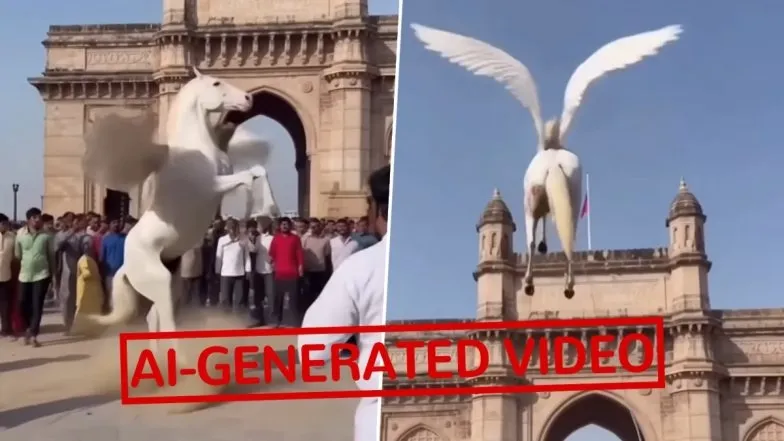
A visually striking video circulating on social media platforms has captured widespread attention, purporting to show a majestic white flying horse making an appearance at Mumbai's iconic Gateway of India. The clip, shared across platforms like Instagram, rapidly gained traction, accumulating tens of thousands of views and igniting discussions among viewers. The video appears to depict the historical monument as a backdrop while a large crowd gathers, seemingly mesmerized by the spectacle of the mythical creature.
The accompanying narrative in the viral posts suggested the horse was introduced to the landmark with the express purpose of enhancing tourism. However, closer examination and subsequent fact-checking have revealed a different, though equally fascinating, reality behind the imagery. The purported event, while captivating, was not a real-world occurrence but rather a sophisticated creation leveraging advanced artificial intelligence techniques.
The Reality Behind the Viral Spectacle: AI Generation
Upon investigation, it was confirmed that the viral video showcasing a white flying horse at the Gateway of India was entirely generated using artificial intelligence. The individual responsible for this captivating piece of digital artistry is Rahul Nanda, an AI filmmaker and VFX artist. Nanda, who has a significant online following for his AI-generated video content, shared the clip on his social media, where it quickly became a talking point.
Nanda himself provided clarity regarding the video's origin. In the caption accompanying his post, he explicitly stated that the creation was AI-generated, adding a thought-provoking comment: "Of course, this is AI generated, but imagine if this really happened." This direct clarification from the creator confirmed that the horse and its apparent flight were digital constructs, not a physical event.
The Artistry of AI Filmmaking
Rahul Nanda's work exemplifies the growing capabilities of AI in creative fields. As a VFX artist with a track record of generating billions of views for his AI-driven projects, his ability to craft such a believable and engaging scene highlights the evolving landscape of digital content creation. The video's popularity underscores the public's fascination with the intersection of technology and imagination, particularly when applied to iconic landmarks and fantastical concepts.
The creation of such AI-generated videos involves complex algorithms and vast datasets, allowing for the synthesis of realistic imagery and motion. While Nanda's video was not a real event aimed at boosting tourism, it successfully captured public imagination and demonstrated the power of AI as a storytelling and artistic tool. The resulting virality can be seen as a testament to the effectiveness of his creative execution.
Understanding Viral Content and Fact-Checking
The incident serves as a salient reminder of the importance of media literacy and fact-checking in the digital age. Videos and images can be easily manipulated or created using AI, making it crucial for viewers to verify information before accepting it as fact. The initial surge of belief in the flying horse's appearance demonstrates how compelling AI-generated content can be, blurring the lines between reality and digital fabrication.
Platforms and fact-checking organizations play a vital role in debunking misinformation and providing accurate context. In this case, the creator's own admission and subsequent fact-checks helped to clarify the situation. This process is essential for maintaining trust and preventing the spread of potentially misleading narratives, especially concerning real-world events and locations.
Impact Analysis
While this specific instance involved an AI-generated video rather than a physical event for tourism, the virality of such content has broader implications for the tourism and entertainment industries. It highlights the potential for AI to create novel marketing campaigns and virtual experiences that could attract interest. Furthermore, it underscores the ongoing challenge of discerning authenticity in digital media, necessitating robust verification mechanisms and an informed public to navigate the evolving information ecosystem.