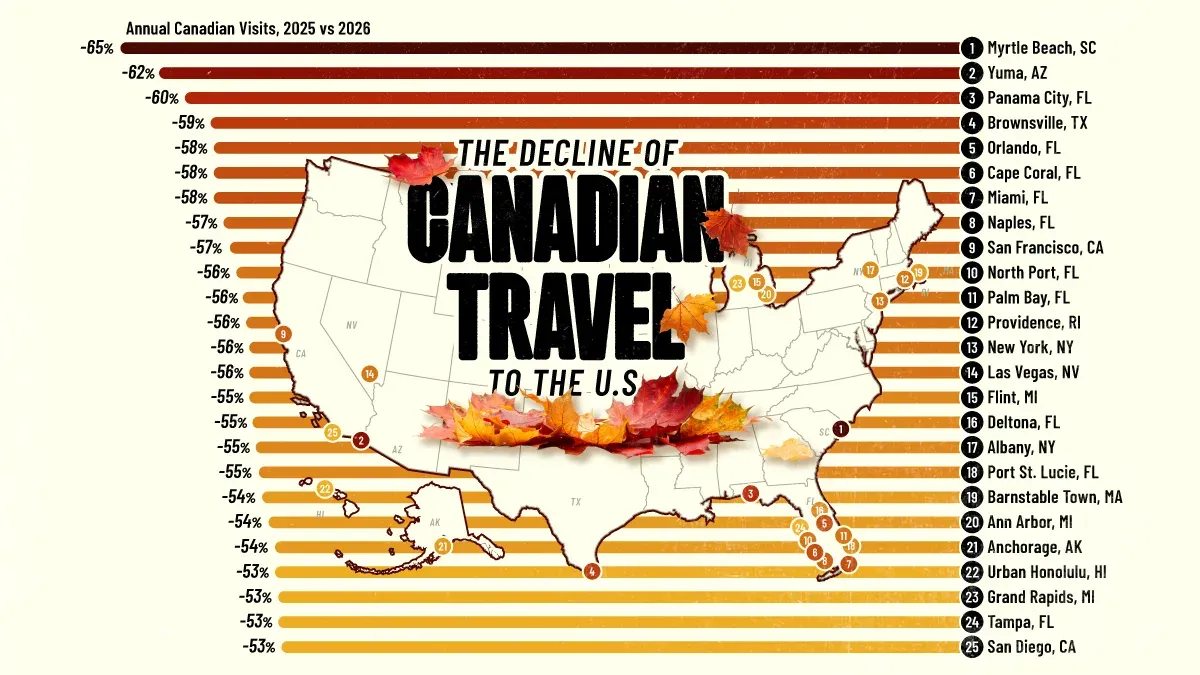
Canadian travel to the United States has experienced its most significant decline in decades, excluding pandemic-related disruptions. This trend is attributed to a confluence of factors including heightened political tensions, economic headwinds, and a less favorable exchange rate for the Canadian dollar. Analysis of mobile location data reveals that major U.S. travel destinations are witnessing substantial drops in Canadian visitor numbers, signaling a notable shift in cross-border travel patterns.
The University of Toronto’s School of Cities has compiled data indicating that popular tourist hubs such as Orlando, Miami, New York City, Las Vegas, and San Francisco have seen Canadian visits plummet by over 55%. This sharp decrease underscores the growing impact of geopolitical discourse and economic realities on the choices of Canadian travelers, who traditionally represent a vital segment of the U.S. tourism market.
U.S. Metros Experiencing Steepest Declines in Canadian Visitation
Data tracking Canadian visitor numbers between April 2024 and March 2025, compared to the same period in 2025-2026, highlights the extent of the downturn across various U.S. metropolitan areas. The findings reveal that several of America's most sought-after destinations are disproportionately affected. Myrtle Beach, South Carolina, leads the list with a 65.4% decrease in Canadian visitors, followed closely by Yuma, Arizona, with a 62.3% decline.
Florida emerges as a significant hotspot for these declines, with ten of the top 25 hardest-hit U.S. metros located within the state. Destinations like Panama City, Orlando, Cape Coral, Miami, and Naples have all recorded drops exceeding 58%. Other major cities feeling the impact include San Francisco, California (-56.9%), and New York City, New York (-55.5%), alongside iconic leisure destinations like Las Vegas, Nevada (-55.5%). This concentration suggests that specific regional appeal and market dynamics within Florida are particularly vulnerable to the current travel trends.
Impact on Major U.S. Tourism Brands
The decrease in Canadian travel is not confined to less prominent destinations; it is significantly affecting some of the most recognizable U.S. tourism brands. Cities like Orlando, Miami, New York, Las Vegas, and San Francisco, which historically attract millions of Canadians annually, are now experiencing a substantial reduction in this key demographic. These locations rely heavily on consistent international visitor flows, and the current trend poses a considerable challenge to their tourism economies.
The consistent appearance of these major destinations in the rankings of steepest declines underscores a broader issue impacting the attractiveness of U.S. tourism for Canadians. The strength of their global brand reputation is being tested by factors that are making travel less appealing, leading to a significant reevaluation of holiday choices among Canadian consumers.
Root Causes: Political and Economic Factors
The downturn in Canadian travel is multi-faceted, stemming from a complex interplay of political rhetoric and economic pressures. Intensified trade disputes and the often contentious political discourse between the two nations have fostered an environment of unease. Specifically, remarks concerning Canada’s potential status as the "51st state" have resonated negatively in Canada, impacting perceptions of the U.S. as a welcoming destination.
Concurrently, the depreciation of the Canadian dollar against its U.S. counterpart has rendered vacations in the United States considerably more expensive for Canadian residents. This economic reality directly reduces the purchasing power of Canadian travelers, making budget-conscious decisions more critical and potentially diverting spending towards domestic or more affordable international destinations. Statistics Canada data corroborates this, indicating that 2025 saw the most substantial annual decrease in Canadian travel to the U.S. outside of the pandemic period.
Florida's Disproportionate Exposure
Florida, a perennial favorite for Canadian visitors, particularly during winter months, is experiencing a pronounced effect. The state accounts for a significant portion of the top declining metros, highlighting its deep reliance on Canadian tourism. Millions of Canadians, including "snowbirds" and seasonal residents, traditionally flock to Florida for its climate and lifestyle, with Canadians often comprising up to a third of the state’s international visitor base.
The implications extend to the real estate market as well, where many Canadians own property in Florida. Emerging data suggests a growing number of these property owners are considering divesting, potentially due to the same factors influencing travel decisions. This indicates a broader trend of reassessment of U.S. holdings and travel plans among Canadians, reflecting a potential weakening of long-standing cross-border ties.
Economic Ramifications for the U.S. Tourism Sector
The decline in Canadian visitation carries significant economic weight for the United States. Prior to this recent downturn, Canadian tourists were a cornerstone of the U.S. tourism economy, contributing approximately $20 billion annually and supporting an estimated 140,000 jobs. The reduction in these numbers, especially from such a reliable visitor base, creates a palpable economic gap.
International visitor spending in the U.S. saw a notable decrease, with the diminished presence of Canadian travelers being a key driver. The consistent, extended stays and diverse spending habits of Canadian visitors across various sectors—including hospitality, retail, dining, and entertainment—mean that even moderate decreases in their numbers can have an outsized impact on local economies. Destinations at the forefront of this decline are not merely losing tourist volume; they are forfeiting a crucial and dependable source of international revenue.
Impact Analysis
The substantial drop in Canadian tourism to the U.S. signifies a critical juncture for the American travel industry. It necessitates a strategic reevaluation of how to attract and retain this vital demographic. Understanding the specific economic and political triggers is paramount for developing targeted strategies, potentially involving revised marketing approaches, addressing exchange rate concerns where possible, and fostering a more welcoming political climate. Failure to adapt could lead to prolonged economic challenges for many U.S. tourism-dependent regions, particularly in states like Florida and major metropolitan hubs that rely heavily on this cross-border traffic.