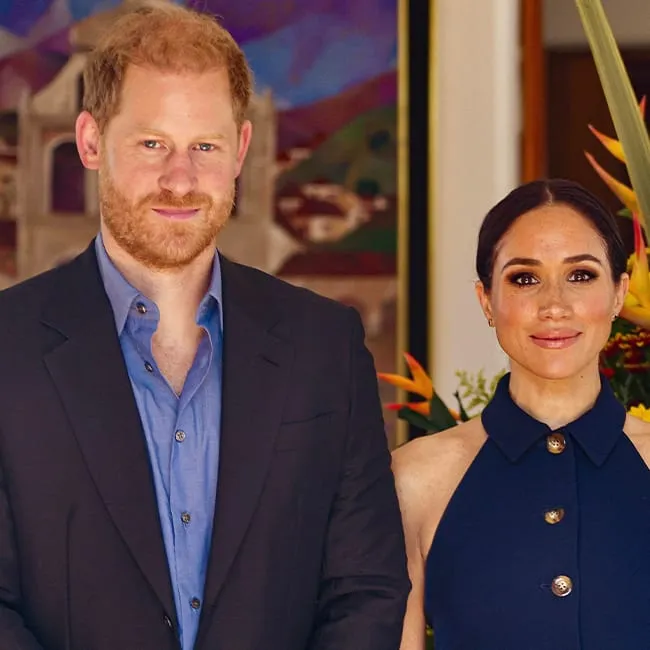
A recent photograph released by Prince Harry and Meghan Markle, featuring their daughter Princess Lilibet, has ignited a debate among social media users concerning its authenticity. The image, shared online, has drawn accusations of significant digital manipulation, with some users speculating that it may have been generated using artificial intelligence (AI). This scrutiny follows a pattern of public image controversies involving prominent figures, including instances within the royal family itself, which have previously led to widespread discussion and analysis.
The Duke and Duchess of Sussex have previously encountered public discourse regarding their family portraits. The most recent photograph, reportedly posted by Meghan to commemorate Princess Lilibet's fifth birthday, has become a focal point of online commentary. Close examination of the image by a segment of the public has revealed perceived anomalies in lighting, subject positioning, and the rendering of extremities, leading to these claims of digital alteration.
Analysis of Digital Manipulation Allegations
The photograph in question depicts Prince Harry holding his daughter, Princess Lilibet, who is five years old and dressed in a white floral outfit. Prince Harry is seen in a dark blue ensemble, while Meghan Markle appears in an olive-toned top and trousers. Social media users have pointed to specific details within the image as evidence of manipulation. One prominent concern raised involves the anatomical rendering of Princess Lilibet's fingers behind Prince Harry's neck, which some argue does not align with the natural positioning of her body.
Further claims suggest inconsistencies in the blending of elements within the image, such as around the arms, hands, and clothing folds, creating what some describe as an "over-processed" or "stitched together" appearance. These technical observations have led to comparisons with the typical artifacts found in AI-generated images, which often exhibit difficulties in accurately depicting complex anatomical details like finger joints and overlapping limbs, as well as maintaining natural depth perception between subjects. Additionally, subtle discrepancies in the alignment of Prince Harry's gaze with his daughter's face have been noted, contributing to the perception that the image might be a composite of multiple photographs.
Public and Expert Reactions to the Image
The reactions on social media platforms have been varied but largely critical, with many users expressing skepticism about the photo's originality. Some comments directly label the image as "fake" and draw parallels to previous controversies, including perceived inconsistencies in the portrayal of Princess Catherine's family photos. Specific critiques have focused on the apparent blurring of Princess Lilibet's right leg, which some argue is inconsistent with the sharp focus maintained on the other individuals in the frame. This has led to a debate about the technical capabilities of cameras versus the potential for digital editing.
Beyond the technical aspects, users have also commented on the perceived age of Princess Lilibet in the photograph, with some suggesting that her physical features do not align with her stated age. Concerns have also been raised about the positioning and proportions of the adult figures. Meghan Markle's height relative to Prince Harry has been questioned, and the layering of Meghan's elbow over Prince Harry's arm has been cited as another potential indicator of digital compositing. The overall impression for some is that the image is a "collage" or that elements, such as Prince Harry's head, have been unnaturally integrated into the scene, reminiscent of previous controversial royal family photographs.
Potential Implications and Industry Context
The intense scrutiny applied to images released by public figures highlights a growing public awareness and concern regarding digital authenticity. In an era where sophisticated editing software and AI image generation tools are increasingly accessible, the ability to discern genuine photographs from manipulated ones has become a significant societal challenge. This trend impacts not only the perception of public figures and institutions but also the broader media landscape, where trust in visual information is paramount.
For public figures like Prince Harry and Meghan Markle, managing their public image involves navigating these technological advancements and public expectations. The backlash over perceived image manipulation can affect public perception, brand integrity, and media coverage. The debate underscores the importance of transparency and authenticity in visual communications, particularly for individuals who command significant public attention. The continuous advancement of AI also poses ongoing challenges for content creators and consumers alike in verifying visual media.
Impact Analysis
The ongoing debate surrounding the authenticity of digitally presented images, particularly those involving high-profile individuals, reflects a broader societal shift in media consumption and critical evaluation. As AI-generated content becomes more sophisticated and indistinguishable from reality, the public's capacity to trust visual media is increasingly tested. This has significant implications for journalism, public relations, and personal branding, demanding greater transparency and robust methods for verifying the integrity of visual content. For public figures, maintaining credibility in the digital age requires not only compelling narratives but also verifiable visual evidence, making any perceived manipulation, intentional or otherwise, a potentially damaging issue.