

-
-
- External Hard Drives
- SSDs
- Optical Drive
- USB Flash Drives
- Memory Cards
- Network Attached Storage (NAS)
- Floppy Drives
- Media Duplicators
- Storage Device Parts
- Backup Storage Devices
- Storage Backup Batteries
- USB Flash Drive Cases
- Memory Card Cases
- Storage Drive Cases
- Storage Drive Docking Stations
- Personal Cloud Storage
- Card Readers
- Disk Arrays
-
-
- Compare Electronics
- Blog Electronics
- Wiki Electronics
- Brands
- News
- Versus Wizard
- Electronics
- Modems & Network Equipment
- Professional & Fiber Scaling
- Network Media Converters Brand SilverNet
Network Media Converters Brand SilverNet
Specifications, pros & cons, and live price list of 1 Network Media Converters models from SilverNet.
-
Product colourBlack
-
Weight350 g
-
User guide-
-
I/O ports-
-
Ethernet interface type-
-
Connectivity technologyWired
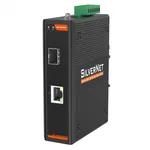
In the intricate landscape of modern networking, the seamless transition between different media types is paramount for establishing robust and scalable infrastructure. The SilverNet SIL 73101P emerges as a critical component for bridging the gap between standard copper-based Gigabit Ethernet and high-speed fiber optic networks. This media converter is engineered to facilitate reliable data transmission over extended distances, overcoming the inherent limitations of Ethernet cabling. Its design prioritizes interoperability and performance, making it an indispensable tool for network administrators tasked with expanding network reach, enhancing bandwidth, or ensuring data integrity in environments where electromagnetic interference is a concern.
The SIL 73101P distinguishes itself with its support for Gigabit Ethernet speeds, ensuring that the transition to fiber does not become a bottleneck for high-demand applications. By converting electrical signals to optical signals and vice versa, it enables the integration of fiber optic segments into existing copper networks, offering a cost-effective upgrade path. This is particularly valuable for enterprises, data centers, and telecommunication providers looking to leverage the superior bandwidth, security, and distance capabilities of fiber optics without a complete overhaul of their current infrastructure. The robust construction and adherence to industry standards underscore SilverNet's commitment to delivering dependable networking solutions.
Key Features and Performance Analysis
At its core, the SilverNet SIL 73101P operates as a Gigabit Ethernet to Fiber Optic converter. It features a standard RJ-45 port for the copper Ethernet connection, supporting 10/100/1000 Mbps auto-negotiation, and a fiber optic port (typically SC or LC, though not specified, it's a common interface for such devices) for the optical transmission. This dual-media capability is its primary function, allowing for seamless integration into diverse network topologies. The converter is designed to operate efficiently within standard temperature ranges, suitable for typical enterprise or industrial closet deployments. While specific fiber optic transceiver types (like SFP or fixed connectors) and wavelengths are not detailed in the provided context, the device's fundamental purpose is to extend network reach significantly beyond the 100-meter limit of standard Ethernet cables, leveraging the inherent advantages of fiber optics for data transmission.