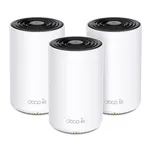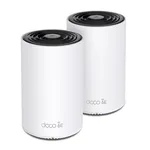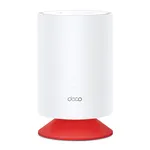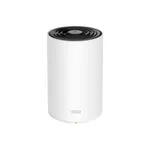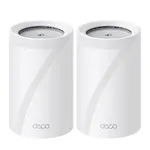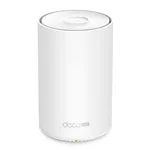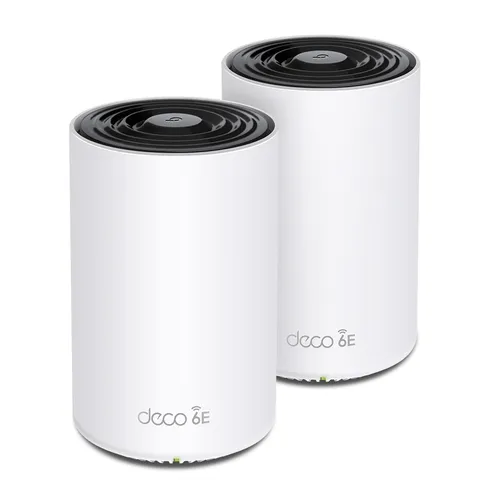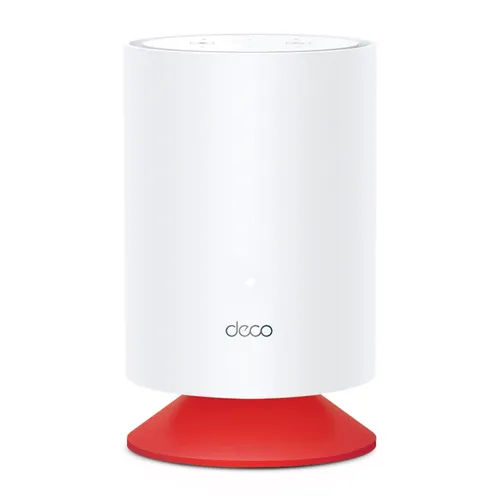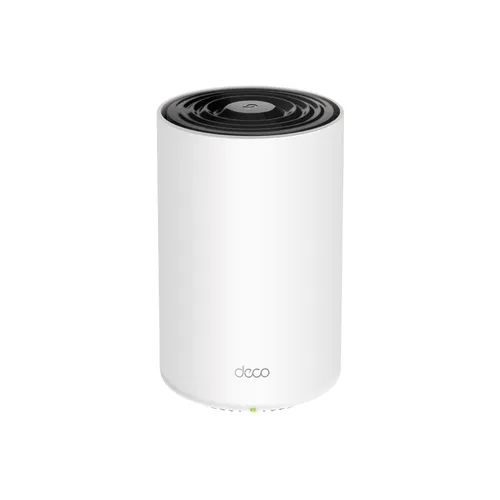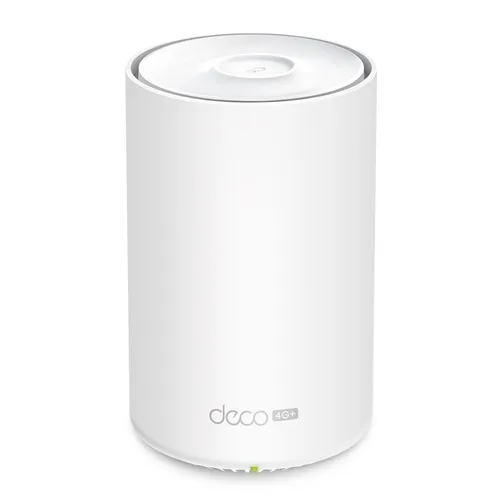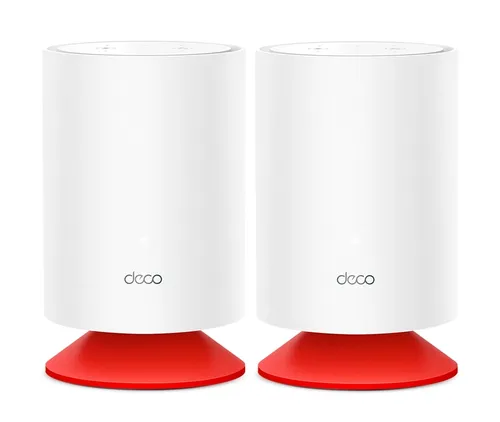


TP-Link AX1800 Deco X20 Mesh Wi-Fi 6 System (2-Pack)
Specifications
Design
Design
| Product colour |
White
|
|---|---|
| LED indicators |
Power
|
| Antenna type |
Internal
|
| Antennas quantity |
2
|
| Reset button |
Yes
60% have it
|
Wireless LAN features
Wireless LAN features
| Wi-Fi band |
Dual-band (2.4 GHz / 5 GHz)
|
|---|---|
| Top Wi-Fi standard |
Wi-Fi 6 (802.11ax)
|
| Wi-Fi standards |
802.11a, 802.11b, 802.11g, Wi-Fi 4 (802.11n), Wi-Fi 5 (802.11ac), Wi-Fi 6 (802.11ax)
|
| WLAN data transfer rate (first band) |
574 Mbit/s
|
| WLAN data transfer rate (second band) |
1201 Mbit/s
|
| Networking standards |
IEEE 802.11a, IEEE 802.11ac, IEEE 802.11ax, IEEE 802.11b, IEEE 802.11g, IEEE 802.11k, IEEE 802.11n, IEEE 802.11r, IEEE 802.11v
|
| Security algorithms |
WPA, WPA2-PSK, WPA3
|
| Number of guest networks (5 GHz) |
1
|
| Number of guest networks (2.4 GHz) |
1
|
| Point-to-point protocol over Ethernet (PPPoE) |
Yes
73% have it
|
| Dynamic IP |
Yes
56% have it
|
| Static IP |
Yes
60% have it
|
| IGMP proxy |
Yes
79% have it
|
| IGMP snooping |
Yes
56% have it
|
| Tagged VLAN |
Yes
92% have it
|
| Dynamic DNS (DDNS) |
Yes
76% have it
|
| Guest access |
Yes
56% have it
|
| Apps supported |
TP-Link Deco
|
Features
Features
| Built-in processor |
Yes
63% have it
|
|---|---|
| Processor cores |
4
|
| Processor frequency |
1.5
GHz
44% better than others
|
| Built-in microphone |
Yes
57% have it
|
| Built-in speaker(s) |
Yes
66% have it
|
| Speaker power |
5
W
74% better than others
|
| Virtual assistant |
Amazon Alexa
|
| Port forwarding |
Yes
81% have it
|
| BeamForming |
Yes
80% have it
|
| Transmitting power (CE) |
<20 dBm (2.4 GHz) <23 dBm (5 GHz)
|
| Transmitting power (FCC) |
<30 dBm(2.4 GHz) <30 dBm(5 GHz)
|
| NAT functionality |
Port Forwarding
UPnP
|
| DHCP server |
Yes
91% have it
|
| Parental control |
Yes
61% have it
|
| Firmware upgradeable via |
Network
|
| Supported WAN type |
Dynamic IP
Static IP
PPPoE
PPTP
L2TP
|
| MU-MIMO technology |
Yes
57% have it
|
| MIMO |
Yes
63% have it
|
| Operating modes |
Router, Access Point
|
Ports & interfaces
Ports & interfaces
| Ethernet LAN (RJ-45) ports |
2
|
|---|---|
| DC-in jack |
Yes
60% have it
|
Power
Power
| AC input voltage |
100 - 240 V
|
|---|---|
| AC adapter input current |
0.6
A
27% better than others
|
| AC input frequency |
50/60 Hz
|
| AC adapter output voltage |
12
V
19% better than others
|
| AC adapter output current |
1.5
A
91% better than others
|
Certificates
Certificates
| Certification |
CE, EAC, FCC, IC, RoHS, RCM
|
|---|
Operational conditions
Operational conditions
| Operating temperature (T-T) |
0 - 40 °C
|
|---|---|
| Storage temperature (T-T) |
-40 - 60 °C
|
| Operating relative humidity (H-H) |
10 - 90%
|
| Storage relative humidity (H-H) |
5 - 90%
|
Weight & dimensions
Weight & dimensions
| Width |
105
mm
73% better than others
|
|---|---|
| Depth |
105
mm
45% better than others
|
| Height |
170
mm
68% better than others
|
Packaging content
Packaging content
| Number of products included |
2 pc(s)
|
|---|---|
| AC adapter included |
Yes
55% have it
|
| Number of units included |
2 pc(s)
|
| Ethernet cable |
Yes
75% have it
|
Logistics data
Logistics data
| Harmonized System (HS) code |
85171800
68% better than others
|
|---|
Disclaimer: Information on this page may need review. If you notice any discrepancies, please report them

The TP-Link AX1800 Deco X20 represents a compelling entry into the burgeoning mesh Wi-Fi 6 market, offering a blend of robust performance, user-friendly setup, and integrated smart home capabilities. Designed for modern households grappling with increasing numbers of connected devices and the demand for seamless, high-speed internet coverage, this 2-pack system aims to eliminate dead zones and provide a consistent wireless experience across multiple floors and rooms. Its adoption of the Wi-Fi 6 (802.11ax) standard is a significant upgrade, promising enhanced efficiency, speed, and capacity compared to older Wi-Fi generations, making it well-suited for bandwidth-intensive activities like 4K streaming, online gaming, and extensive smart home device integration.
At its core, the Deco X20 system leverages advanced technologies to deliver on its promise of superior connectivity. With combined speeds of up to 1800 Mbps (574 Mbps on 2.4 GHz and 1201 Mbps on 5 GHz), it provides ample bandwidth for demanding applications. The system's mesh architecture allows multiple units to work in concert, creating a single, unified network with a single SSID. This means devices can seamlessly roam between Deco units without dropping connections, a crucial feature for mobile users within the home. Furthermore, the inclusion of Alexa integration simplifies network management through voice commands, adding a layer of convenience for users already invested in the Amazon ecosystem. The system's compact, unobtrusive design also ensures it can blend into most home decor without becoming an eyesore.
Pros & Cons
Pros
What we love about this product
- Wi-Fi 6 Performance: Supports 802.11ax standard, delivering higher speeds, lower latency, and increased capacity for a greater number of connected devices.
- Seamless Roaming: Mesh technology creates a unified network with a single Wi-Fi name and password, allowing devices to automatically switch to the strongest signal as you move around your home.
- Alexa Integration: Built-in Alexa support enables voice control for network management tasks, adding convenience for smart home users.
- Wide Coverage: A 2-pack system is designed to cover up to 3,500 sq. ft., effectively eliminating Wi-Fi dead zones in medium to large homes.
Cons
Points to consider before buying
- Limited Ethernet Ports per Unit: Each Deco X20 unit typically comes with only two Gigabit Ethernet ports, which might be insufficient for users needing to hardwire multiple devices in different locations.
- No Dedicated Backhaul (Potential Limitation): While not explicitly stated as absent, many entry-level mesh systems rely on shared wireless backhaul, which can sometimes reduce overall throughput compared to systems with a dedicated wireless or wired backhaul option.