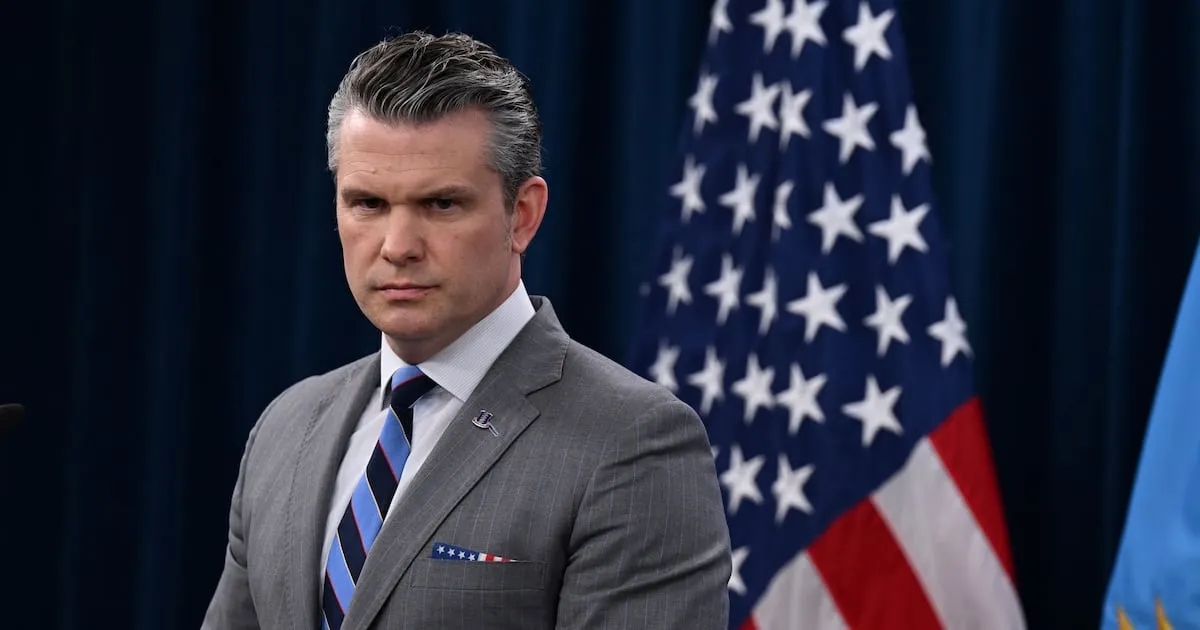
U.S. Defense Secretary Pete Hegseth recently ignited a firestorm of criticism for integrating anti-immigration rhetoric into remarks at a D-Day commemoration ceremony in France. Speaking at an American military cemetery on the 82nd anniversary of the pivotal World War II invasion, Hegseth drew a parallel between the historical Allied forces storming the beaches of Normandy and the contemporary arrival of migrants in Europe.
His controversial statement, delivered at the cemetery in Langrune-sur-Mer, suggested that "different European beaches are stormed by different, dangerous ideologies." He further elaborated, referencing arrivals in Spain, Italy, Greece, and Bulgaria, and questioning when European capitals would address this perceived "invasion." Hegseth concluded his remarks by emphasizing the importance of maintaining the freedom secured by the D-Day veterans for future generations, a message that many found jarringly juxtaposed with his immigration commentary.
Controversial Remarks Draw Bipartisan Rebuke
The integration of political commentary on immigration into a solemn D-Day anniversary event was met with swift and significant backlash, even from within Hegseth's own party. Michael McCaul, speaking on ABC News' 'This Week,' expressed strong disapproval, stating that while immigration is a valid issue, D-Day was unequivocally not the appropriate forum. As the son of a D-Day veteran, McCaul emphasized that the focus should have been solely on the veterans' sacrifice, service, and their critical role in protecting the free world against Nazi Germany.
McCaul further described Hegseth's remarks as "out of place" and "inappropriate," a sentiment echoed by others who felt the occasion was diminished by political posturing. Even some individuals who share Hegseth's conservative views on immigration expressed reservations. One user on X, previously known as Twitter, acknowledged agreeing with Hegseth's concerns about European immigration but deemed the D-Day commemoration an unsuitable venue for such discourse, calling the timing "HOLY S--T."
Prior to Hegseth's speech, his presence in France also drew scrutiny. Reports indicated that he was accompanied by his wife and six children from his blended family, leading some critics to question his understanding of the event's solemnity and professional protocols. Local residents in Langrune-sur-Mer had also reportedly protested Hegseth's involvement, citing "warlike statements" and "American supremacist pronouncements."
In response to the criticism regarding his family's presence and the nature of his trip, Pentagon spokesman Sean Parnell stated that Secretary Hegseth adheres strictly to all ethics rules and departmental travel policies. Parnell affirmed that travel policies are applied consistently and with full accountability, ensuring that taxpayer resources are protected while senior leaders conduct official duties.
D-Day Commemoration and Political Discourse
The events surrounding Hegseth's speech highlight a recurring tension between historical remembrance and contemporary political agendas. D-Day, a watershed moment in World War II, represents a profound sacrifice made by Allied forces to combat totalitarianism and preserve democratic values. Commemorations of this event typically focus on honoring the bravery of the soldiers, reflecting on the costs of war, and reinforcing the importance of international cooperation and freedom.
The inclusion of divisive political commentary, such as that on immigration, by a high-ranking defense official during such a commemoration risks trivializing the historical significance of the event and alienating allies. Critics argue that these ceremonies should transcend partisan politics and serve as a unifying moment for reflection and remembrance, focusing on the shared values that the D-Day landings fought to protect rather than current policy debates.
Impact Analysis
The controversy surrounding Secretary Hegseth's D-Day remarks underscores the challenges of navigating political discourse during sensitive commemorative events. By linking the historical struggle against Nazism to contemporary immigration debates, Hegseth has sparked debate about the appropriate role of political commentary in military ceremonies and the potential for such rhetoric to undermine the intended message of unity and remembrance.
This incident could lead to increased scrutiny of official statements made during national and international commemorations, potentially prompting stricter guidelines or a renewed emphasis on apolitical messaging. Furthermore, it highlights the ongoing political divisions within the United States and their spillover into international diplomacy and historical interpretations, potentially affecting perceptions of U.S. foreign policy and its commitment to historical alliances.