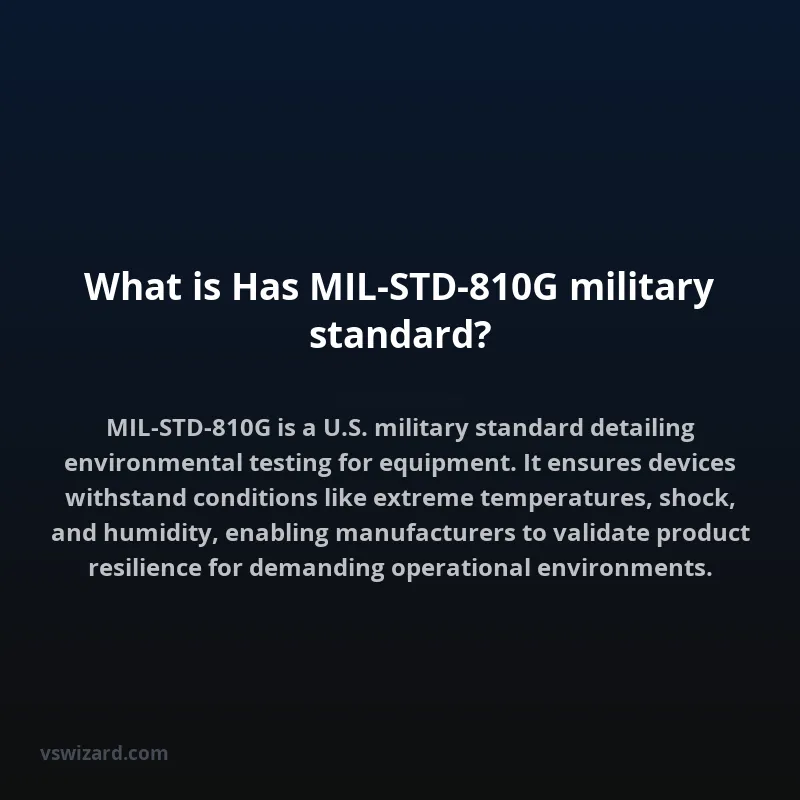
The designation "Has MIL-STD-810G military standard" signifies that a device has undergone and successfully passed a series of rigorous environmental testing protocols as outlined in the United States Military Standard MIL-STD-810G. This standard, officially titled "Environmental Engineering Considerations and Laboratory Tests," is a procedural document designed to ensure that equipment can withstand the harsh conditions encountered during military operations, including extreme temperatures, humidity, shock, vibration, and other environmental stressors. Compliance with MIL-STD-810G does not imply a singular, universally applicable certification but rather adherence to specific test methodologies that manufacturers can choose from to validate the resilience of their products under defined scenarios. Each test method within the standard has specific parameters and procedures, and the reported compliance typically details which methods and under what conditions the device was tested.
MIL-STD-810G, and its subsequent revisions, is not a product specification nor a certification body in itself. Instead, it provides a framework for conducting tests that simulate real-world environmental challenges. Manufacturers select relevant test methods from the standard based on the intended operating environment of their product. For example, a ruggedized tablet intended for field use in arctic conditions would undergo low-temperature storage and operation tests, while a device deployed in desert environments might focus on high-temperature, humidity, and dust ingress tests. Successful completion of these tests provides an empirical basis for claims of durability and reliability, assuring users that the product is engineered to perform under demanding circumstances beyond the scope of typical consumer-grade electronics.
History and Evolution
The genesis of MIL-STD-810 traces back to the early 20th century, with its formalization as a military standard evolving over decades to address increasingly complex technological and environmental challenges. MIL-STD-810G, published in 2008, represented a significant update, incorporating advancements in testing methodologies and addressing emerging environmental concerns. It superseded the earlier MIL-STD-810F. A key characteristic of the 'G' revision was its emphasis on tailoring tests to the specific operational environment of the equipment, moving away from a one-size-fits-all approach. This allowed for more realistic simulation of conditions. In 2019, MIL-STD-810H was released, further refining the standard with updated methods and improved guidance, continuing the evolution towards more accurate and relevant environmental testing for military and commercial applications.
Test Methodologies and Principles
MIL-STD-810G encompasses a broad spectrum of environmental tests, each with distinct objectives and procedures. Manufacturers select and implement specific methods relevant to their product's intended use case. The standard is divided into categories such as:
- Low Temperature: Simulates storage and operation in cold environments.
- High Temperature: Simulates storage and operation in hot environments.
- Temperature Shock: Evaluates resistance to rapid temperature changes.
- Explosive Atmosphere: Tests for potential ignition of explosive vapors.
- Immersion: Assesses performance when submerged in liquids.
- Contamination by Liquids: Tests resistance to spills or direct contact with fluids.
- Humidity: Evaluates performance and material degradation under high moisture conditions.
- Salt Fog: Assesses resistance to corrosive effects of salt spray.
- Sand and Dust: Tests for ingress protection and operational integrity in dusty environments.
- Acceleration: Simulates forces experienced during rapid changes in velocity.
- Shock: Tests resistance to sudden impacts.
- Vibration: Evaluates structural integrity and operational performance under sustained oscillatory forces.
- Acoustic Vibration: Tests resistance to high sound pressure levels.
- Pyroshock: Simulates extreme impulse forces from events like missile launches.
- Gunfire Vibration: Tests for effects of firing sequences on equipment.
- Intact Transport: Simulates conditions during normal shipment.
- Low Pressure (Altitude): Tests performance at reduced atmospheric pressures.
- High Pressure (Storage): Simulates storage conditions under elevated pressures.
- Solar Radiation: Evaluates material degradation and thermal effects from sunlight exposure.
- Rain and Blowing Rain: Tests for water ingress and functional integrity during precipitation.
- Fungus Resistance: Assesses material resistance to fungal growth.
- Sand and Dust (Blowing): Similar to sand and dust but with specific blowing conditions.
- Fungus Susceptibility: Evaluates how materials might support or be degraded by fungus.
- Salt/Fog Atmosphere: Similar to salt fog but for atmospheric conditions.
- Icing and Freezing Rain: Tests resistance to ice accumulation.
- Nuclear Biological Chemical (NBC) Contamination Resistance: Assesses ability to withstand decontamination procedures.
- Thermal Shock: Evaluates the effects of extreme and rapid temperature fluctuations.
- Explosive Atmosphere (Low Pressure): Assesses the risk of ignition in a potentially explosive atmosphere at low pressures.
- Material Resistance to Explosives: Tests the potential for materials to react to explosive substances.
- Ballistic Shock: Simulates the impact of ballistic events.
- Fluid Susceptibility: Evaluates the effect of exposure to various fluids.
Practical Implementation and Verification
Implementing MIL-STD-810G testing involves selecting the appropriate methods and tailoring them to the specific product and its intended operational profile. This is crucial because not all methods are relevant for every device. For instance, a device designed for deep-sea exploration would prioritize immersion and pressure tests, while a handheld communication device for ground troops would focus on shock, vibration, and extreme temperature resilience. Manufacturers must document the specific methods employed, the parameters used for each test, and the results achieved. This documentation is vital for substantiating claims of compliance and for end-users to understand the environmental capabilities of the product.
Industry Standards and Commercial Adoption
While originating as a military standard, MIL-STD-810G has found widespread adoption in the commercial sector, particularly for devices targeting professional, industrial, and outdoor use. Rugged laptops, tablets, smartphones, and other peripherals often advertise compliance to attract customers who require durable electronics. The standard provides a recognized benchmark for robustness, allowing consumers to make informed purchasing decisions based on perceived resilience. However, it is important to note that compliance can vary significantly. Manufacturers may test to only a few select methods, or they may achieve results under less stringent parameters than a full military specification would require. Therefore, prospective buyers should always seek detailed specifications from the manufacturer regarding which specific MIL-STD-810G test methods were passed and under what conditions.
Advantages and Limitations
Advantages
- Enhanced Durability: Devices tested to MIL-STD-810G are inherently more resistant to damage from drops, impacts, vibrations, and extreme environmental conditions.
- Increased Reliability: Ensures operational continuity in challenging environments, reducing downtime and failure rates.
- Market Differentiation: Compliance serves as a strong marketing point, appealing to specific consumer segments prioritizing ruggedness.
- Reduced Lifecycle Costs: Although initial costs may be higher, the increased lifespan and reduced repair needs can lower total cost of ownership.
Limitations
- Variability in Testing: The standard is a set of guidelines, not a rigid certification. Manufacturers can choose specific tests, leading to varied levels of resilience even among "MIL-STD-810G certified" products.
- No Intrinsic Waterproofing/Dustproofing Guarantee: Compliance with specific methods (e.g., immersion, dust ingress) is required; the standard itself doesn't automatically confer an IP rating.
- Cost of Testing: Achieving and documenting MIL-STD-810G compliance incurs significant costs for testing and development, which can be passed on to the consumer.
- Misinterpretation by Consumers: The public often perceives MIL-STD-810G compliance as a guarantee of near-indestructibility, which is not always the case depending on the specific tests performed.
Comparison Table: MIL-STD-810G vs. IP Ratings
The following table illustrates a general comparison between MIL-STD-810G compliance and Ingress Protection (IP) ratings, highlighting their differing scopes and applications.
| Feature | MIL-STD-810G | IP Rating (e.g., IP68) |
| Primary Focus | Environmental Stress Testing (temperature, shock, vibration, humidity, etc.) | Protection against ingress of solid objects (dust) and liquids (water). |
| Scope | Broad range of durability tests simulating operational environments. | Specific levels of protection against dust and water penetration. |
| Testing Authority | Manufacturer-driven testing based on the standard's methodologies. | Independent testing or manufacturer testing to IEC standard. |
| Specificity | Tests can be tailored to specific operational scenarios; compliance levels vary. | Clearly defined levels for dust and water protection (e.g., IP6x for dust, IPx7/8 for water). |
| Application | Military equipment, rugged commercial devices, industrial machinery. | Consumer electronics, outdoor equipment, industrial enclosures. |
| Certification Mark | No single official mark; claims are based on manufacturer documentation. | Official rating mark (e.g., IP68). |
| Example Tests | Drop tests, vibration tests, temperature extremes, humidity cycles. | Dust ingress test, immersion test (depth and duration). |
Future Outlook
The evolution of MIL-STD-810, culminating in its latest revisions, underscores a continuous effort to align testing protocols with the realities of modern technology and operational demands. As electronic devices become more integral to diverse fields, from advanced logistics to remote sensing and extreme adventure sports, the need for robust environmental qualification will only intensify. Future iterations are expected to incorporate more nuanced simulations of complex environmental interactions, potentially including finer-grained thermal management assessments, advanced vibration profiles reflecting new modes of transport, and enhanced considerations for electromagnetic interference under specific environmental stresses. The trend towards greater specificity and environmental tailoring ensures that MIL-STD testing will remain a critical benchmark for ensuring equipment reliability and performance in the most challenging conditions.